

On September 10, 2026, DeepSeek shipped a model that nearly doubled its backbone — from 284 billion to 552 billion parameters — and got cheaper to serve. Four days later, the company started routing its own Pro-tier traffic to it.
DeepSeek V4.1 Flash beats V4 Flash on every shared agentic benchmark, cuts memory usage per token by roughly four times, and lowers API input prices by about a third. V4 Flash still makes sense for text-only batch jobs on existing pipelines and for teams mid-migration on the 0731 checkpoint. For new deployments — especially agents, long documents, and anything with images — V4.1 Flash is the right default.
Both are MIT-licensed open weights, which means European companies can run them through EU-sovereign providers like Regolo.ai without sending data outside their compliance perimeter.
Table of Contents
- Why DeepSeek rebuilt the engine
- The six-dimension scorecard
- Use-case benchmarks, workload by workload
- When to pick V4 Flash anyway
- How to run this open-source technology in your company
- A deployment checklist for European teams
- FAQ
- 5 key takeaways
Why DeepSeek rebuilt the engine
Think of an AI agent as an employee who reads a lot and writes a little. A coding agent opens your terminal output, your files, and your conversation history — hundreds of thousands of words — then answers with a short instruction. Repeat that loop all day, and the cost of the job is not the writing. It is the constant re-reading.
The old V4 Flash handled this the obvious way: every piece of text, read or written, went through the same full machine, and the machine kept detailed notes on everything it had ever read, stored at high resolution forever. Two expenses pile up fast: paying the entire machine just to read, and paying warehouse rent for a mountain of notes.
V4.1 splits the machine in two, like an office divided into a reading department and a writing department. The reading half is cheap to run (8 billion active parameters instead of 13), and its only job is to digest incoming documents into a compact briefing. The writing half works off that briefing instead of re-deriving everything from scratch.
Then DeepSeek attacked the note-taking itself: the model now shares one set of notes across its internal teams instead of each team keeping its own copy, recycles its old bookmarks when the topic has not changed, stores notes in a compressed format, and — for anything older — throws the detailed notes away and rewrites them quickly when needed.
The six-dimension scorecard
Scores are computed on a 0–10 scale
Capabilities is a normalized average of the seven benchmarks both models share; pricing efficiency inverts a blended 3:1 input/output token cost on DeepSeek’s API. Context, output capacity, and recency are measured against documented specs — both models publish a 384K output ceiling on their primary hosted deployments (confirmed on the SCNet and Hugging Face listings for V4 Flash 0731, and on OrcaRouter for V4.1). The composite weights are: benchmark performance 35%, pricing 25%, context 10%, recency 10%, versatility 10%, and output capacity 10%.
Figure 1 — Six-dimension scorecard with weighted composite score:
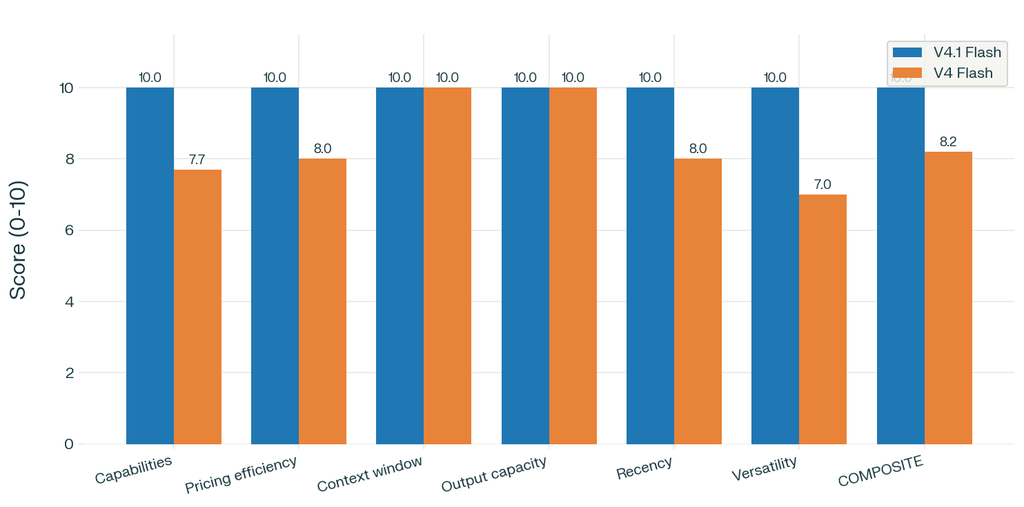
Source: Regolo analysis. Capabilities normalized over seven shared benchmarks; pricing from DeepSeek’s September 2026 API rates; specs from official model documentation.
| Dimension | V4.1 Flash | V4 Flash | What drives the score |
|---|---|---|---|
| Capabilities (benchmark aggregate) | 10.0 | 7.7 | Normalized mean of TB 2.1, DeepSWE, TB 4.0, AutomationBench, GPQA, Codeforces, CyberGym |
| Pricing efficiency (quality-adjusted cost) | 10.0 | 8.0 | Blended cost $0.26/M vs $0.33/M at a 3:1 in/out ratio — and V4.1 delivers higher quality at that price |
| Context window | 10.0 | 10.0 | Both document 1M tokens |
| Output capacity | 10.0 | 10.0 | Both document a 384K max output ceiling on their primary hosted deployments |
| Recency | 10.0 | 8.0 | Released September 10 vs July 31, 2026 |
| Versatility (modalities, license, tool use) | 10.0 | 7.0 | V4.1: native vision + text, MIT. V4: text-only, MIT |
| Composite score | 10.0 | 8.2 | Weighted as above |
Figure 2 — The six benchmarks shared by both models:
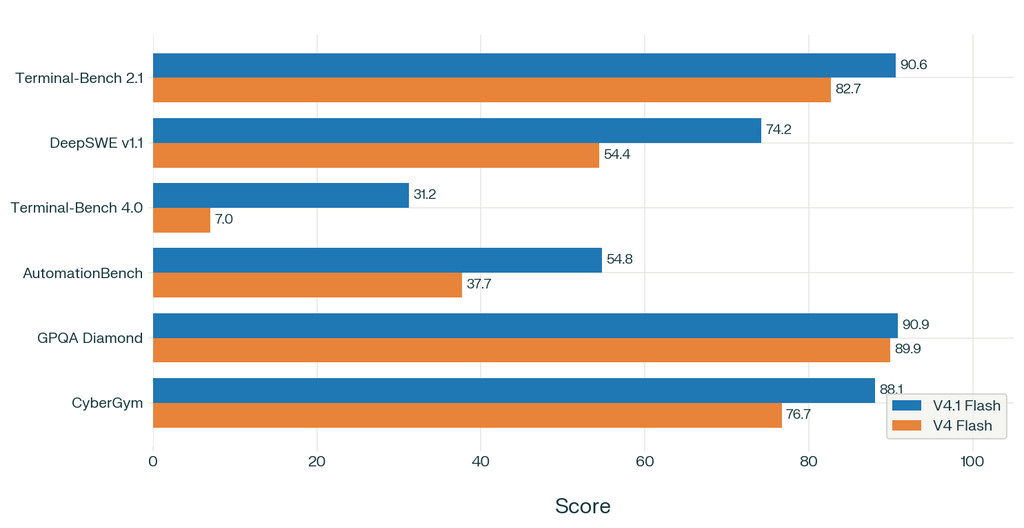
Source: DeepSeek published tables, September 2026. All V4.1 figures at maximum reasoning effort.
Behind the capabilities row: Terminal-Bench 2.1 moved from 82.7 to 90.6, DeepSWE v1.1 from 54.4 to 74.2, Terminal-Bench 4.0 from 7.0 to 31.2, AutomationBench from 37.7 to 54.8, CyberGym from 76.7 to 88.1, and the Codeforces rating from 3,289 to 3,471. GPQA Diamond barely moved (89.9 to 90.9), and on Humanity’s Last Exam, text-only, V4 Flash actually edges V4.1, 37.8 to 36.8. This is an agentic upgrade, not a general-knowledge one.
Figure 3 — Where the gap is large, and where the older model still leads:
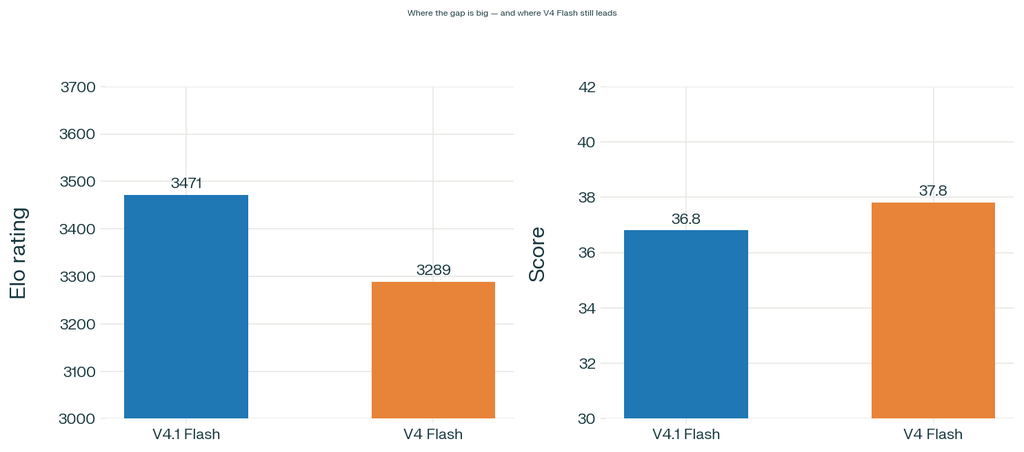
Source: DeepSeek published tables. Note the reversed result on HLE text-only: 37.8 for V4 Flash vs 36.8 for V4.1.
One honest caveat before the next section: all these figures come from DeepSeek’s own harness at maximum reasoning effort. The same DeepSWE evaluation swings from 65.5 to 74.2 depending on the scaffold, which tells you the harness moves results as much as the model. Treat every vendor table as a hypothesis to re-test on your own stack.
Use-case benchmarks, workload by workload
Figure 4 — API pricing per million tokens:
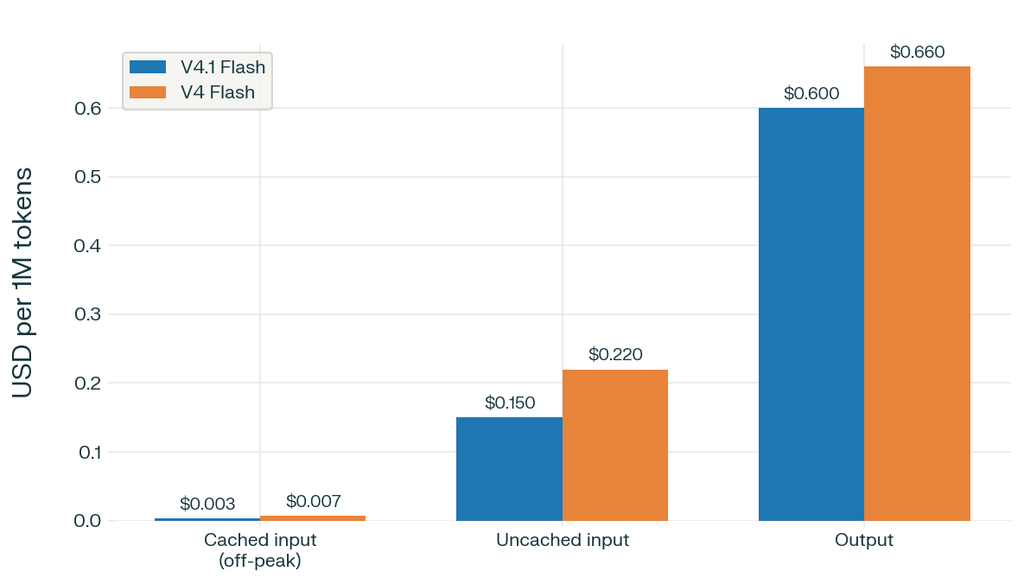
Source: DeepSeek API pricing, September 2026. Off-peak rates shown where applicable.
| Workload | V4.1 Flash | V4 Flash | Winner | Why |
|---|---|---|---|---|
| Coding & code review | DeepSWE 74.2, TB 2.1 90.6, Codeforces 3,471 | DeepSWE 54.4, TB 2.1 82.7, Codeforces 3,289 | V4.1, decisively | +19.8 on real software engineering tasks |
| Long document analysis | 1M context at 890 bytes/token memory, 72h retention | 1M context at 3,514 bytes/token memory | V4.1 | ~4x less memory; cache-hit input at $0.003/M |
| Batch extraction | $0.15/M uncached input | $0.22/M uncached input | V4.1 | 32% cheaper input; gap widens with cache hits |
| Creative writing | MultiLoKo 45.5 (base); HLE text 36.8 | MultiLoKo 42.6; HLE text 37.8 | Tie | No public creative-writing benchmark covers either checkpoint (verified September 14, 2026, across BenchLM, aiwiki, opencode.ai); scores sit within noise |
| Image understanding / OCR | Native vision, images up to 1,024 tokens each | Text-only (vision was a separate experimental model) | V4.1, by default | V4 Flash cannot see |
| Latency & speed | 190.1 output tok/s (Artificial Analysis); median 199 tok/s on first-party API, 1.13 s to first chunk | 188.1 output tok/s (Artificial Analysis) | Tie | The new model is not measurably faster at writing; its savings live on the reading side |
Coding and code review
The +19.8-point DeepSWE jump is the largest single-generation gain we have tracked this year in an open-weight model. For a team running an agentic reviewer over a monorepo, that delta translates directly into fewer abandoned tool-call loops — the failure mode that wastes both tokens and developer patience. Our position: if your workload is coding agents, this comparison ends here. Ship V4.1.
Long document analysis and batch extraction
Both models read a million tokens; they differ in what it costs to keep reading them. V4.1’s compressed working notes use about a quarter of V4 Flash’s per-token memory (890 vs 3,514 bytes per token), and long-term storage of those notes drops to roughly an eighth, because detailed notes are discarded and quickly rewritten from the most recent stretch of text — a 128-token replay window — when needed again. For extraction pipelines that re-process the same document corpus with different prompts, V4.1’s cached-input price of $0.003 per million off-peak changes the unit economics by an order of magnitude versus naïve re-sending.
Figure 5 — The real trade-off of this generation: a quarter of the memory, the same generation speed:
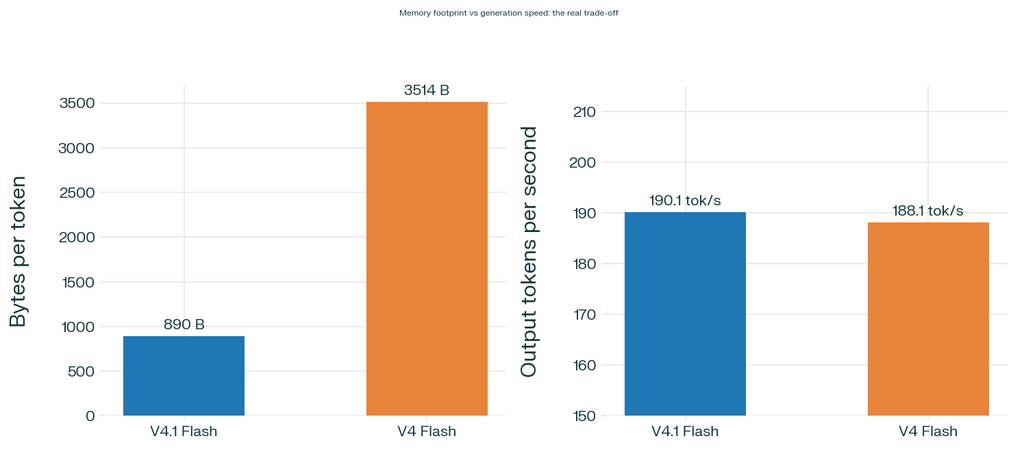
Source: DeepSeek KV cache figures via zyvop analysis; speed from Artificial Analysis measurements, September 2026.
Creative writing
Here is our counterintuitive position: for prose generation, the extra money buys you nothing we can measure. Base-model MMLU-Pro favors V4.1 (74.1 vs 68.3), but AGIEval actually tilts toward the old Flash (83.9 vs 83.4), and the text-only HLE gap is one point. No public creative-writing benchmark covers either checkpoint as of today. If your brand voice depends on it, run your own blind A/B before migrating the pipeline.
Image understanding and OCR
V4.1 Flash ships with native visual understanding, with image input documented at up to 1,024 tokens per image. V4 Flash never had it in the mainline checkpoint. Invoice parsing, scan extraction, and screenshot-to-code workflows have exactly one option in this pairing — and it is not the older model.
Latency and speed
Do not assume the newer model writes faster — independent measurement says it does not. Artificial Analysis puts V4.1 Flash at 190.1 output tokens per second against 188.1 for V4 Flash 0731, a statistical tie, while the first-party API median sits at 199 tok/s with 1.13 seconds to the first chunk.
What changed is where the work happens: V4.1 spends far less effort reading incoming text and managing its memory, so end-to-end job time improves on long-context tasks while pure generation speed stays flat. If your product is a real-time chat with short prompts, speed is not a reason to migrate. If your agents re-read a codebase every three minutes, it is.
When to pick V4 Flash anyway
Persistence beats novelty more often than engineers admit, stay on V4 Flash for now if:
- Your production pipeline is tuned on the 0731 checkpoint and your regression suites cost real money to re-run — freeze it, schedule the migration, do not improvise it.
- Your workload is text-only batch extraction with short outputs, where the pricing gap (~32% on input) is smaller than your re-validation cost.
- You are contractually pinned to a provider that has not deployed the new weights yet.
Everything else — agents, long context, images, new builds — goes to V4.1 Flash.
How to run this open-source technology in your company
Both checkpoints ship under MIT: the weights are a public asset, and no single vendor’s endpoint, pricing change, or region policy can take them away from you. DeepSeek demonstrated the flip side the same week — starting September 14, V4 Pro API requests get rerouted to V4.1 Flash automatically. Elegant for DeepSeek. Less elegant if your evals were calibrated on Pro.
There are three practical routes to put these weights into production:
- DeepSeek’s API: fastest to try, data leaves your perimeter and, for most European companies, that ends the compliance conversation before it starts.
- An EU-sovereign inference provider: this is where we sit. Regolo serves open-weight models from European infrastructure with zero data retention — prompts and completions are never stored — through an OpenAI-compatible API, aligned with GDPR and the AI Act. Migration is a base-URL change, not a rewrite. Start signing up and get 30 days free on all our API models.
For companies whose “model” is actually several models, our Brick semantic router sends each request to the cheapest model that can handle it, cutting inference spend by up to 80% — V4.1 Flash for agentic and long-context calls, smaller checkpoints for classification and extraction.
Frontier models like GLM 5.2 and Qwen 3.8 27B run on the same endpoint, so a routing strategy never locks you into one lab’s release cycle, and because agent benchmarks swing 9+ points with the scaffold alone, we advise every customer to re-run evaluations inside their own harness before committing. We provide the sandbox; you keep the verdict.
FAQ
Is DeepSeek V4.1 Flash better than V4 Flash for coding agents?
Yes, by a wide margin. V4.1 scores 74.2 on DeepSWE v1.1 versus 54.4, and 31.2 versus 7.0 on Terminal-Bench 4.0, on DeepSeek’s published table. Re-test inside your own scaffold — harness choice alone swings DeepSWE by several points.
How much cheaper is DeepSeek V4.1 Flash than V4 Flash?
On DeepSeek’s API, uncached input moved from $0.22 to $0.15 per million tokens and output from $0.66 to $0.60. Cached off-peak input fell from about $0.007 to $0.003 per million, which compounds fast in agent loops that re-read long contexts.
Is DeepSeek V4.1 Flash actually faster than V4 Flash?
Not in pure generation: independent measurement shows 190.1 versus 188.1 output tokens per second — a tie. The speed advantage appears on long-context, read-heavy agent jobs thanks to cheaper input processing and a four-times-smaller memory footprint.
Can European companies run DeepSeek V4.1 Flash under GDPR?
Yes. The weights are MIT-licensed, so an EU provider can serve them with zero data retention. Regolo.ai hosts open-weight models on European infrastructure through an OpenAI-compatible API, keeping prompts inside your compliance perimeter.
Does DeepSeek V4.1 Flash support image understanding and OCR?
Yes. V4.1 has native multimodal input, with images documented at up to 1,024 tokens each. V4 Flash is text-only — the previous generation’s vision capability lived in a separate experimental checkpoint.
Should I migrate existing V4 Flash pipelines immediately?
Not blindly. If your regression suites and pricing are calibrated on the 0731 checkpoint, freeze it, run your own harness comparison, and migrate bucket by bucket. New builds should start on V4.1 Flash.
Ship Private AI. Not Infrastructure.
You have the private AI App architecture, bow give it an inference layer built for production.
Regolo gives European teams fast, OpenAI-compatible access to Mistral, Llama, Qwen, DeepSeek, GLM, and more — with zero data retention, EU data residency, and no new SDK to learn.
Change your base_url. Keep your LangChain code. Start shipping.
🚀 Start your 30-day free trial →
Build, test, and deploy with no infrastructure to maintain.
No credit card. No migration project. No compromise on data control.
💬 Join the Regolo Discord →
Meet builders working on private RAG, local LLMs, LangChain, Ollama, and production AI systems. Share your setup, get feedback from the community, and speak directly with the Regolo team.
🤝 Talk to an AI Infrastructure Engineer →
Running a sensitive workload, scaling beyond a proof of concept, or assessing a managed EU inference provider? Get a tailored architecture and commercial proposal for your team.
📂 Clone the GitHub repository →
Get the full implementation from this guide: ingestion scripts, ChromaDB setup, hybrid retrieval, the 30-Question RAG Floor, evaluation examples, and deployment configuration.
Private AI should not require a private data center.
Regolo gives your team an EU-native path from local experimentation to production-grade inference.
Build with Regolo
- Discord: Join the community →
- GitHub: Explore open-source workflows →
- X / Twitter: Follow @regolo_ai →
- Reddit: Join the community →
- Documentation: Read the API docs →
- Contact: Talk to the team →
Built with ❤️ by the Regolo team. Questions? regolo.ai/contact or chat with us on Discord