

Plus Hosting Grupa, faced recurring problems typical of digital enterprises with growing support volumes: ensuring consistent quality across hundreds of customer interactions, providing clear reporting for management and HR, and maintaining strict GDPR compliance while using AI.
Their solution was a modular, open‑source AI pipeline built around EU infrastructure and GDPR principles that automatically transcribes, evaluates, and reports on all daily calls.
The result: roughly 15 hours of manual review time eliminated per month. Every single call is evaluated, not just a sample. Coaching now focuses exclusively on high-impact interactions rather than supervisors spending hours digging through audio.
Business Context and Challenge
Digital enterprises and infrastructure providers with growing support volumes face three recurring challenges:
1. Ensuring consistent quality across hundreds or thousands of customer interactions.
2. Providing clear, actionable reporting for management, HR, and training teams.
3. Maintaining strict compliance with GDPR and data-privacy requirements while using AI.
Plus Hosting Grupa initially relied on manual call reviews — team leads listened to recordings and completed evaluation templates, spending around 15 hours per month on this activity alone.
As call volumes increased, the process became unsustainable. Most conversations are routine; supervisors had to dig through hours of audio to find a handful of interactions that truly needed coaching attention.
The sustainability problem
| Metric | Before | After |
|---|---|---|
| Manual review time | ~15 hours/month | ~0 hours |
| Calls evaluated per day | ~10-20 (sample) | ~70 (100% coverage) |
| Coaching focus | Hunting for “needles” in haystack | Targeted, high-impact only |
| Evaluation per agent | Hours of listening | ~30 minutes |
Solution Architecture: Modular Open‑Source AI Pipeline
Regolo designed a four‑stage pipeline optimized for native language (Croatian), regional accents, telephone audio, and enterprise-grade performance. Our approach deliberately avoided building a proprietary “black box.” Everything runs on open-source models, auditable code, and EU data residency.
Audio Transcription
- Model:
faster-whisper-large-v3 - Role: Converts raw call audio into text, handling conversational Croatian, regional accents, fast speech, and imperfect telephony audio with low latency.
The key here is not just transcription accuracy — it’s robustness. Telephony audio is notoriously difficult: compression artifacts, background noise, low sampling rates. faster-whisper-large-v3 handles these conditions reliably.
2. Script Sanitization and Normalization
- Model:
gemma4-31b - Role: Detects acoustic artifacts (e.g., Cyrillic characters, language inconsistencies) and normalizes them into standard Latin script, producing clean, analyzable transcripts.
Croatian typing conventions vary across regions and generations, this stage ensures downstream analytics work with trustworthy, normalized text — not noisy, inconsistent data.
3. Sentiment and Soft‑Skills Analysis
- Model:
gemma4-31b - Role: Performs contextual analysis directly in Croatian, tracking:
- Politeness and tone of voice
- Professionalism and clarity
- Evolution of customer sentiment from opening to closing
By working in the native language, the system preserves nuance and context that translation layers often lose. This gives HR and L&D a rich, language-aware view of customer experience and agent soft skills.
4. Automated Coaching and Performance Reports
- Model:
gemma4-31b - Role: Aggregates data at agent and team level, generating structured monthly performance reviews that supervisors can use immediately in coaching and appraisal processes.
Design Choice: Soft Skills, Not Technical Accuracy
A deliberate design decision was not to train the system to audit technical accuracy of troubleshooting steps. Instead, the pipeline focuses exclusively on soft skills and sentiment.
The listening room dashboard (see below) shows the clear, consistent evaluation framework that avoids ambiguous “right/wrong” judgments on complex technical solutions — something supervisors are better positioned to assess directly.
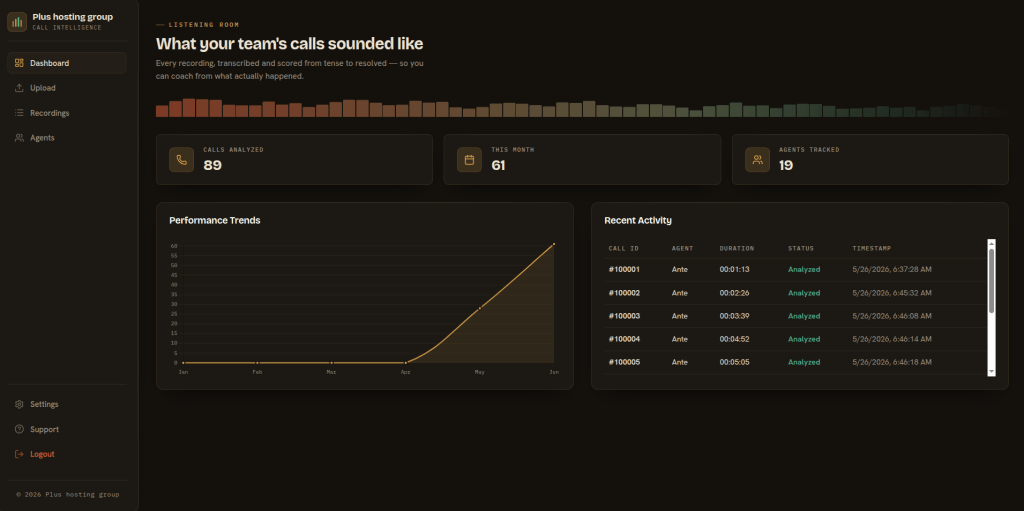
The listening room dashboard
Why this matters: The customer’s perceived experience matters more than what technical step was taken. This approach drives improvements where they impact CSAT and retention most, and supports targeted soft-skills training at scale.
Loop Engineering in the QA Workflow
The Plus Hosting pipeline demonstrates Loop Engineering principles in action — a pattern we’re seeing increasingly in production systems that need to run autonomously without constant human supervision.
The key architectural insight: You’re not building a system that “evaluates calls.” You’re building a loop that starts with an ingestion trigger, discovers what calls need evaluation, plans the analysis steps, executes the pipeline, verifies the output quality, and iterates if necessary.
The automation fires — perhaps scheduled via cron or webhook integration — the agents read from a shared STATE.md that lasts between runs, the verifier agent (independent from the analyzer) grades whether transcripts meet quality thresholds, and the system only moves forward when the stop condition is proven by an objective check (e.g., “transcript length > 1000 chars, sentiment score calculated, quality score assigned”).
This is the shift from “prompting for outputs” to “engineering systems that produce verified outcomes.”
The only manual touchpoint remaining is feeding data into the system. Work is already underway to integrate directly with Plus Hosting Grupa’s 3CX phone system, aiming for a fully hands-free pipeline that fits seamlessly into enterprise communications infrastructure.
If you’re wondering how this relates to other use cases: we’ve built similar loops for automated code review, research synthesis (Discover → Plan → Execute → Verify → Iterate), and content generation.
Outcomes Before vs After Regolo
| Metric | Before | After |
|---|---|---|
| Monthly review time | ~15 hours of manual listening | 0 hours of listening |
| Per-agent evaluation | Hours of audio playback | ~30 minutes per agent |
| Calls processed per day | ~70 (partial sampling) | ~70 (100% coverage) |
| Coaching focus | Searching for “needles” in logs | High-impact interactions only |
Client Perspective
With Regolo, our only real manual task is feeding the data into the system. We are already working on new integrations to make the entire pipeline completely hands-free.

Plus Hosting Grupa views the collaboration with Regolo as a strategic enabler: the system reliably transcribes, evaluates, and ranks customer support calls, continuously tracking politeness, professionalism, and sentiment change across roughly 70 daily interactions.
Why GDPR and EU Infrastructure Matter
Because Regolo operates as an EU-based service built on open-source models, Plus Hosting Grupa can run this intensive data analysis with full confidence in GDPR compliance and long-term data governance.
The constraint that forced a better architecture: Regulatory requirements weren’t a limitation here — they were the design driver. Processing audio calls in the EU means data residency requirements, encryption standards, and audit trails. Building on open-source models allowed full control over data flow, model inputs, and outputs — no black box, no vendor lock-in, no cross-border data transfer without clear contractual safeguards.
This is the kind of architecture we see in production for enterprises that need more than “it works for a test campaign.”
Technical Considerations: European Infrastructure and Open Source
When designing for EU enterprises, we deliberately chose models and infrastructure that match regulatory and compliance requirements:
- Language-native models: Croatian nuances are preserved when analyzing directly in Croatian, not translating to English first.
- Open-source masking: Organizations can deploy on-premise or in closed cloud environments.
- Audit trails: Open-source pipelines let HR teams inspect the entire reasoning process, not just a final score.
- GDPR-aligned: Data never leaves EU infrastructure without explicit consent.
We’ve deployed similar architectures for other European enterprises needing to process sensitive data — the pattern is the same: your compliance constraints often force better system design anyway.
Client Perspective
With Regolo, our only real manual task is feeding the data into the system. We are already working on new integrations to make the entire pipeline completely hands-free
Plus Hosting Grupa views the collaboration with Regolo as a strategic enabler: the system reliably transcribes, evaluates, and ranks customer support calls, continuously tracking politeness, professionalism, and sentiment change across roughly 70 daily interactions.
Because Regolooperates as an EU‑based service built on open‑source models, Plus Hosting Grupa can run this intensive data analysis with full confidence in GDPR compliance and long‑term data governance.