


EngiMedia used Regolo’s managed AI inference to build Reportem, an AI-powered technical SEO reporting tool that agencies can resell without managing models, GPUs, or complex pipelines. The product ingests performance data (e.g. PageSpeed), uses LLMs to detect technical SEO issues, and generates ready-to-use remediation plans plus a chatbot interface, all under a zero data retention, GDPR-compliant setup.
What is Reportem and who is it for?
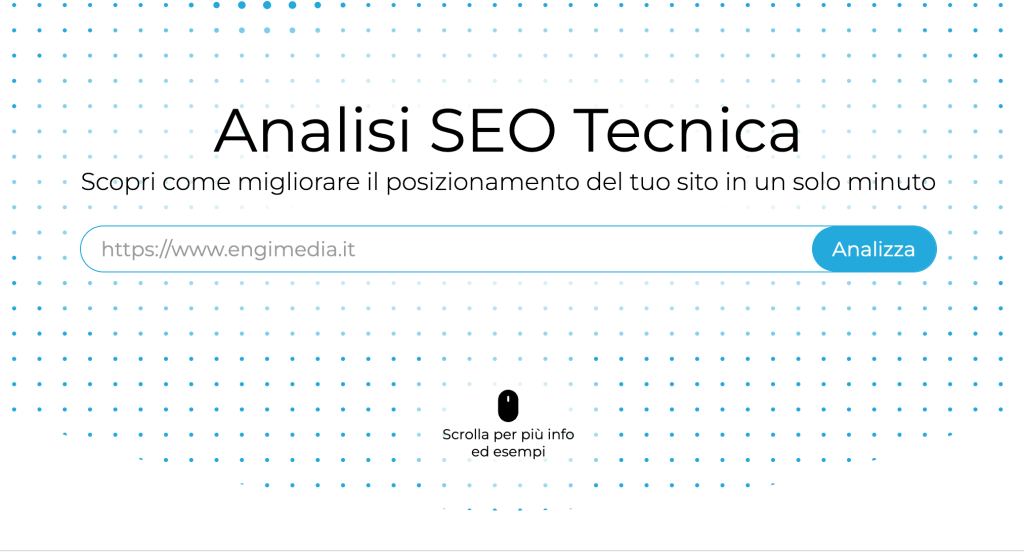
Reportem is an AI-powered technical SEO analysis service built by EngiMedia for digital and web agencies that excel at content, branding, and link building but lack deep technical SEO skills. It plugs into existing agency workflows as an add-on service: the agency keeps the client relationship, while Reportem provides the technical diagnosis and step-by-step fixes under the agency’s brand via white-label reports.
The system focuses on the “invisible layer” of SEO: crawlability, indexability, site speed, Core Web Vitals, and architecture issues that can silently block rankings even when content and backlinks are strong. Instead of asking agencies to interpret raw metrics and logs, Reportem transforms those signals into structured tasks that a non-technical team can act on.
How the AI-powered technical SEO workflow works
EngiMedia’s AI pipeline starts by collecting raw site performance data from web service APIs like Google PageSpeed Insights and other crawling tools, which expose metrics on speed, Core Web Vitals, and technical defects. This data is normalized and enriched with context (page type, importance, affected templates) so that the AI models can understand what each issue means for SEO and UX.
The formatted dataset is then sent to Regolo, which provides a unified inference layer to multiple open models through a single API. EngiMedia’s team used this to test and compare engines such as Gemma, adjust prompts, and converge on outputs that identify concrete SEO problems and suggest prioritized fixes in clear language for agencies.
From manual audits to automated, explainable reports
Traditionally, a full technical SEO audit could take hours or days of specialist work: crawling the site, checking robots rules, mapping redirects, reviewing Core Web Vitals, and interpreting Google Search Console signals. For many agencies, that meant either outsourcing the work, doing partial checks, or skipping technical SEO altogether.
Reportem automates this process by generating structured reports that explain, for each page or cluster of pages, what is wrong, why it matters for rankings, and how to fix it in practical terms. The output is not just a pass/fail score: it provides remediation plans with concrete examples and recommended implementation steps, which account managers can translate directly into tickets for developers or site maintainers.
Integrated chatbot: “chat with your SEO report”
On top of static documents, EngiMedia added an integrated chatbot experience so that agencies and end clients can ask natural language questions about the findings. The chatbot is restricted to the content of the generated reports and related documentation, which keeps answers focused on the site’s actual data and avoids hallucinated advice.
This interaction model turns dense technical information into an on-demand assistant: users can ask things like “Which pages hurt Core Web Vitals the most?” or “What should I fix first on mobile?” and receive targeted explanations grounded in the report’s metrics. For client-facing teams, this makes it much easier to turn technical SEO conversations into clear, outcome-oriented discussions.
Why EngiMedia moved away from local AI and generic chatbots
In 2025, EngiMedia experimented with running AI models locally on their own GPU hardware to power bespoke chatbots for clients. The cost of servers, setup, and ongoing maintenance quickly eroded the business case, especially for projects where margins depended on small retainers or one-off builds.
At the same time, generic retrieval-augmented chatbots that simply “attach documentation” proved hard to position and sell to digital agencies. Clients struggled to see clear ROI from open-ended chat interfaces, while support and maintenance were high because every project was a custom build with different data sources and expectations.
The business challenge: from experiments to a repeatable product
Before Reportem, EngiMedia faced four main constraints:
- High hardware costs for local AI: GPU servers and on-premise inference environments created a high upfront cost, which was difficult to justify for early-stage or experimental AI projects.
- Weak product-market fit for generic RAG chatbots: agencies saw limited value in broad conversational interfaces that did not map directly to a recurring business problem or revenue stream.
- Market gap in technical SEO services: many agencies could write content and manage campaigns but lacked the engineering depth to resolve complex technical SEO penalties and performance issues.
- Strict privacy and data sovereignty needs: technical SEO often surfaces sensitive details such as internal site structures, proprietary templates, and security misconfigurations, so any AI solution needed strong guarantees on data handling and GDPR compliance.
These drivers pushed EngiMedia to search for a narrower, higher-value use case that would justify sustained investment and allow packaging AI as a product, not just as a custom feature.
The pivot: from custom RAG projects to a productized SEO engine
The key insight was to stop selling generic AI chat and instead solve one painful, repeatable problem for a clear buyer: technical SEO for agencies that manage multiple client sites. Instead of building a new chatbot for every customer, EngiMedia created a single-purpose pipeline that turns raw site metrics into technical SEO remediation plans.
This move shifted the business from low-margin, bespoke RAG development to a repeatable vertical service with clear pricing and value: one pipeline, many agency customers, each with their own websites. The AI layer became an internal engine powering a product, not a standalone feature looking for a use case.
Why Regolo’s inference layer was a fit
To support this pivot, EngiMedia chose Regolo as its inference backend. Regolo exposes a uniform interface to multiple large language models and runs on European infrastructure with strict privacy guarantees and zero data retention. This allowed EngiMedia to:
- Compare and calibrate different models (including open-source like Gemma) without reworking their application code.
- Avoid the capital expense of GPU hardware and operations, paying only for consumed inference.
- Meet demanding client requirements on GDPR, data sovereignty, and non-retention of sensitive crawl and performance data.
Internally, the team estimated that a local deployment with GPU servers, installation, and production configuration would have cost around €7,000 up front, while Regolo’s managed inference enabled them to run the same logic for roughly a few tens of euros per month in usage, making the MVP viable even at small scale.
We estimated that deploying a local AI model with GPU servers, setup, installation, and production configuration would have cost us around €7,000. With Regolo, we’re currently spending only about €20 per month — the difference is simply incomparable
Fabio Vigo
AEO and technical SEO: how Reportem supports modern search
In 2026, answer engine optimization (AEO) rewards content and sites that are fast, technically clean, and easy for AI systems to interpret. Technical SEO issues like crawl barriers, poor Core Web Vitals, and messy site structures can prevent both search engines and AI answer systems from trusting or citing a site.
By diagnosing problems like slow Largest Contentful Paint (LCP), layout shifts, blocked resources, and weak internal linking, Reportem helps agencies deliver sites that are not only better for classic rankings but also more “answer-ready” for AI systems. Clear technical baselines make it easier for content and schema improvements to be recognized and reused by search engines and answer engines.
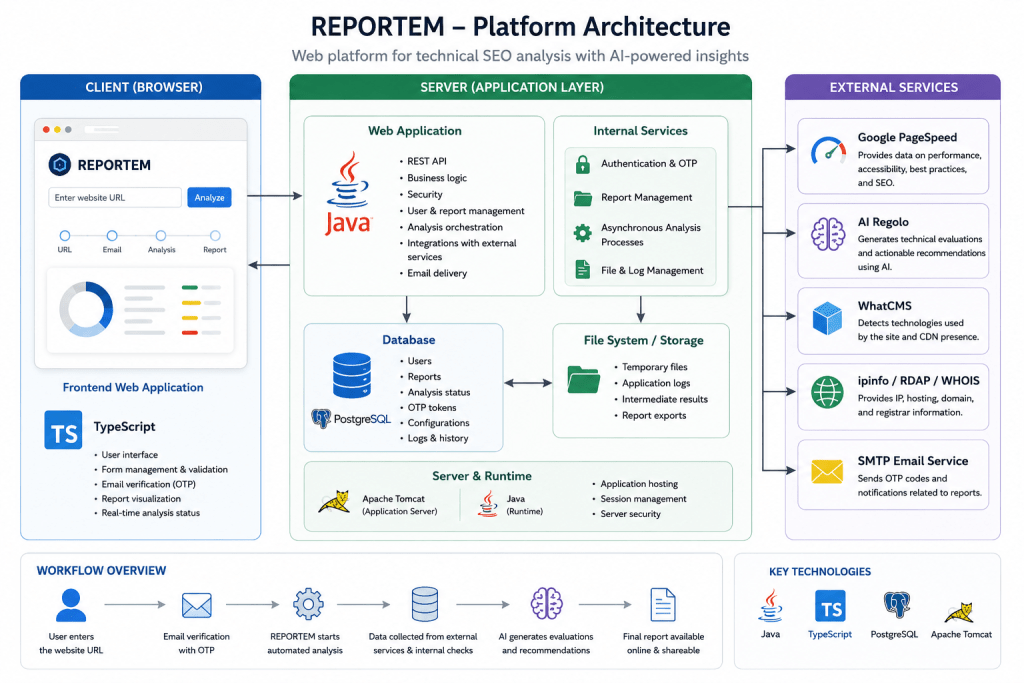
Architecture: from data ingestion to AI-generated remediation
The automated reporting architecture has three main phases:
- Data ingestion and crawling
The pipeline pulls metrics from tools such as Google PageSpeed Insights, crawlers, and internal logs, capturing performance scores, Core Web Vitals, and structural data about pages and templates. All this information is normalized into a common schema. - AI analysis via Regolo
The enriched dataset is sent to Regolo’s inference API, which orchestrates calls to selected LLMs and applies prompts tuned for technical SEO diagnosis. The models classify defects (e.g. slow LCP, render-blocking resources, non-mobile-friendly layouts) and relate them to business impact and practical remediation steps. - Report generation and chatbot layer
The AI outputs are assembled into human-readable reports with sections, prioritization, and recommended actions. The same corpus feeds the integrated chatbot, which allows agency staff or clients to query the findings using natural language, staying safely constrained to the audited site’s data.
This architecture keeps the application logic simple while allowing EngiMedia to switch or upgrade underlying models without changing how agencies use the product.
Data sovereignty, GDPR, and zero retention by design
A core requirement for EngiMedia’s agency customers is that technical SEO analysis does not create new compliance risks. Site crawls and performance logs can expose internal URLs, admin paths, and details about infrastructure that should not persist in third-party systems. To address this, Reportem relies on Regolo’s zero data retention inference model.
In practice, this means that prompts and outputs are processed in memory while the API call is active and not written to disk, logs, or training buffers on the provider side. Once the response is delivered, the data is discarded, aligning with GDPR principles of data minimization and purpose limitation, and giving agencies a clear story to tell clients about where their crawl data goes.
Business outcomes for EngiMedia and agencies
The shift to Reportem created a product with predictable costs and recurring revenue potential instead of one-off chatbot projects. Using managed inference let the team focus on domain logic, UX, and agency onboarding instead of DevOps and GPU capacity planning.
For digital agencies, Reportem offers:
- A ready-made technical SEO “expert” that fits into existing proposals and retainers.
- Faster audits and clearer reports they can explain to clients without deep engineering knowledge.
- A GDPR-conscious, EU-hosted AI backend that matches their clients’ privacy expectations.
The result is a scalable, sustainable, and compliant way to add high-value technical SEO services without building in-house data science or infrastructure teams.