


Redix is a software company founded in 1990, made up of a team of around 30 professionals with extensive experience in developing customized solutions to support companies in their digital transformation journey.
In recent years, Redix has invested in the field of Artificial Intelligence and Large Language Models to build platforms capable of managing and enhancing large volumes of unstructured data, with a strong focus on security, privacy, and regulatory compliance.
Initial Pain Points
The goal was to create an environment where corporate documents were not only stored, but truly usable. Redix wanted to enable users to upload heterogeneous files – from PDFs and Word documents to structured datasets – and query them using natural language, obtaining answers, summaries, and new insights.
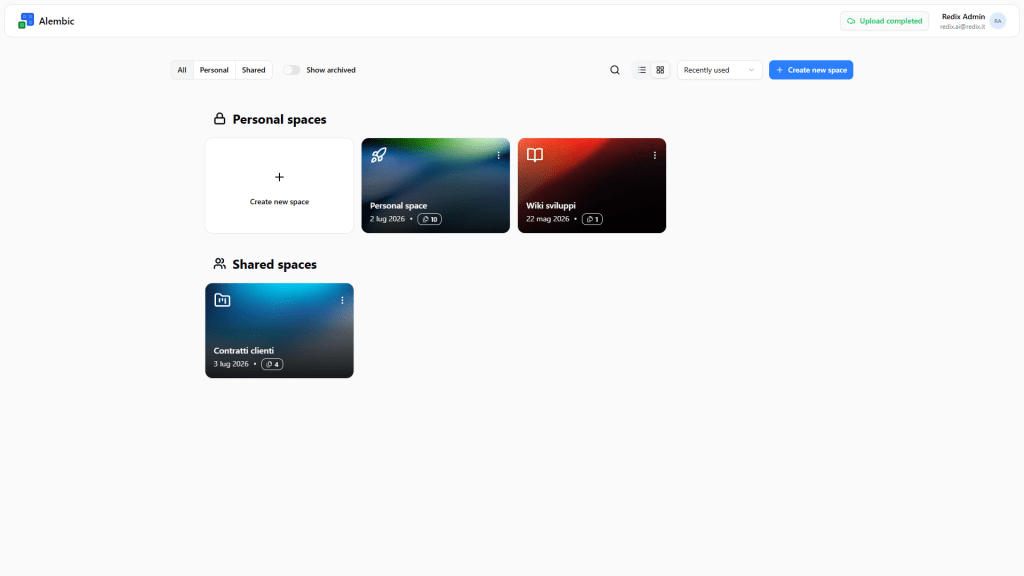
An additional key requirement was to maintain a controlled environment, avoiding the limitations of public AI platforms in terms of privacy, governance, and regulatory compliance.
Solution Implementation
To bring this vision to life, Redix created Alembic, which integrates Regolo into its platform, developed in collaboration with Seeweb.
The system enables the creation of private or shared workspaces where documents can be uploaded and queried. The user experience is simple and conversational: a chat interface through which users can explore content, summarize it, or generate new outputs.
Behind this simplicity, however, lies a complex architecture.
The platform developed by Redix is based on a Retrieval-Augmented Generation (RAG) architecture, in which Regolo manages several critical stages of the process.
During the data ingestion phase, documents are split into smaller units (chunking) and transformed into vector representations using embedding models. These vectors are then stored in a dedicated database, enabling efficient semantic search even across large volumes of data.
When a user starts an interaction, the system activates a pipeline that is not immediately visible: the query is analyzed, the most relevant content is retrieved, and this content is further refined through reranking models. Only then is the information passed to the inference model.
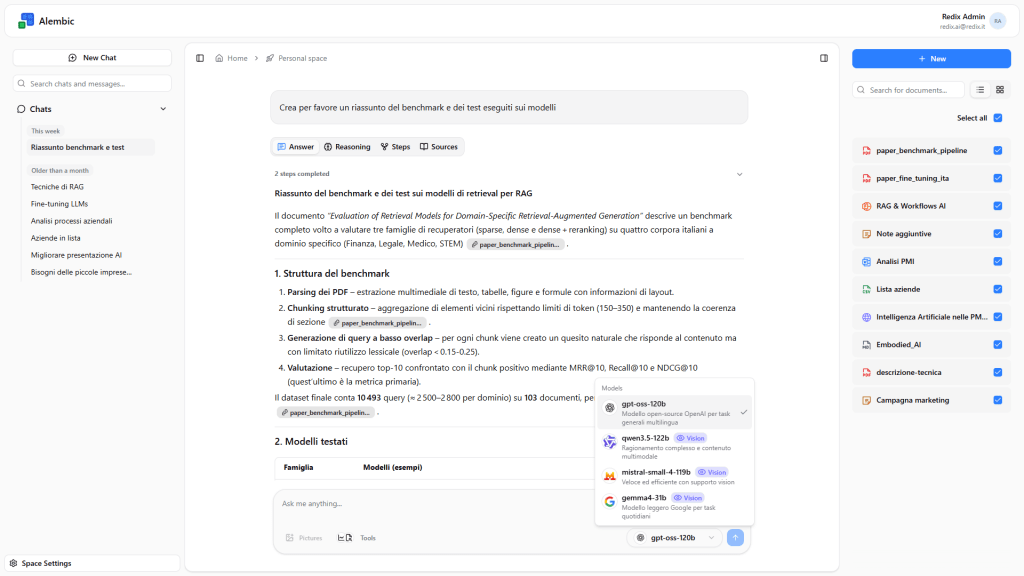
A key distinguishing factor is the separation between models used in different stages. Redix uses extremely lightweight and specialized models for embedding and reranking – such as Qwen3-Embedding-8B – optimized for speed and efficiency. The generation phase, on the other hand, is handled by much larger models, such as GPT OSS 120b, which produce the final response.
This architecture makes it possible to balance quality and cost by leveraging different models depending on their specific role within the pipeline.
Another important aspect is that the choice of the inference model is left to the end user, while the retrieval components remain orchestrated at the system level. This ensures flexibility without compromising performance.
Results
The result is a platform that makes corporate documents queryable in a natural and immediate way. Search activities become faster, information emerges with greater accuracy, and many manual processes are automated.
At the same time, Redix has been able to build a solution that meets the requirements of private AI, maintaining full control over data and ensuring compliance with regulations such as GDPR.
Evolution
Building on this foundation, Redix is working on a progressive verticalization of the platform, with a particular focus on the legal sector. In these contexts, the ability to analyze highly sensitive documents in controlled environments represents a significant competitive advantage.
In parallel, the team is exploring fine-tuning and model specialization activities, with the aim of further improving the quality of analysis in specific domains.