

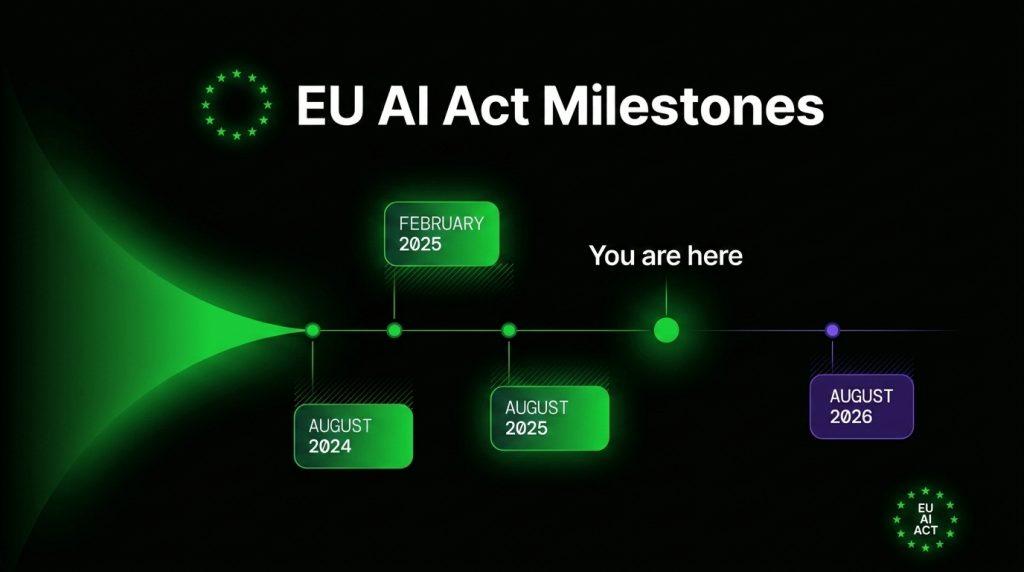
On that date, the AI Act’s general application phase starts: most obligations for high‑risk AI systems and transparency duties kick in for companies operating in the EU. This includes strict requirements on risk management, data governance, technical documentation, logging, human oversight and incident reporting for any system that falls under the “high‑risk” categories.
It also activates the full sanction regime, with fines up to a significant percentage of global annual turnover for serious infringements. If you are a CTO or owner running AI in hiring, credit, health, critical infrastructure or similar domains, your governance and engineering stack must already be able to prove how the system behaves, not just that it works.
Why 2 August 2026 matters
From 2 August 2026, the AI Act becomes generally applicable across the EU for most regulated uses of AI, after a two‑year transition that started in 2024. This is the moment when obligations stop being a roadmap and start being requirements that regulators, courts and auditors can enforce. Technically, this phase covers high‑risk systems listed in the regulation’s annexes — where malfunction or bias can seriously affect health, safety or fundamental rights.
One unpopular but important truth: for many businesses, the deadline is not about installing new tools, it is about being able to produce evidence on demand. Contracts, DPIAs, ethics committees and “AI policies” will not save you if you cannot produce logs and documentation showing what your system did, on which data, under which safeguards.
What enters into force for your AI stack
High‑risk AI systems
The core change on 2 August 2026 is the application of obligations to “high‑risk” AI systems defined by sector and use case (for example: credit scoring, recruitment and promotion, education, medical devices, critical infrastructure management, access to essential public services, law enforcement support, migration and border control, justice assistance). If your AI falls into these buckets, you are no longer in “nice to have” territory.
A high‑risk system must sit on top of a documented risk‑management framework, with clear identification of risks to safety and rights, mitigation measures and continuous monitoring. This is not just an ISO badge: it implies ongoing assessment, not a one‑off risk register that nobody updates after go‑live.
Transparency and interaction duties
The AI Act also introduces transparency duties for AI systems that interact with people, regardless of risk level. Users must know they are interacting with an AI, not a human, when that could reasonably be unclear. Deepfake‑like content must be labelled as artificially generated or manipulated. For customer‑facing chatbots, virtual assistants and generative interfaces, this means explicit disclosure in the UX and in contracts, not just internal awareness.
This transparency is not a cosmetic requirement. It connects directly to trust and liability: if users were misled into thinking they were dealing with a human professional, any mistake or harm can quickly escalate into regulatory and legal exposure.
Logging, monitoring and incident reporting
A central piece of the 2026 obligations is logging and monitoring. High‑risk systems must generate and retain logs sufficient to understand their operation, detect anomalies and reconstruct decisions or outputs in case of audits or incidents. Without logs, compliance is basically impossible: you cannot demonstrate how the system behaved, so you cannot prove you applied “appropriate diligence”.
The Act also expects structured incident reporting: serious malfunctions, security breaches or harms linked to AI must be escalated, internally and to authorities where thresholds are met. This forces CTOs to integrate AI systems into their incident‑management and cybersecurity processes, rather than treating them as separate, experimental tools.
Human oversight
High‑risk AI cannot run in fully autonomous mode without meaningful human oversight. The Act requires that humans with appropriate competence, training and authority supervise AI operations, can interpret outputs and have the ability to intervene, override or shut down the system where necessary.
The weak pattern many companies use today — a nominal “owner” with no time, no training and no tools — will not pass this bar. You need real people in the loop, with clear responsibilities mapped into job descriptions and workflows.
Who is directly exposed on 2 August 2026
Providers vs deployers
The AI Act splits obligations between “providers” (those who develop and place AI systems on the market) and “deployers” (those who use them in their operations). If you ship AI products or models, your compliance perimeter includes design, development, testing, documentation and post‑market monitoring. If you embed third‑party AI into your business processes, you inherit obligations on how you configure, supervise and log the system.
Buyers assuming “the vendor is compliant, so we are safe” – the Act explicitly assigns duties to deployers of high‑risk systems, including how they use the system, who they put in charge and how they monitor outcomes. Outsourcing development does not outsource responsibility.
Sectors that should already be nervous
By 2 August 2026, certain sectors are squarely in the spotlight:
- Banks and insurers using AI for creditworthiness, pricing, fraud detection or claims handling.
- Employers using AI in recruitment, internal mobility, performance assessment or workforce management.
- Healthcare organisations adopting AI in diagnostic support, triage, resource allocation or personalised treatment.
- Operators of critical infrastructure (energy, transport, communications) using AI in control systems.
- Public authorities using AI for access to benefits, risk scoring, policing support or migration decisions.
If you recognise your organisation in these examples and you do not have an AI inventory, risk classification and governance in place, you are late.
What “being compliant” actually means for a CTO
Compliance on 2 August 2026 does not mean having a glossy AI policy or a slide deck about ethics. It means being able to produce, quickly and consistently, a set of artefacts that show how each high‑risk system is governed.
At minimum, for every high‑risk system you should be able to hand over:
- A clear description of the system, its purpose, architecture and scope.
- The risk‑management file: identified risks, mitigations, residual risks, decisions.
- Data documentation: origin, quality checks, bias assessment, governance measures.
- Technical documentation: training, validation, test results, limitations.
- Operational procedures: human‑oversight flow, escalation paths, incident response.
- Logs and monitoring evidence: what the system did, when, under which conditions.
If this bundle does not exist, or lives only in scattered emails and tickets, you are not ready.
A practical framework: six moves to reach minimum compliance
1. Build a complete AI inventory
First step: list every AI system in use or under serious consideration in your organisation. Not only those with “AI” in the product name, but any system that performs automated decision‑making, profiling, prediction or content generation using machine‑learning or similar techniques.
Include shadow AI: scripts, models or services that teams have adopted without formal approval, often starting as “experiments” and quietly drifting into production. The inventory is the backbone of any risk classification; without it, everything else is guesswork.
2. Classify each system’s risk
Once you have the inventory, classify each system against the AI Act’s risk categories. Ask two questions: does the use case align with high‑risk areas listed in the regulation? If not, does it still significantly affect health, safety or fundamental rights?
Adopt a simple but strict internal classification scheme (for example: prohibited / high‑risk / medium / low). Pay special attention to borderline cases: HR tools that “just recommend candidates”, credit tools that “support decisions”, chatbots that “only give guidance”. If outputs influence real decisions in sensitive domains, treat them as high‑risk in practice.
3. Assign clear ownership and human oversight
For each high‑risk system, assign a named technical owner and a business owner. Define who has authority to approve changes, who supervises day‑to‑day operation and who can intervene or shut down the system if necessary.
Then integrate human oversight into actual workflows: dashboards that people really use, review queues, escalation procedures, training programmes. Oversight that exists only in documentation is a compliance theatre; regulators will look at how the system runs, not just at how you say it runs.
4. Implement robust logging and monitoring
Set up logging so that every meaningful interaction, decision or output from your high‑risk systems can be reconstructed. Logs should be tamper‑resistant, retained for an appropriate period and linked to monitoring pipelines that can flag anomalies, drifts or incidents.
Do not rely solely on vendor dashboards. If the system is core to your business and risk profile, you need your own logging and observability. When something goes wrong, you will be asked what the system did and why; answering “we don’t have those logs” is the fastest way to turn a technical issue into a regulatory problem.
5. Consolidate documentation into a single “AI file” per system
Instead of scattering information across Confluence pages, Git repos, tickets and PDFs, build a single AI file per high‑risk system. Think of it as a medical record for the AI: one place that contains the narrative of design choices, data sources, tests, limitations, controls and incidents.
This file should be maintained as the system evolves, not only at launch. In practice, it becomes the central artefact you can hand to auditors, regulators, courts or counterparties. If compiling it now feels painful, that pain is a leading indicator of how unstructured your AI governance currently is.
6. Train people and align incentives
No logging or documentation will save you if the people operating and using the systems do not understand their capabilities, limits and risks. System owners, operators, and frontline staff need training on the basics of AI risk, the specific behaviour of the systems they touch, and the organisation’s escalation rules.
At the same time, adjust incentives: if teams are rewarded only for speed and automation, they will bypass oversight and controls. Make it clear that responsible use of AI — including reporting issues and rejecting unsafe automation — is part of performance expectations, not an optional extra.
FAQ
What is considered a “high‑risk” AI system under the AI Act?
High‑risk systems are defined by sector and function, typically where AI influences decisions on health, safety, access to essential services, employment, credit, education, law enforcement or justice. They require strict controls because failure or bias can seriously harm people or society. If your AI changes who gets a job, a loan, a medical treatment or a benefit, assume you are in high‑risk territory until proven otherwise.
Do we need to stop using AI on 2 August 2026 if we’re not fully compliant?
No, the AI Act is not a ban on AI. But continuing to run high‑risk systems without basic governance, logging, documentation and oversight becomes a serious liability. The key is to be able to demonstrate you understand the risks, have controls in place and are actively improving. If you cannot credibly show that, you are effectively gambling with regulatory and legal exposure.
Is buying a “compliant” AI solution from a vendor enough?
Buying from a vendor that claims compliance is better than ignoring the Act, but it is not sufficient. As a deployer, you have independent obligations on how you configure, use and supervise the system. You must understand the model’s limits, adapt it responsibly to your context, and keep your own records and logs. Treat vendor compliance as a baseline, not a shield.
How much documentation is “enough” for an AI system?
Enough means you can reconstruct the system’s purpose, design, data, tests, decisions and incidents without hunting across ten tools. For high‑risk systems, you should have a single AI file containing risk analysis, data description, technical documentation, oversight procedures and logs. If an external expert can understand the system from that file alone, you are in a reasonable place.
What is the biggest mistake CTOs are making right now regarding the AI Act?
The biggest mistake is treating the AI Act as a purely legal issue and delegating it entirely to compliance or legal teams. In reality it is an engineering and operations problem: without changes to how you build, deploy, monitor and maintain AI systems, policies are just paper. CTOs who own the technical side of compliance now will have a far easier time when regulators and courts start asking detailed questions.
Start your free 30-day trial at regolo.ai and deploy LLMs with complete privacy by design.
👉 Talk with our Engineers or Start your 30 days free →
- Discord – Share your thoughts
- GitHub Repo – Code of blog articles ready to start
- Follow Us on X @regolo_ai
- Open discussion on our Subreddit Community
Built with ❤️ by the Regolo team. Questions? regolo.ai/contact or chat with us on Discord