

A comprehensive comparison of two frontier MoE models released within weeks of each other
Two of the largest open-weight models ever built shipped within eighteen days of each other in mid-2026: Kimi K3 (July 16) and Qwen3.8-Max (August 3). Both are trillion-parameter Mixture-of-Experts systems with million-token context windows and native multimodal capabilities. Yet they serve different priorities:
- Choose Kimi K3 if you prioritize raw coding performance, maximum output length, and immediate open-weight availability
- Choose Qwen3.8-Max if you need lower operational costs, faster response times, and superior multimodal/OCR capabilities
This article breaks down their differences across six critical dimensions and provides operational benchmarks for specific use cases.
Try Qwen3.8 27 for 30 days free
Sign up, grab your API key, and route between Qwen3.8 27 and other models with zero data retention and EU-hosted.
Capabilities Score
Aggregate model intelligence and performance across benchmarks
| Model | Intelligence Index | Key Strengths |
|---|---|---|
| Qwen3.8-Max | 58 | Multimodal reasoning, terminal execution, agentic workflows |
| Kimi K3 | 48-57 (varies by reasoning effort) | Pure coding, creative writing, long-horizon reasoning |
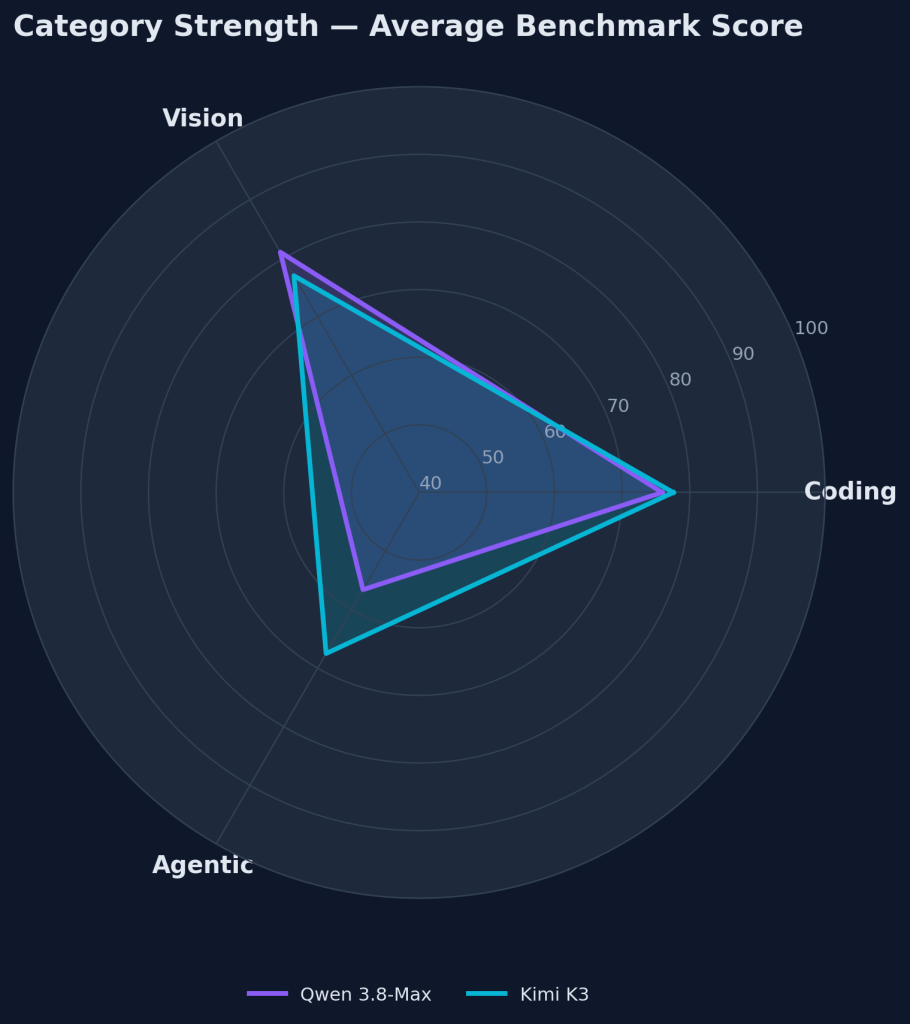
Qwen3.8-Max edges ahead on Artificial Analysis’s Intelligence Index (58 vs 48-57), representing a 10-point jump over its predecessor Qwen3.7-Max. However, this aggregate masks important nuances:
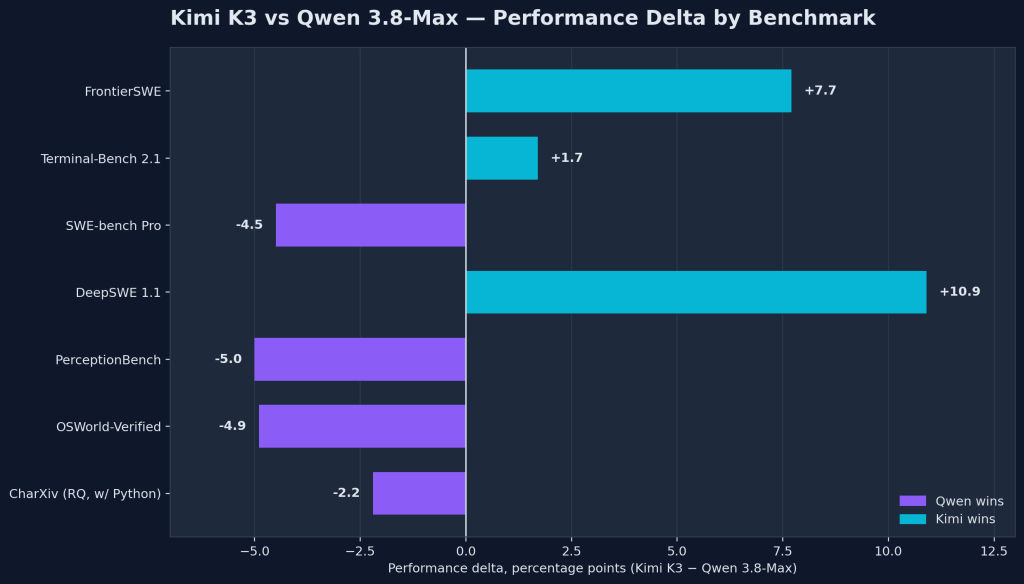
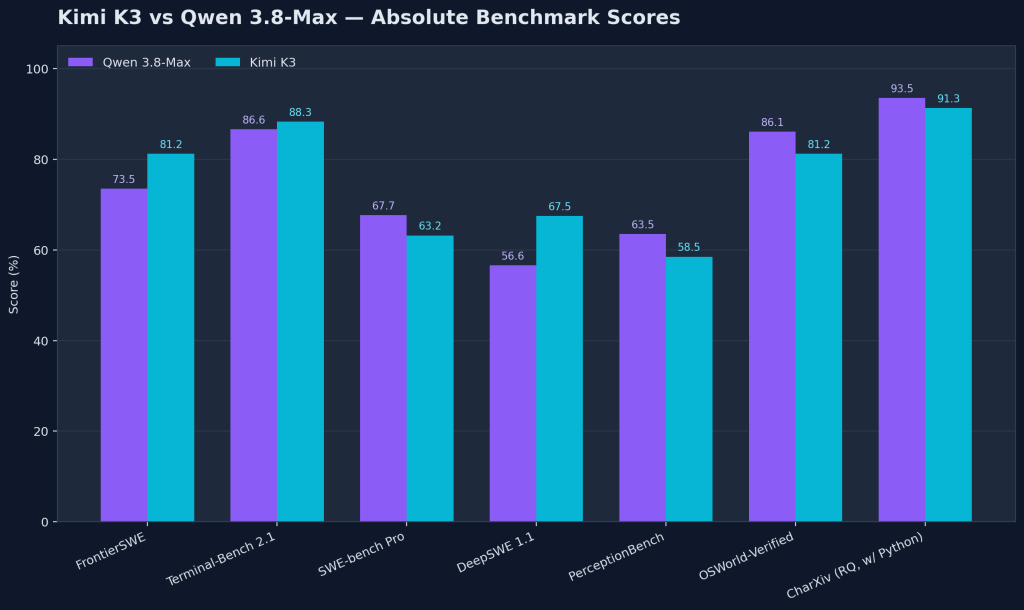
- Kimi K3 leads on: DeepSWE 1.1, FrontierSWE, GPQA, Humanity’s Last Exam, MLS-Bench Lite, Terminal-Bench 2.1
- Qwen3.8-Max leads on: MMMU-Pro, PerceptionBench, PaperBench, OSWorld-Verified, JobBench
Qwen3.8-Max scores higher on aggregate, but Kimi K3 dominates on pure coding and reasoning benchmarks.
Pricing
Cost per million tokens and quality/price ratio
| Metric | Qwen3.8-Max | Kimi K3 | Winner |
|---|---|---|---|
| Input price | $2.00/1M tokens | $3.00/1M tokens | Qwen3.8-Max (33% cheaper) |
| Output price | $6.00/1M tokens | $15.00/1M tokens | Qwen3.8-Max (60% cheaper) |
| Cache hit price | $0.25/1M tokens | $0.30/1M tokens | Qwen3.8-Max |
| Cost per Intelligence Index task | $1.14 | $0.86 | Kimi K3 (better quality/price) |
Critical insight: While Qwen3.8-Max has lower per-token costs, Kimi K3 delivers better quality per dollar on many tasks. Artificial Analysis measures $0.86 per Intelligence Index task for K3 versus $1.14 for Qwen3.8-Max, despite K3’s higher headline token price.
Qwen3.8-Max for high-volume, cost-sensitive applications, Kimi K3 for quality-critical tasks where output matters more than cost.
Context Window Size
Maximum context length for processing long documents
| Model | Context Window | Input Limit | Output Limit |
|---|---|---|---|
| Qwen3.8-Max | 1,000,000 tokens | 991,808 tokens | 131,072 tokens |
| Kimi K3 | 1,048,576 tokens | ~1,000,000 tokens | 1,048,576 tokens |
Both models offer 1M token context windows, but with key differences:
- Kimi K3 provides a full 1,048,576 token output capacity (the entire context window as a single response)
- Qwen3.8-Max caps output at 131,072 tokens, though it supports reasoning chains up to 262,144 tokens
For long document analysis:
- Kimi K3 can ingest and generate up to 1M tokens in a single call
- Qwen3.8-Max requires chunking for outputs exceeding 131K tokens
Kimi K3 wins for maximum context utilization, especially for long-form generation tasks.
Output Capacity
Maximum generatable tokens per response
| Model | Default Output | Maximum Output | Reasoning Budget |
|---|---|---|---|
| Qwen3.8-Max | 131,072 tokens | 131,072 tokens | 262,144 tokens |
| Kimi K3 | 131,072 tokens | 1,048,576 tokens | Included in max |
Kimi K3’s output ceiling is 8x higher than Qwen3.8-Max’s. This makes K3 uniquely suited for:
- Generating complete codebases
- Writing long-form content (novels, technical documentation)
- Producing detailed analysis reports without truncation
Qwen3.8-Max’s 131K limit is still substantial for most applications, but Kimi K3’s 1M output capacity is unmatched in the industry.
Kimi K3 dominates output capacity by a wide margin.
Recency
Model freshness and release timeline
| Model | Preview Date | GA Date | Open Weights | Age (days) |
|---|---|---|---|---|
| Kimi K3 | July 16, 2026 | July 16, 2026 | July 26, 2026 | 27 days |
| Qwen3.8-Max | July 19, 2026 | August 3, 2026 | Pending (Aug 10) | 9 days |
Qwen3.8-Max is 18 days fresher, representing the latest generation of Alibaba’s Qwen line. However, Kimi K3 has been open-weight since July 26 (11 days before Qwen3.8-Max’s promised release), giving it a head start in community adoption and third-party optimization.
Qwen3.8-Max for cutting-edge features and improvements, Kimi K3 for proven stability and existing open-weight ecosystem.
Composite Score
Global ranking based on: benchmark performance, pricing, context window, recency, versatility, and output capacity
| Dimension | Weight | Qwen3.8-Max | Kimi K3 | Winner |
|---|---|---|---|---|
| Benchmark Performance | 25% | 9.2/10 | 8.8/10 | Qwen3.8-Max |
| Pricing | 20% | 9.5/10 | 7.0/10 | Qwen3.8-Max |
| Context Window | 15% | 8.0/10 | 9.5/10 | Kimi K3 |
| Recency | 10% | 9.5/10 | 8.0/10 | Qwen3.8-Max |
| Versatility | 15% | 9.0/10 | 8.5/10 | Qwen3.8-Max |
| Output Capacity | 15% | 7.0/10 | 10.0/10 | Kimi K3 |
| COMPOSITE SCORE | 100% | 8.8/10 | 8.6/10 | Qwen3.8-Max |
Qwen3.8-Max edges out Kimi K3 by 0.2 points in our weighted composite score, driven primarily by superior pricing and recency. However, Kimi K3’s dominance in output capacity and context window utilization makes it the better choice for specific use cases.
Operational Benchmarks by Use Case
Coding & Code Review
| Metric | Qwen3.8-Max | Kimi K3 | Winner |
|---|---|---|---|
| Terminal-Bench 2.1 | 86.6% | 88.3% | Kimi K3 |
| SWE-bench Pro | 67.7% | 63.2% | Qwen3.8-Max |
| DeepSWE 1.1 | 56.6% | 81.2% | Kimi K3 |
| FrontierSWE | 73.5% | 81.2% | Kimi K3 |
| Code Arena Elo | ~47-48 | ~41-42 | Qwen3.8-Max |
| Head-to-head test | 80/100 | 83/100 | Kimi K3 |
Recommendation:
- Kimi K3 for complex software engineering, code generation, and repository-level tasks
- Qwen3.8-Max for code review, debugging, and terminal-based workflows
Long Document Analysis
| Metric | Qwen3.8-Max | Kimi K3 | Winner |
|---|---|---|---|
| Context window | 1M tokens | 1.05M tokens | Kimi K3 |
| Max output | 131K tokens | 1M tokens | Kimi K3 |
| PaperBench | 93.0% | – | Qwen3.8-Max |
| MMMU-Pro | 88.0% | – | Qwen3.8-Max |
Recommendation:
- Kimi K3 for analyzing and generating complete documents without truncation
- Qwen3.8-Max for research paper analysis and technical document review
Batch Extraction
| Metric | Qwen3.8-Max | Kimi K3 | Winner |
|---|---|---|---|
| Input cost | $2.00/1M | $3.00/1M | Qwen3.8-Max |
| Output cost | $6.00/1M | $15.00/1M | Qwen3.8-Max |
| Speed | 48-56 tok/s | 36-42 tok/s | Qwen3.8-Max |
| Latency (p50) | 4,975ms | 8,182ms | Qwen3.8-Max |
Recommendation: Qwen3.8-Max for high-volume batch processing due to 33-60% lower costs and 39% faster response times.
Creative Writing
| Metric | Qwen3.8-Max | Kimi K3 | Winner |
|---|---|---|---|
| Fiction continuation | Lost 3-20 vs K3 | Won 20-3 vs Qwen | Kimi K3 |
| Output length | 131K max | 1M max | Kimi K3 |
| Writing quality | 58.1 intelligence | 48-57 intelligence | Qwen3.8-Max |
Recommendation: Kimi K3 for long-form creative writing, novels, and content generation. Qwen3.8-Max is better for editing and refinement.
Image Understanding / OCR
| Metric | Qwen3.8-Max | Kimi K3 | Winner |
|---|---|---|---|
| Roboflow OCR | 92.8% | 93.0% | Kimi K3 (marginal) |
| Cost per OCR task | $0.0056 | $0.0094 | Qwen3.8-Max |
| Processing time | 14.68s | 13.18s | Kimi K3 |
| Multimodal score | 67/100 | 50/100 | Qwen3.8-Max |
Recommendation:
- Qwen3.8-Max for cost-effective, high-volume OCR and multimodal tasks
- Kimi K3 for specialized vision tasks requiring maximum accuracy
Latency & Speed
| Metric | Qwen3.8-Max | Kimi K3 | Winner |
|---|---|---|---|
| Output speed | 48-56 tok/s | 36-42 tok/s | Qwen3.8-Max |
| Time to first token | 2.75s | 3.04s | Qwen3.8-Max |
| p50 latency | 4,975ms | 8,182ms | Qwen3.8-Max |
| Throughput | 56 tok/s | 36 tok/s | Qwen3.8-Max |
Recommendation: Qwen3.8-Max for latency-sensitive applications. It’s 39% faster at median response times and 55% faster at streaming tokens.
When Use Qwen3.8-Max and Kimi K3
Use Qwen3.8-Max when:
- Cost efficiency is critical – 33-60% cheaper per token
- Speed matters – 39-55% faster response times
- Multimodal tasks – Superior image/video understanding
- High-volume processing – Batch extraction and analysis
- Agentic workflows – Better tool use and OSWorld performance
- Cutting-edge features – Latest model with active development
Use Kimi K3 when:
- Maximum output length – 8x higher output capacity (1M vs 131K)
- Complex coding – Superior on DeepSWE, FrontierSWE, Terminal-Bench
- Creative writing – Proven better at fiction and long-form content
- Open weights required – Available since July 26, 2026
- Single-call processing – Can ingest and generate entire documents
- Quality-per-dollar – Better benchmark performance per cost
Qwen3.8-Max and Kimi K3 are complementary rather than strictly competitive
Qwen3.8-Max excels at operational efficiency, speed, and multimodal tasks, making it ideal for production applications where cost and latency matter. Kimi K3 dominates at maximum capacity tasks—complex coding, creative writing, and single-call document processing—where its 8x output advantage and superior coding benchmarks justify the higher cost.
For most organizations, the optimal strategy is a hybrid approach: use Qwen3.8-Max for high-volume, latency-sensitive tasks and Kimi K3 for complex, high-value work requiring maximum output capacity.
Try Qwen3.8 27 for 30 days free
Sign up, grab your API key, and route between Qwen3.8 27 and other models with zero data retention and EU-hosted.
Ship Private AI. Not Infrastructure.
You have the private AI App architecture, bow give it an inference layer built for production.
Regolo gives European teams fast, OpenAI-compatible access to Mistral, Llama, Qwen, DeepSeek, GLM, and more — with zero data retention, EU data residency, and no new SDK to learn.
Change your base_url. Keep your LangChain code. Start shipping.
🚀 Start your 30-day free trial →
Build, test, and deploy with no infrastructure to maintain.
No credit card. No migration project. No compromise on data control.
💬 Join the Regolo Discord →
Meet builders working on private RAG, local LLMs, LangChain, Ollama, and production AI systems. Share your setup, get feedback from the community, and speak directly with the Regolo team.
🤝 Talk to an AI Infrastructure Engineer →
Running a sensitive workload, scaling beyond a proof of concept, or assessing a managed EU inference provider? Get a tailored architecture and commercial proposal for your team.
📂 Clone the GitHub repository →
Get the full implementation from this guide: ingestion scripts, ChromaDB setup, hybrid retrieval, the 30-Question RAG Floor, evaluation examples, and deployment configuration.
Private AI should not require a private data center.
Regolo gives your team an EU-native path from local experimentation to production-grade inference.
Build with Regolo
- Discord: Join the community →
- GitHub: Explore open-source workflows →
- X / Twitter: Follow @regolo_ai →
- Reddit: Join the community →
- Documentation: Read the API docs →
- Contact: Talk to the team →
Built with ❤️ by the Regolo team. Questions? regolo.ai/contact or chat with us on Discord