
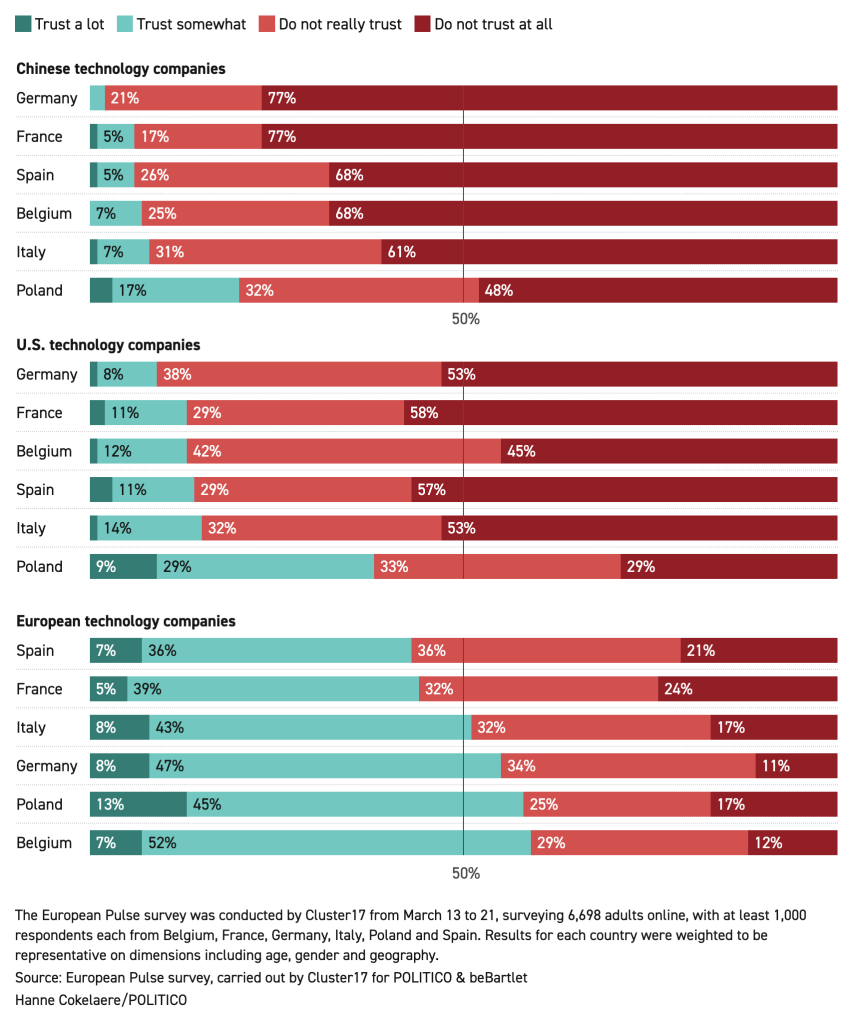
A March 2026 Politico survey put a number on something many people in European tech had already felt: 84% of Europeans do not trust American tech companies to handle their personal data responsibly, and that figure rises to 93% for Chinese firms. These are not fringe opinions. They come from a representative sample of 6,698 adults across Germany, France, Italy, Spain, Poland, and Belgium — covering roughly two-thirds of the EU population.
The survey, called European Pulse, was jointly designed by Politico and the political consulting firm beBartlet, with fieldwork conducted by Cluster17 between 13 and 21 March 2026. It covers energy, defense, mobility, cost of living, and technology — and on every dimension, the pattern is the same: Europeans are clear about what they want and deeply skeptical about who they trust to deliver it.
Credits to Politico.eu
What the data actually says
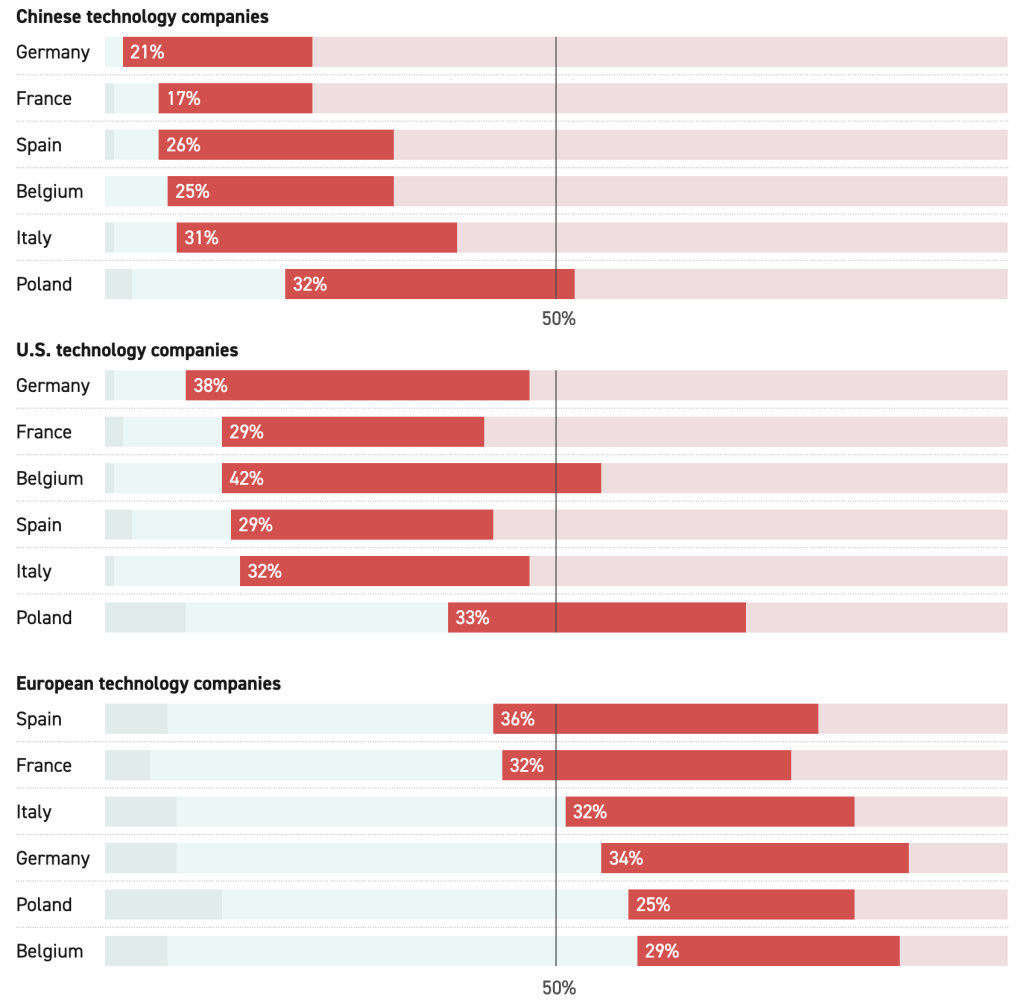
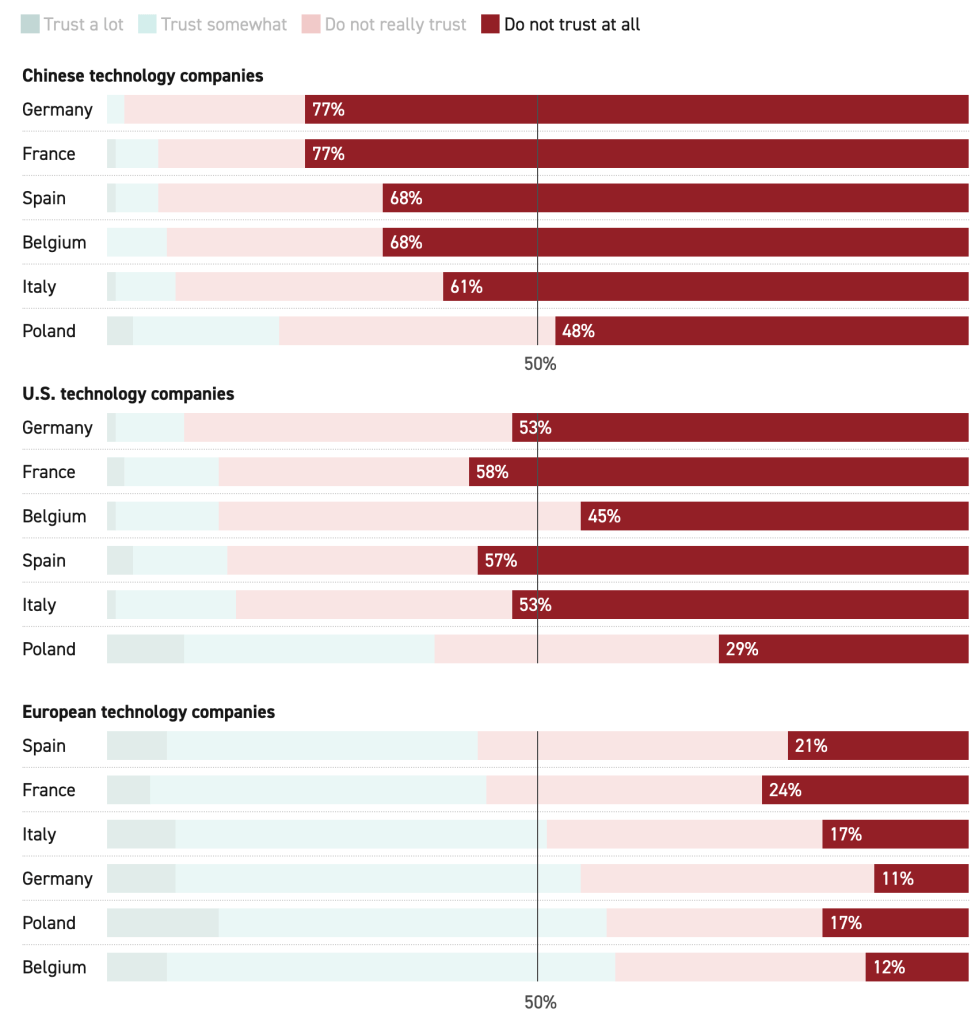
Trust in European tech companies sits at roughly 51% across the six countries surveyed — far above the confidence levels for US or Chinese providers. Belgium shows the highest trust in EU firms at 59%. Germany is the most distrustful of foreign providers: 91% of German respondents do not trust American companies and 98% do not trust Chinese ones.
When it comes to US companies specifically, only 10 to 15% of respondents in Germany, France, Italy, Spain, and Belgium expressed any level of trust — compared to approximately 38% in Poland, which has a distinct security calculus given its proximity to Russia.
The 84% aggregate distrust figure for US firms is not a reaction to any single event. As independent AI analysts have noted, European distrust of American companies is rooted in structural legal issues, not just current politics.
The underlying legal issue is the US CLOUD Act, which allows US authorities to compel American cloud and software providers to hand over data stored anywhere in the world — including in European data centers.
GDPR’s Chapter V governs international data transfers, but the EU-US Data Privacy Framework that replaced Privacy Shield is itself subject to ongoing legal challenge, with a “Schrems III” scenario widely anticipated. For organizations processing sensitive data, this is not a theoretical risk. It is an active compliance exposure.
A structural shift, not a moment
The survey data aligns with a broader trend that has been building for years. A 2019 Bertelsmann Foundation poll of more than 12,000 people across 28 EU countries found that 40% of Europeans trusted European companies with their data, compared to 20% for American companies and just 6% for Chinese firms. The 2026 numbers show the same hierarchy, but the gap has widened and the awareness has sharpened.
At the organizational level, 62% of European organizations are now seeking sovereign AI solutions in response to geopolitical uncertainty. In sectors such as banking (76%), public services (69%), and utilities (70%), sovereign AI adoption is already being led from the top. Among IT decision-makers specifically, 54% now prioritize data sovereignty in procurement decisions. The survey data from citizens and the procurement signals from organizations are pointing in the same direction.
This is also reflected in how Europeans talk about the cloud. An estimated 97% of Europe’s cloud infrastructure market is dominated by US or Chinese providers — a figure that creates significant tension with the sovereignty preferences expressed in survey after survey. The gap between where data currently lives and where Europeans want it to live is the business opportunity.
Start your free 30-day trial at regolo.ai and deploy LLMs with complete privacy by design.
👉 Talk with our Engineers or Start your 30 days free →
- Discord – Share your thoughts
- GitHub Repo – Code of blog articles ready to start
- Follow Us on X @regolo_ai
- Open discussion on our Subreddit Community
Built with ❤️ by the Regolo team. Questions? regolo.ai/contact or chat with us on Discord