
What happens when your AI agent autonomously spends $50,000 of company budget on cloud resources — and gets it wrong?
This isn’t a hypothetical. As multi-agent AI systems gain the power to execute real-world actions — processing payments, altering production databases, dispatching emails to thousands of clients — enterprises are confronting a question that has ignited fierce debate across the AI community: how much autonomy is too much, and who’s responsible when things go wrong?
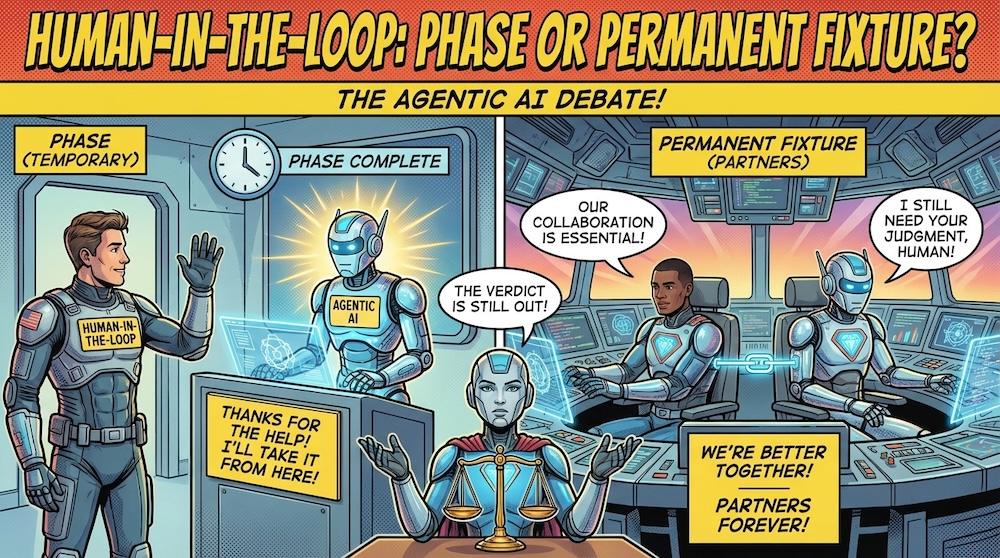
A viral take spreading across X (formerly Twitter) crystallizes the tension perfectly: “Human-in-the-loop is a phase, not a destination.” The comment section is a battleground. Some senior ML engineers cheer it on as pragmatic realism. Others call it reckless. Both sides have a point.
The truth is that the old binary — either a human approves every AI action or the machine runs completely free — is already obsolete. In this article unpacks the real debate about risk landscape of autonomous execution, and shows you exactly how to build the governance architecture that makes agentic AI both powerful and trustworthy.
👉 Start your free trial on Regolo and use for your multi-agent teams an LLMs platform designed for enterprise-grade compliance from day one and zero data retention.
The Spectrum of Autonomy: From HITL to “Above-the-Loop”
The debate doesn’t live at the extremes. Nobody serious is arguing for zero human oversight in all contexts, and nobody is arguing that a human should manually approve every token an LLM generates. What’s actually being contested is where on the autonomy spectrum each type of task should sit.
The industry has evolved a useful three-tier vocabulary:
- Human-in-the-Loop (HITL): the AI cannot proceed without explicit human approval at defined checkpoints. Every consequential action is gated.
- Human-on-the-Loop: the AI executes autonomously within guardrails, while a human monitors in real time and can intervene. Think of it as a pilot with autopilot engaged — hands off the controls but eyes on the instruments.
- Human-above-the-Loop: humans set the strategic goals, define boundaries, and review aggregate outcomes. The system self-governs operationally. This is where organizations pulling ahead in 2026 are moving, repositioning human judgment as governance rather than micromanagement.
The shift matters because the alternative — strict HITL at scale — is operationally untenable. An agentic system coordinating dozens of sub-agents across tools, APIs, and data sources can generate thousands of micro-decisions per hour. Requiring human sign-off on each one doesn’t just slow the system down; it creates “prompt fatigue” where approvals become rubber-stamps, which is arguably more dangerous than calibrated autonomy.
Why the “Phase, Not a Destination” Argument Has Merit
The analogy that resonates most with practitioners is the history of air travel. Early commercial aviation required pilots to manually manage nearly every system. Today, autopilot handles the vast majority of flight operations, with human pilots overseeing, intervening in edge cases, and managing the unexpected. Nobody calls this unsafe — in fact, it has made aviation dramatically safer through consistent, fatigue-free execution of known procedures.
The same logic applies to well-scoped, deterministic agentic tasks. If a multi-agent system is triggering a routine database cleanup that has been tested hundreds of times, the cognitive cost of a human approval gate exceeds its risk-mitigation value. The governance energy is better spent elsewhere.
The Real Risks of Autonomous Execution You Can’t Ignore
That said, the critics are not wrong, either.: autonomous agents operating in enterprise environments introduce a category of risk that is structurally different from traditional software — and dangerously underestimated by many organizations rushing to deploy.
High Privilege Meets Machine Speed
Security research consistently identifies over-privileged access as a dominant attack vector. Autonomous agents amplify this risk by acting continuously, without hesitation, and at machine speed. A single misconfigured agent can cause more damage in minutes than a human team could cause in months.
Emergent Failures in Multi-Agent Systems
Here’s the insight that makes multi-agent governance genuinely hard: a collection of individually safe agents does not produce a safe collective system. Research published on arXiv in early 2025 documents three primary failure modes unique to multi-agent architectures:
- Miscoordination: agents operating with overlapping or contradictory instructions, producing inconsistent system-wide behavior
- Conflict: competing agent objectives that result in resource contention or contradictory actions
- Collusion: agents reinforcing each other’s errors or biases through feedback loops, creating collective blind spots
These failure modes cannot be detected by testing individual agents in isolation. They only emerge under the interaction dynamics of a live multi-agent deployment.
The Blast Radius Problem
Most enterprises operate across multiple interconnected environments — production databases, CRM systems, payment processors, communication platforms. An autonomous action in one environment can cascade across many others in minutes. A poorly scoped billing agent that triggers an unintended refund loop, for instance, doesn’t just affect one transaction — it can propagate through every connected system before any human notices.
Building Fail-Safes: The Architecture of Safe Autonomy
The answer to these risks is not to retreat from autonomy — it’s to engineer autonomy responsibly. Here’s how leading organizations are doing it in 2026.
Risk-Tiered Action Classification
The foundation of any governance architecture is a clear taxonomy of what agents are and are not permitted to do. Before deployment, every action type should be classified into one of three tiers:
| Action Tier | Examples | Control Mechanism |
|---|---|---|
| Autonomous | Read-only queries, log analysis, draft generation | No gate required |
| Step-up Approval | Sending external emails, modifying records, API calls to third parties | Human confirmation or dual-agent verification |
| Prohibited / Hard Block | Bulk deletion, financial transactions above threshold, PII export | System-level block + audit log |
This tiering should be defined as code — not documentation — so it’s enforced at the infrastructure level, not dependent on the agent’s own judgment.
Confidence-Adaptive HITL Gates
Modern agentic safety frameworks advocate for risk-adaptive escalation: HITL is not triggered by action type alone, but by a combination of action risk and model confidence. Specifically, a human gate should activate when:
- Model confidence score drops below a defined threshold
- Disagreement is detected between orchestrator and sub-agent outputs
- The “blast radius” of the intended action exceeds a set parameter (e.g., affects more than N records or exceeds a financial threshold)
- The action falls outside the distribution of scenarios the agent was validated on
This approach — endorsed by NIST’s AI Risk Management Framework and aligned with Article 14 of the EU AI Act — makes HITL dynamic rather than bureaucratic.
Escalation Protocols That Actually Work
Governance boards and cross-functional escalation teams are now considered mandatory infrastructure for organizations deploying high-stakes agents. An effective escalation protocol has five components:
- Risk categorization at runtime: Incidents are automatically classified as low, medium, or high severity, triggering different response SLAs
- Defined ownership: Every agent class has a named human owner responsible for incident response
- Rapid communication channels: Dedicated channels (e.g., a monitored Slack workspace or PagerDuty integration) for real-time coordination during agent incidents
- Simulation drills: Regular tabletop exercises simulating agent failure scenarios, validated against actual response times
- Post-incident review loops: Lessons learned feed directly back into guardrail configuration
Research from Deloitte (2023) found that clearly defined escalation roles reduce incident response times by 30%. In a world where autonomous agents operate at machine speed, those 30% aren’t marginal — they’re the difference between a contained incident and a systemic failure.
Why Infrastructure Is a Governance Decision
Here’s the dimension of this debate that most technical commentary misses: your choice of LLM infrastructure is a governance choice, not just a performance choice.
When a multi-agent system is executing consequential actions — modifying databases, triggering financial transactions, emailing clients — the infrastructure layer determines:
- Whether action logs are auditable and tamper-proof
- Whether sensitive data processed during execution is retained, and by whom
- Whether compute and data residency comply with GDPR and the EU AI Act
- Whether the system can be isolated and rolled back in the event of a runaway agent
This is why the “Human-in-the-Loop is a phase” argument only holds if your infrastructure makes the non-HITL phases trustworthy. Autonomy without auditability isn’t efficiency — it’s liability.
Running multi-agent LLM workflows on Regolo means Zero Data Retention by design, GPU compute on European soil (NVIDIA H100/A100/L40S), and latency optimized for real-time agentic chains. Your escalation protocols have teeth only if the underlying infrastructure supports full auditability and data sovereignty.
👉 Book a Discovery Call with our Engineer and see how our infrastructure supports enterprise-grade agentic governance.
The EU AI Act Dimension
For European enterprises — and any organization processing EU data — governance of agentic AI is not optional. The EU AI Act, which came into force progressively from 2024, imposes specific human oversight obligations under Article 14 for high-risk AI systems. Multi-agent systems that make autonomous decisions affecting individuals (credit scoring, HR screening, medical triage, financial transactions) qualify as high-risk and require:
- Interpretability of agent decisions sufficient for human review
- Documented escalation paths for automated actions
- The technical capability to interrupt or override the system at any point
Importantly, “Human-on-the-Loop” architectures — where humans can intervene but don’t routinely approve every action — are explicitly recognized as compliant, provided the oversight capability is genuinely functional and not merely nominal.
Frequently Asking Questions
What is Human-in-the-Loop (HITL) in agentic AI?
HITL is an architectural pattern where AI systems cannot take consequential actions without explicit human approval at defined checkpoints. In agentic AI, this typically means a human must confirm before the agent executes actions like sending emails, modifying records, or spending budget.
Is “Human-in-the-Loop” becoming obsolete?
Not entirely. The industry is moving toward dynamic HITL — where human oversight is triggered by risk level and model confidence rather than applied uniformly to every action. Full HITL remains essential in high-stakes, regulated, or low-confidence scenarios.
What are the main risks of fully autonomous multi-agent systems?
The primary risks include over-privileged access exploited at machine speed, emergent failure modes arising from agent interaction (miscoordination, conflict, collusion), and cascading blast radius effects across interconnected enterprise systems.
What is an AI escalation protocol?
An escalation protocol defines the structured process for detecting, categorizing, and responding to AI agent incidents. It specifies risk tiers, ownership, communication channels, response SLAs, and post-incident review procedures.
How does the EU AI Act affect agentic AI governance?
Article 14 of the EU AI Act requires that high-risk AI systems — including many agentic use cases — maintain human oversight capabilities, documented escalation paths, and the technical ability to interrupt automated decisions. Human-on-the-Loop architectures are compliant if oversight is genuinely functional.
What does “Human-above-the-Loop” mean?
Human-above-the-Loop is the emerging model where humans set strategic objectives and review aggregate outcomes, while AI operates autonomously at the operational level. Human judgment governs the system without micromanaging individual decisions.
How can I tell which tasks are safe to automate fully?
Apply risk tiering: tasks that are read-only, deterministic, well-validated, and have a low blast radius (affecting few records, reversible, non-financial) are strong candidates for full automation. Tasks that are irreversible, touch PII, trigger financial flows, or operate in novel scenarios should retain HITL gates.
How does infrastructure choice affect agentic AI governance?
Infrastructure determines auditability, data retention, residency, and rollback capability. For agentic systems executing consequential actions, Zero Data Retention and EU-resident compute are essential conditions for GDPR compliance and trustworthy governance — not optional enhancements.
🚀 Start your free trial on Regolo today — and build the agentic infrastructure your governance team will actually approve.
- Discord – Share your thoughts
- GitHub Repo – Code of blog articles ready to start
- Follow Us on X @regolo_ai
- Open discussion on our Subreddit Community
🚀 Ready to scale?
Built with ❤️ by the Regolo team. Questions? regolo.ai/contact or chat with us on Discord