

We analyzed the raw comparative benchmarks published on July 30—right after K3’s weights opened—to extract a clear decision framework for engineering teams. We gather verified benchmarks on both models across our production repositories, and our team noticed that the headline scoreboard shows a paradox: on a simple arithmetic average across six evaluation axes, GLM-5.2 wins with 69.3 against Kimi K3’s 67.3.
This benchmark does not compare models of equal scale, architecture, or resource footprints.
| Parameter / Architectural Axis | GLM-5.2 (Zhipu AI) | Kimi K3 (Moonshot AI) | Asymmetry & Impact |
|---|---|---|---|
| Total Parameter Count | 753 Billion (753B) | 2.8 Trillion (2,800B) | K3 is 3.7x larger in total scale |
| Active Parameters per Token | 40 Billion (40B MoE) | Heavy Dense/Sparse Hybrid | GLM activates ~70% fewer parameters per forward pass |
| Native Modality | Text-Only | Native Multimodal (Text, Image, Video) | K3 carries vision encoder overhead |
| Self-Hosting Footprint | 1 Node (8x H200 GPUs) | 1.56 TB VRAM (8–32x H200 GPUs) | GLM self-hosting is ~4x cheaper in hardware |
| Blended API Pricing | $2.07 / M tokens | $11.00 / M tokens | K3 costs 5.3x more per token |
It pits a lightweight, high-efficiency production workhorse (GLM-5.2) against a heavyweight, ultra-dense frontier agent (Kimi K3).
The relevant question is trying to reply here is not “Which model is superior in a vacuum?” but rather “Does Kimi K3’s 3.7x parameter footprint and 5.3x cost premium deliver a proportionate capability gain for my specific workloads?”
Summary & Architectural Scoreboard
Selecting between GLM-5.2 and Kimi K3 isn’t a choice between “good” and “better.” It’s an architectural trade-off between high-throughput production efficiency and long-horizon autonomous agency.
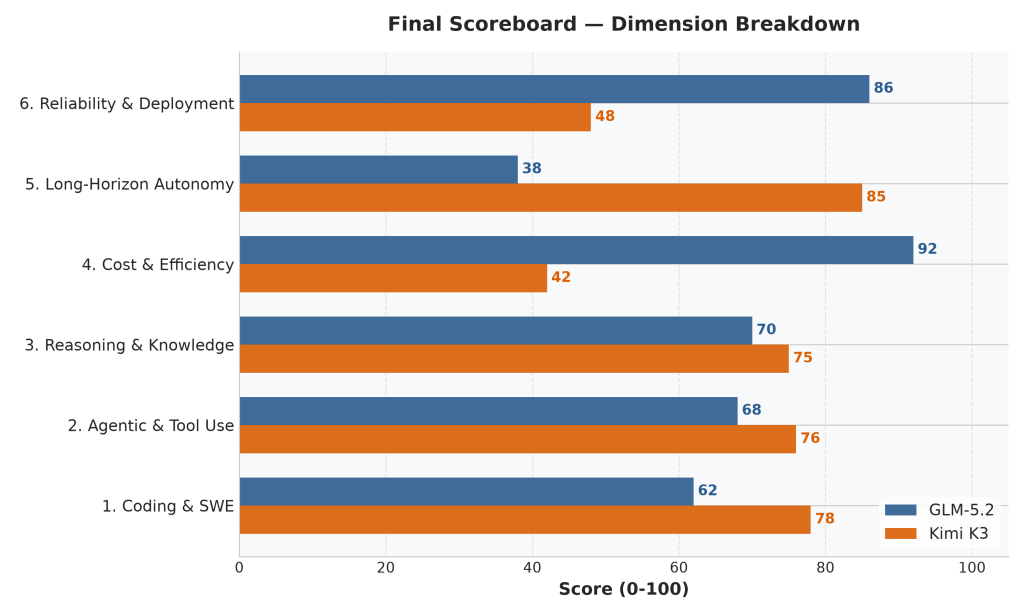
Why this chart matters to your engineering roadmap
- GLM-5.2 (Blue) dominates operational friction points: Cost & Efficiency (92) and Reliability & Deployment (86).
- Kimi K3 (Orange) leads in deep capability axes: Long-Horizon Autonomy (85), Coding & SWE (78), Agentic Tool Use (76), and Reasoning (75).
The practical takeaway: if your engineering bottleneck is daily token burn, slow PR review loops, or air-gapped self-hosting, GLM-5.2 is your workhorse. If your team is building multi-step coding agents that run overnight across massive codebases without human intervention, Kimi K3’s capability premium justifies its operational overhead.
Software Engineering & Coding Capability
When evaluating coding models for developer platforms or internal CLI agents, lab benchmarks like SWE-bench Verified can be deceiving because they suffer from saturation.
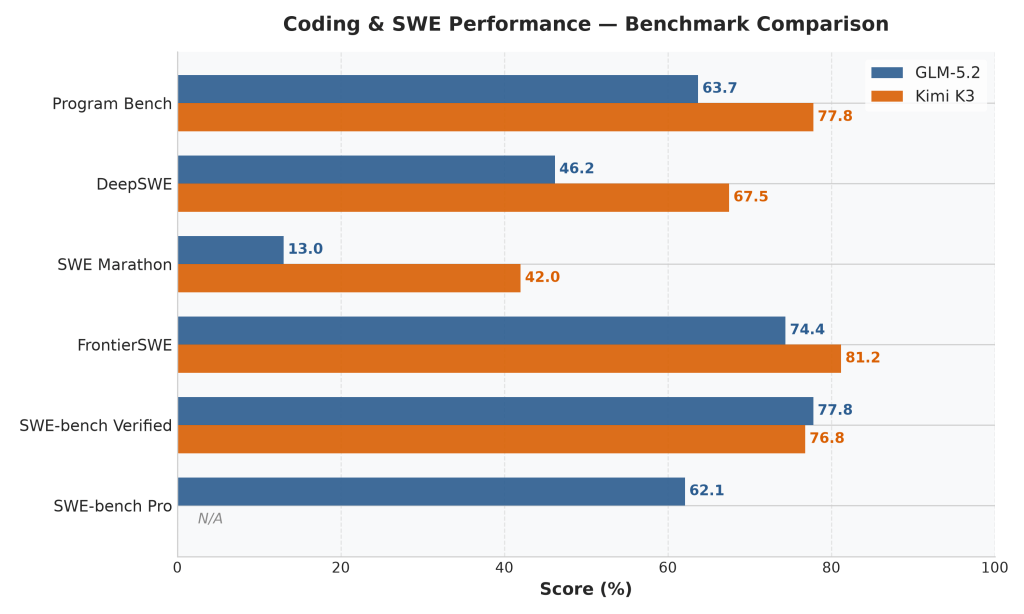
How to read this chart as a Technical Lead
- SWE-bench Verified: The models are practically tied (GLM-5.2 at 77.8% vs. K3 at 76.8%). For isolated unit-level fixes or single-file PR generation, developers will perceive zero difference in output quality.
- SWE-bench Pro (62.1): GLM-5.2 is currently the only model in this comparison with an independently verified third-party score on SWE-bench Pro, outperforming GPT-5.5 (58.6).
- SWE Marathon (13.0 vs. 42.0) & DeepSWE (46.2 vs. 67.5): This is where Kimi K3 breaks away. On multi-hour software engineering tasks involving context drift, refactoring across 20+ files, and iterative bug hunting, K3 holds its context dramatically better.
Value: use GLM-5.2 for real-time IDE code completion, quick bug fixes, and automated inline PR reviews. Reserve Kimi K3 for complex migrations, legacy refactoring, and multi-file feature generation where agent loops must run for hours without losing the thread.
Agentic Execution & Tool Navigation
Modern software engineering relies heavily on Model Context Protocol (MCP) integrations, CLI execution, and terminal tool calling.
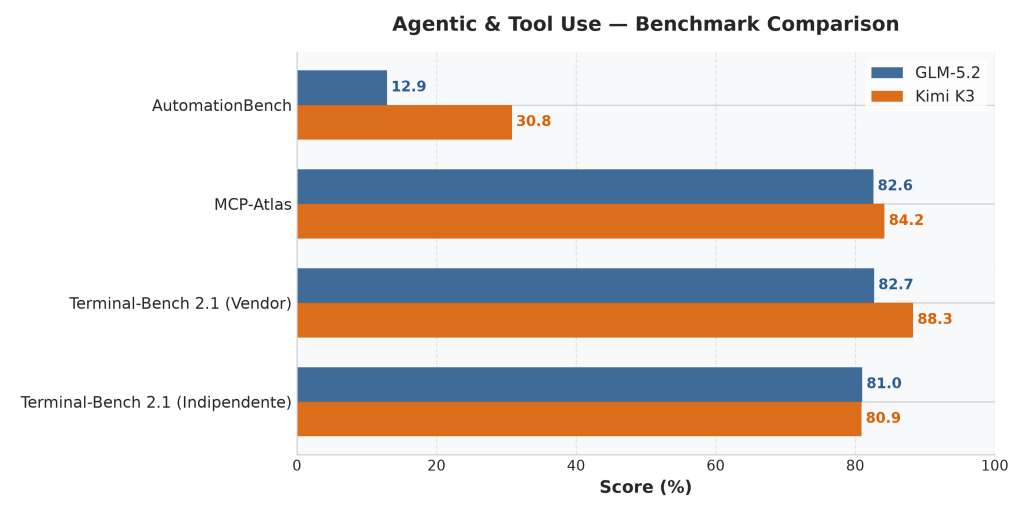
What this chart tells you
- Terminal-Bench 2.1 (Independent): When evaluated by independent testing frameworks (Z.ai / Vals), both models land at exact parity (81.0 vs. 80.9). For standard bash command execution, file manipulation, and git operations, both models handle terminal tools with identical reliability.
- AutomationBench (12.9 vs. 30.8): On complex multi-tool workflow automation, Kimi K3 experiences significantly fewer failed execution loops.
- Frontend Code Arena (1679 Elo): Kimi K3 secured the #1 rank on LMArena’s Frontend Code Arena at launch, demonstrating superior capability in translating visual mockups into clean, responsive React and CSS components.
Value: if you are wiring simple MCP server tools or bash agents into your CI/CD pipeline, GLM-5.2 delivers identical precision at a fraction of the latency. If you are building AI frontend engineers that turn Figma designs into production code, Kimi K3′s visual understanding and layout generation provide a clear edge.
Reasoning, knowledge & web research
Agentic engineering requires more than code output; it requires structural reasoning, architectural planning, and deep documentation retrieval
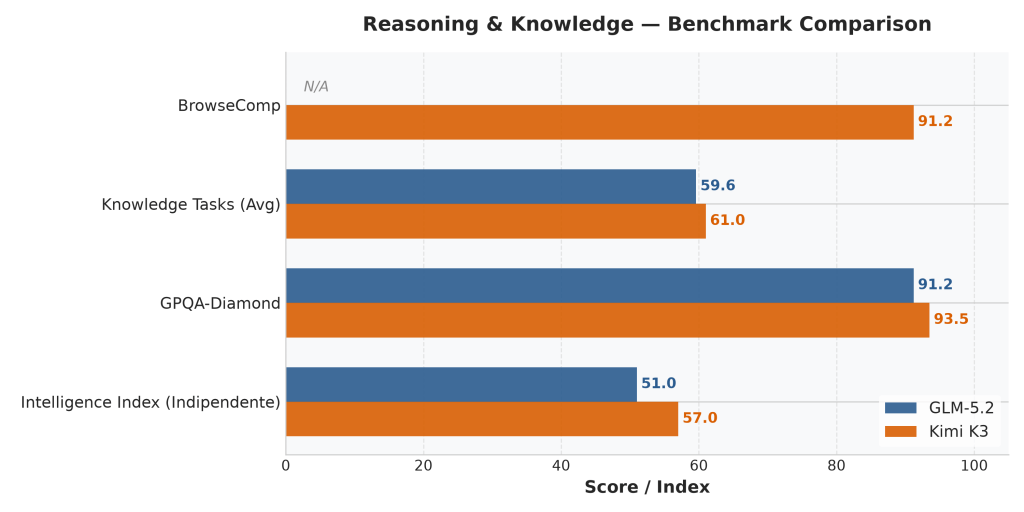
Strategic insights for AI Architects
- Intelligence Index (51 vs. 57): Kimi K3 holds a modest edge in generalized problem-solving and multi-step logic.
- BrowseComp (91.2 SOTA): Kimi K3 achieves state-of-the-art performance on web browsing and documentation synthesis. When an agent must crawl unfamiliar API documentation, parse GitHub issues, and synthesize technical solutions, K3 excels.
- Math & Formal Logic: GLM-5.2 counters with a 99.2% score on AIME 2026, making it exceptionally strong for deterministic algorithmic logic and mathematical computations.
Value: both models remain slightly behind closed frontier systems (like Opus 4.8 or Gemini 3.1 Pro) on high-level system architecture design. However, for documentation-heavy research agents, K3’s BrowseComp score makes it an elite technical researcher.
Production cost, throughput & latency
This is the dimension that flips the entire business case for engineering leadership. A model can be brilliant, but if it destroys your margins or starves developer workflows, it cannot be deployed at scale.
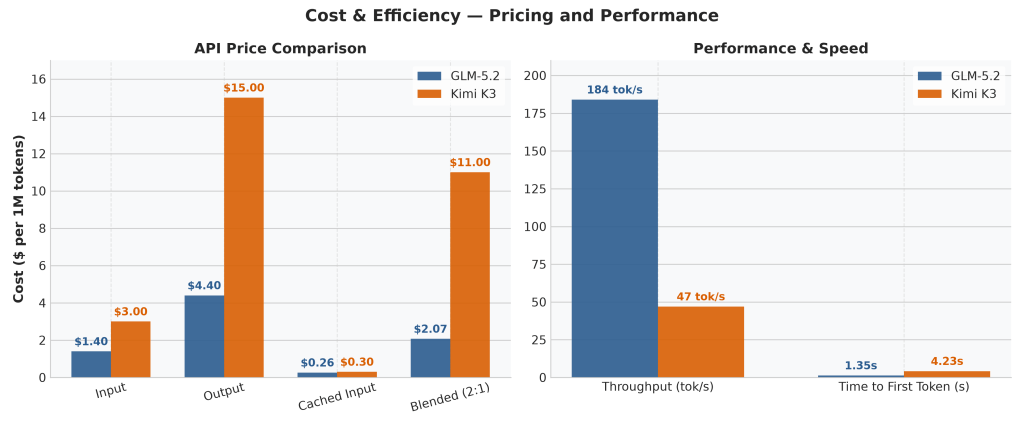
The financial & operational reality in this chart
- Blended Token Cost ($2.07 vs. $11.00 / M tok): Combining input and output at a standard 2:1 ratio, Kimi K3 is more than 5x more expensive per million tokens. On a per-task basis for long-horizon work, GLM-5.2 costs ~$0.46 compared to K3’s ~$0.94.
- Output Throughput (184 vs. 47 tok/s): GLM-5.2 streams code nearly 4x faster. In an interactive developer environment (VS Code extension, terminal agent), waiting for 47 tok/s causes friction and context switching.
- Time to First Token (1.35s vs. 4.23s): GLM-5.2 responds 3x faster. K3’s always-on reasoning chain creates a noticeable 4-second delay before output begins.
Value: for high-volume production microservices, developer autocomplete, automated PR triage, and agentic workflows running hundreds of times per hour, GLM-5.2 is the only economically viable option. Running Kimi K3 across an entire 50-person engineering team will inflate your monthly API bill by 400% without a proportional increase in daily output.
Long-Horizon autonomy & context resilience
When building background agent workers that run overnight in isolated Git worktrees, short-term speed matters far less than long-term focus.
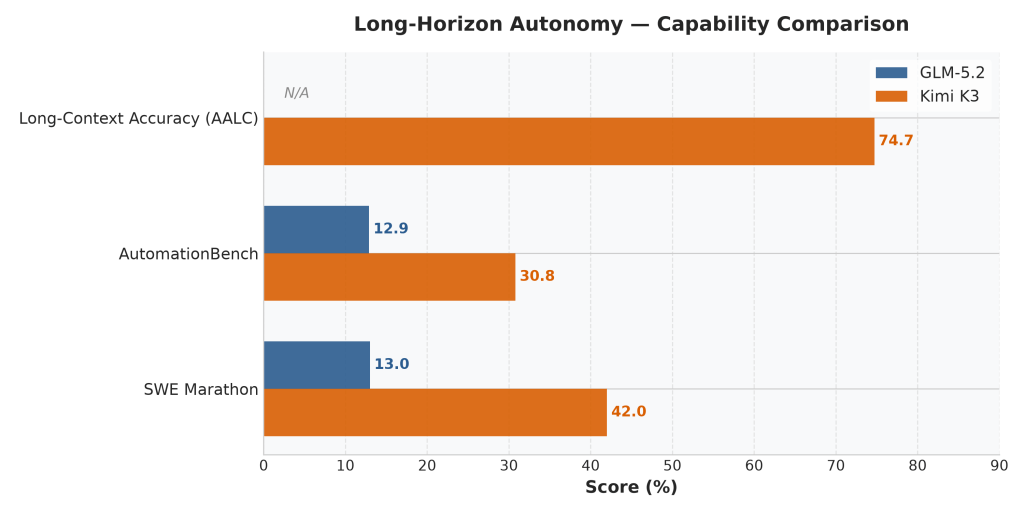
What this chart means for autonomous workflows
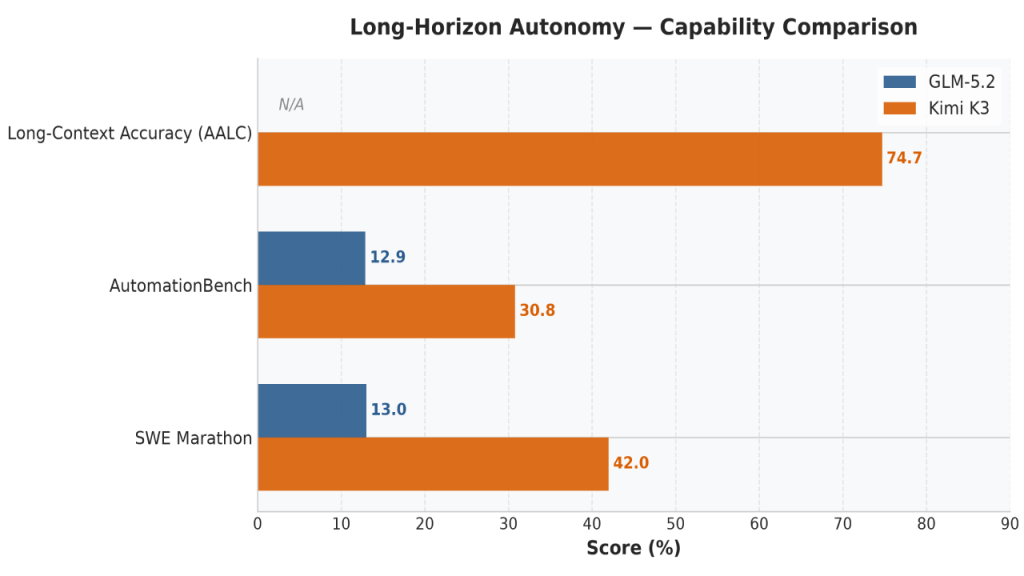
- SWE Marathon (13.0 vs. 42.0): GLM-5.2 degrades rapidly on tasks requiring extended execution loops, often collapsing into repetition or losing state after 20+ execution steps. Kimi K3 maintains strict state tracking over multi-day agent operations.
- Long-Context Accuracy (74.7% AALC): Kimi K3 ranks #5 out of 250 models on Benchm’s independent long-context evaluation, successfully retaining technical constraints across massive 1M token context windows.
Value: if you are building autonomous background workers (e.g., using open-source agent frameworks or custom worktree runners) that ingest entire codebases to write multi-file features, Kimi K3 is fundamentally superior. GLM-5.2 will require frequent human intervention to recover from deadlocks.
Reliability, self-hosting & deployment risk
| Deployment Factor | GLM-5.2 | Kimi K3 | Winner / Impact |
|---|---|---|---|
| Weights License | Unconditional MIT License | Kimi K3 License (Revenue-triggered commercial fees) | GLM-5.2 (Zero legal friction) |
| API Provider Ecosystem | 5+ independent providers (Z.ai, etc.) | Single provider (Documented rate-limiting errors) | GLM-5.2 (High availability) |
| Hardware Requirements | Single node (8x H200 GPUs) | 1.56 TB VRAM (8 to 32x H200 GPUs minimum) | GLM-5.2 (Practical self-hosting) |
| Multimodal Support | Text-Only | Native Vision (Images & Video) | Kimi K3 (UI/UX workflows) |
| Hallucination Rate | Low / Verified | 51% on uncorrected non-fact questions | GLM-5.2 (Higher factual precision) |
Value: GLM-5.2 is an enterprise-ready open-source model. It can be self-hosted on modest hardware, carries a permissive MIT license, and has zero vendor lock-in. Kimi K3 carries significant deployment risk: expensive hardware footprints, restrictive commercial licensing, and single-provider rate limits.
Practical Deployment Matrix: Which Model Should You Use?
To simplify your technology selection, match your immediate project requirements against this decision matrix:
                  ┌─────────────────────────────────────────┐
                  │      WHAT IS YOUR PRIMARY USE CASE?     │
                  └────────────────────┬────────────────────┘
                                       │
            ┌──────────────────────────┴──────────────────────────┐
            ▼                                                     ▼
┌───────────────────────┐                             ┌───────────────────────┐
│ HIGH-VOLUME / FAST    │                             │ COMPLEX / AUTONOMOUS  │
│  PRODUCTION WORKFLOW  │                             │   LONG-HORIZON AGENT  │
└───────────┬───────────┘                             └───────────┬───────────┘
            │                                                     │
            ├─► Inline IDE Code Completion                        ├─► Multi-File Codebase Migration
            ├─► Real-Time PR Triage & Review                      ├─► Overnight Worktree Bug Fixing
            ├─► High-Volume Microservice APIs                     ├─► Figma-to-React UI Generation
            ├─► Air-Gapped / On-Premise Hosting                   └─► Deep Documentation Research
            │                                                     │
            ▼                                                     ▼
┌───────────────────────┐                             ┌───────────────────────┐
│    CHOOSE GLM-5.2     │                             │    CHOOSE KIMI K3     │
│ ($2.07/M, 184 tok/s)  │                             │ ($11.00/M, 47 tok/s)  │
└───────────────────────┘                             └───────────────────────┘
Code language: PHP (php)
Choose GLM-5.2 if you need:
- Cost-sensitive production scale: you are running background indexing, inline developer assistance, or unit test generation across large teams.
- Interactive speed: you need low latency (<1.5s TTFT) and high streaming throughput (>150 tok/s) for interactive CLI or TUI tools.
- Self-hosted privacy: your compliance policies require running models on internal GPU clusters (a single 8x H200 node).
- Permissive licensing: you need clean MIT licensing without commercial revenue triggers or legal restrictions.

Choose Kimi K3 if you need:
- Autonomous long-horizon agents: you are deploying background workers that must operate independently for hours across complex repositories.
- Visual & UI development: your workflows require analyzing screenshots, mockups, or video recordings to generate frontend interfaces.
- Deep technical research: you need SOTA web browsing and documentation retrieval (BrowseComp 91.2) for complex technical synthesis.
- Capability over budget: the financial value of solving a difficult software engineering task outweighs a 5x increase in token costs.
Frequently Asked Questions
Which model wins the overall benchmark comparison, GLM-5.2 or Kimi K3?
On a simple arithmetic average across six dimensions, GLM-5.2 wins 69.3 to 67.3. However, this average is heavily skewed by Dimension 4 (Cost & Efficiency), where GLM-5.2 scores 92 vs. K3’s 42. Kimi K3 wins four out of the six individual dimensions, making it the stronger capability model for complex tasks.
Is Kimi K3 worth 5x the token cost of GLM-5.2 for software teams?
For standard developer tasks (unit testing, bug fixing, code explanations), no. GLM-5.2 performs identically on bounded tasks like Terminal-Bench 2.1 (81.0 vs 80.9). Kimi K3 is only worth the cost premium when running long-horizon autonomous agents (SWE Marathon 42.0 vs 13.0) or multimodal UI generation where GLM-5.2 fails.
What are the self-hosting hardware requirements for GLM-5.2 vs Kimi K3?
GLM-5.2 can be self-hosted easily on a single 8x H200 GPU node due to its efficient 40B active parameter architecture. Kimi K3 requires a massive 1.56 TB VRAM footprint (minimum 8 to 32 H200 GPUs), making self-hosting impractically expensive for most organizations.
Are GLM-5.2 and Kimi K3 open source?
GLM-5.2 is fully open source under the unencumbered MIT License. Kimi K3 open-sourced its weights on July 27, 2026, under the Kimi K3 License, which includes commercial revenue thresholds and usage conditions.
Ship Private AI. Not Infrastructure.
You have the private AI App architecture, bow give it an inference layer built for production.
Regolo gives European teams fast, OpenAI-compatible access to Mistral, Llama, Qwen, DeepSeek, GLM, and more — with zero data retention, EU data residency, and no new SDK to learn.
Change your base_url. Keep your LangChain code. Start shipping.
🚀 Start your 30-day free trial →
Build, test, and deploy with no infrastructure to maintain.
No credit card. No migration project. No compromise on data control.
💬 Join the Regolo Discord →
Meet builders working on private RAG, local LLMs, LangChain, Ollama, and production AI systems. Share your setup, get feedback from the community, and speak directly with the Regolo team.
🤝 Talk to an AI Infrastructure Engineer →
Running a sensitive workload, scaling beyond a proof of concept, or assessing a managed EU inference provider? Get a tailored architecture and commercial proposal for your team.
📂 Clone the GitHub repository →
Get the full implementation from this guide: ingestion scripts, ChromaDB setup, hybrid retrieval, the 30-Question RAG Floor, evaluation examples, and deployment configuration.
Private AI should not require a private data center.
Regolo gives your team an EU-native path from local experimentation to production-grade inference.
Build with Regolo
- Discord: Join the community →
- GitHub: Explore open-source workflows →
- X / Twitter: Follow @regolo_ai →
- Reddit: Join the community →
- Documentation: Read the API docs →
- Contact: Talk to the team →
Built with ❤️ by the Regolo team. Questions? regolo.ai/contact or chat with us on Discord