

In mid-to-late 2026 the “Flash” tier of open-weight models has become the practical workhorse for production systems: these are not the absolute frontier flagships (those still carry higher latency and much higher cost). They are the models teams actually route the majority of traffic to: high volume, strong enough capability, and dramatically better economics.
This article compares the three current leaders of that tier — DeepSeek V4 Flash (0731), Qwen3.8-Flash-Next (served in production as Qwen3.8-Flash), and GLM-5.3-Flash — using official model cards, Artificial Analysis independent measurements, provider pricing pages, and third-party reporting as of early September 2026. Every benchmark number below is sourced and dated; where a figure is vendor-reported rather than independently reproduced, we say so.
Model snapshot
| Model | Developer | Architecture | Active Params | Context | Release | License |
|---|---|---|---|---|---|---|
| DeepSeek V4 Flash | DeepSeek | 284B MoE | ~13B | 1M (up to ~1.31M on some providers) | Apr 2026; 0731 refresh Jul 31, 2026 | Open weights (MIT) |
| Qwen3.8-Flash-Next | Alibaba (Qwen) | 125B MoE + 51B n-gram embedding layer (~177B total) | ~6B | 262K native → 1M (YaRN) | Aug 26, 2026 | Open weights (Qwen Community) |
| GLM-5.3-Flash | Z.ai (Zhipu) | 320B MoE, hybrid linear + sparse attention | ~18B | 1,048,576 tokens | Aug 26, 2026 | Open weights (MIT) |
All three support tool use / function calling and reasoning modes (thinking is on by default in Qwen3.8-Flash-Next and DeepSeek V4 Flash). Qwen3.8-Flash-Next and GLM-5.3-Flash are natively multimodal — GLM accepts image and video input; DeepSeek V4 Flash is text-first in its main checkpoint (vision variants exist separately).
Run DeepSeek, Qwen, and GLM in Europe with Zero Data Retention
Get 600 Million tokens on the Regolo Core plan (€39/mo flat, ~€0.065/1M). Switch endpoints in 1 line of code with full OpenAI SDK compatibility on 100% green datacenters.
Published Benchmark Scores
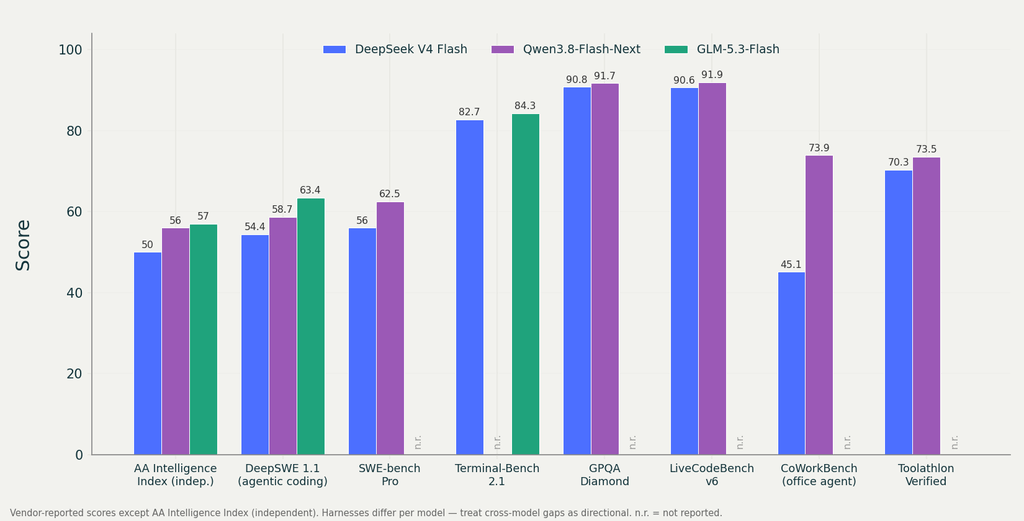
This is the table the original version of this article was missing. Scores are as published by each vendor’s model card unless marked [AA], which denotes Artificial Analysis’s independent measurement. Harnesses, temperatures, and context limits differ per vendor — treat cross-model gaps of a few points as directional, not definitive.
How to read this table: GLM-5.3-Flash posts the strongest agentic-coding number of the tier (DeepSWE 63.4, vs GLM-5.2’s 46.2) and the top independent intelligence score. Qwen3.8-Flash-Next sweeps the language, reasoning, and office-agent rows — its CoWorkBench 73.9 against DeepSeek’s 45.1 is the single largest gap in the table — and does it with only 6B active parameters.
DeepSeek V4 Flash leads on nothing in this table except the security/repo niches, but it is competitive almost everywhere and, as the next sections show, wins decisively on speed and cost.
| Benchmark | DeepSeek V4 Flash 0731 | Qwen3.8-Flash-Next | GLM-5.3-Flash |
|---|---|---|---|
| AA Intelligence Index (independent) | 50 | 56 | 57 |
| Terminal-Bench 2.1 (terminal agent) | 82.7 vendor / 79 [AA] | n.r. | 84.3 |
| DeepSWE 1.1 (agentic coding) | 54.4 | 58.7 | 63.4 |
| SWE-bench Pro (multilingual SWE) | 56.0 | 62.5 | n.r. |
| SWE-bench Multilingual | n.r. | 81.0 | n.r. |
| SWE-bench Verified | 79.0 (April card, Max) | n.r. | n.r. |
| LiveCodeBench v6 | 90.6 | 91.9 | n.r. |
| GPQA Diamond (reasoning) | 90.8 | 91.7 | n.r. |
| IFBench (instruction following) | 79.2 | 81.3 | n.r. |
| CoWorkBench (long-horizon office) | 45.1 | 73.9 | n.r. |
| JobBench (professional tasks) | 41.3 | 55.7 | n.r. |
| Toolathlon Verified (tool use) | 70.3 | 73.5 | n.r. |
| Cybergym (security agent) | 76.7 | n.r. | n.r. |
| NL2Repo (repo generation) | 54.2 | n.r. | n.r. |
| AutomationBench | 25.1 (public) | n.r. | 48.8 |
| OfficeQA Pro | n.r. | n.r. | 62.4 |
| Agents’ Last Exam (pass@1) | 25.2 | 24.3 (score 51.2) | n.r. |
| HLE (frontier reasoning) | 33.8 | 35.9 | 55.3* |
| AndroidWorld (mobile use) | — | 84.5 | n.r. |
| MathVision (visual math) | — | 95.7 (with code interp.) | n.r. |
| Z.ai Code Bench v1.0 (max) | n.r. | n.r. | 29.0 (Opus 4.8: 29.5) |
n.r. = not reported. *GLM’s HLE figure comes from a different, tool-augmented setup and is not comparable to the text-only runs of the other two.
Independent verification: Artificial Analysis
Vendor tables are marketing documents, so the independent column matters most. Artificial Analysis has measured all three models on its standardized harness:
| Metric (AA, first-party API) | DeepSeek V4 Flash 0731 (max) | Qwen3.8-Flash-Next | GLM-5.3-Flash |
|---|---|---|---|
| Intelligence Index | 50 | 56 | 57 |
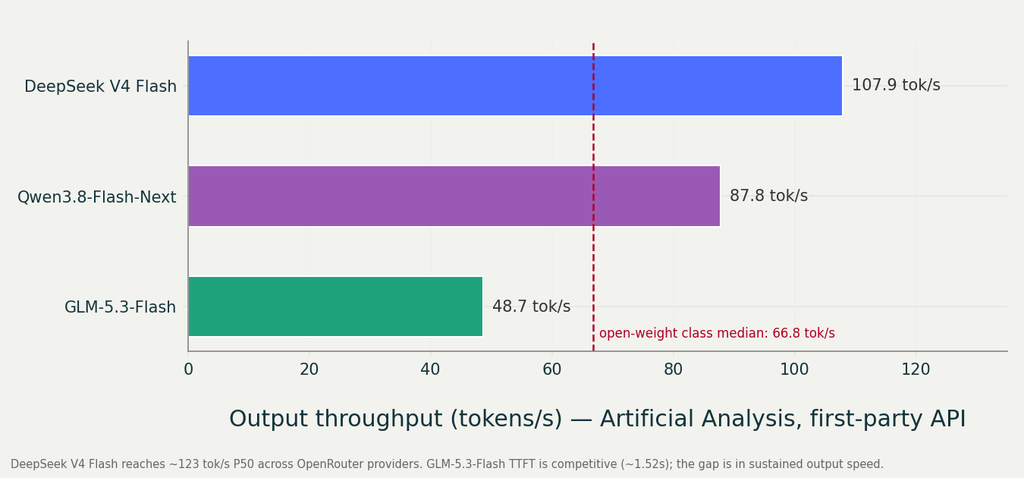
| Output speed | 107.9 tok/s | 87.8 tok/s | 48.7 tok/s |
| Time to first token | 1.50s | ~competitive | 1.52s |
| Tokens to complete the Index | ~206M (down from 234M in April) | n.r. | ~150M (class median: 110M) |
Reference points: the open-weight class median output speed is ~67 tok/s, and GLM-5.3-Flash’s 57 on the Intelligence Index lands just 3 points behind the full GLM-5.3 (60) at roughly one-tenth the token price. DeepSeek’s 0731 checkpoint gained +10 points on the Index over the April preview purely from re-done post-training — same 284B/13B architecture. DeepSeek also holds the #2 open-weight spot on AA’s GDPval v2 Elo (1559), behind Kimi K3 (1687).
Note the verbosity column: GLM-5.3-Flash burns ~150M tokens to finish the Index (36% above the class median) and generates them at half the median speed. That is the “cheap tokens, expensive minutes” effect — decisive for interactive use, irrelevant for overnight batch jobs.
Pricing Snapshot (per 1M tokens, September 2026)
| Model | Input | Cached input | Output | Blended (3:1 in:out) | Notes |
|---|---|---|---|---|---|
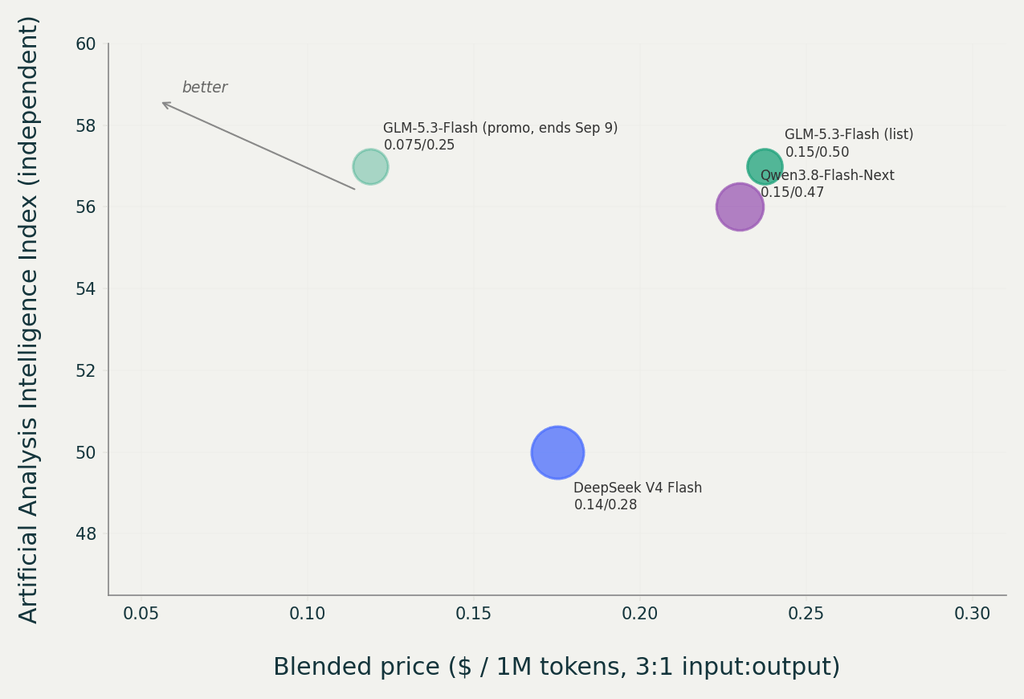
| DeepSeek V4 Flash | $0.14 | $0.0028 (~98% off) | $0.28 | ~$0.18 | OpenRouter providers from ~$0.03/$0.16; 2,500 concurrency limit (5× V4 Pro) |
| Qwen3.8-Flash-Next | $0.15 | varies by provider | $0.47 | ~$0.23 | Blended ~$0.23 measured; thinking tokens bill as output |
| GLM-5.3-Flash | $0.15 | $0.03 | $0.50 | ~$0.24 | 50% launch promo until Sep 9: $0.075/$0.25, cached $0.015 → blended ~$0.12 |
Cost per completed task tells the real story: on AA’s Intelligence Index, GLM-5.3-Flash runs about $0.09 per task at list price (~$0.045 on the promo tier) versus $0.68 for GLM-5.3 — and DeepSeek’s cost per task measured ~60% below GPT-5.6 Luna (max). One billing trap applies to all three: reasoning tokens are charged at output rates, so agentic workloads cost more than the headline input price suggests.
For detailed token math and tier comparisons, consult our model pricing benchmarks directory and see the GLM token pricing breakdown and Core plan savings to calculate operational break-even points under European Zero Data Retention.
Speed and Latency
The word “Flash” is doing different work in each name:
- DeepSeek V4 Flash — 107.9 tok/s on the first-party API, ~123 tok/s P50 across OpenRouter providers, 1.50s TTFT. The fastest of the tier by a wide margin, helped by DSpark speculative decoding.
- Qwen3.8-Flash-Next — 87.8 tok/s, comfortably above the ~67 tok/s class median. The best speed-per-intelligence point in the group.
- GLM-5.3-Flash — 48.7 tok/s despite a snappy 1.52s TTFT. Quick to start, slow to finish, and verbose on top. Fine for async pipelines; painful in interactive coding loops.
Why These Models Are So Efficient (Architecture Notes)
- Qwen3.8-Flash-Next is a public preview of the Qwen4 architecture: a 125B MoE paired with a 51B n-gram embedding layer (an idea borrowed from DeepSeek’s Engram paper) that acts as a cheap lookup memory, letting the model activate only ~6B parameters per token while matching 49B-active models on coding.
- GLM-5.3-Flash is the first GLM-5 model with hybrid attention (KDA linear layers interleaved with NoPE sparse MLA) plus IndexPool key compression: ~3× less attention compute and a 4.4× smaller KV cache than GLM-5.3 at million-token context. Trained on a 30T-token multimodal corpus; native FP8 weights (~306 GiB — self-hosting realistically requires an 8× Hopper-class node).
- DeepSeek V4 Flash 0731 changed no architecture at all — the entire +10 Intelligence Index jump came from re-running post-training (DeepSWE went 7.3 → 54.4 on identical weights). A reminder that in 2026, post-training is a release cycle.
Operational guidance by Use Case
Coding & code review — GLM leads agentic coding (DeepSWE 63.4, Terminal-Bench 84.3, within half a point of Opus 4.8 on Z.ai’s internal code bench). Qwen leads repository-level fixes (SWE-bench Pro 62.5, SWE-bench Multilingual 81.0). DeepSeek remains excellent value (SWE-bench Verified 79, Terminal-Bench 79 [AA]) at the lowest cost per token. Winner, agentic sessions: GLM. Winner, repo-scale fixes: Qwen. Winner, volume: DeepSeek.
Long-document analysis — All three reach ~1M tokens. GLM’s IndexPool was designed exactly for this; DeepSeek is proven at the extreme end; Qwen needs YaRN beyond 262K. Winner: GLM / DeepSeek tie.
Batch extraction & structured output — DeepSeek’s 108 tok/s + $0.0028 cached input is the default for high-volume pipelines (for GDPR compliance without China routing, deploy via the DeepSeek European sovereign API). Qwen (IFBench 81.3) and GLM are more accurate on complex schemas. Winner, volume: DeepSeek. Winner, accuracy: Qwen.
Multimodal / OCR / UI work — Only Qwen and GLM qualify natively. Qwen posts AndroidWorld 84.5 and MathVision 95.7; GLM takes image + video and powers Browser/Computer Use in ZCode, but trails Gemini 3.7 Flash on video benchmarks. Winner: Qwen for static visual tasks, GLM for video and agentic UI.
Interactive products (chat, pair-programming) — Throughput is the product here. DeepSeek or Qwen; GLM’s 49 tok/s will be felt by users. Winner: DeepSeek.
Overnight / async agentic jobs — GLM’s promo pricing (blended ~$0.12 until Sep 9) plus top agentic scores make it close to ideal. Winner: GLM.
Composite scores
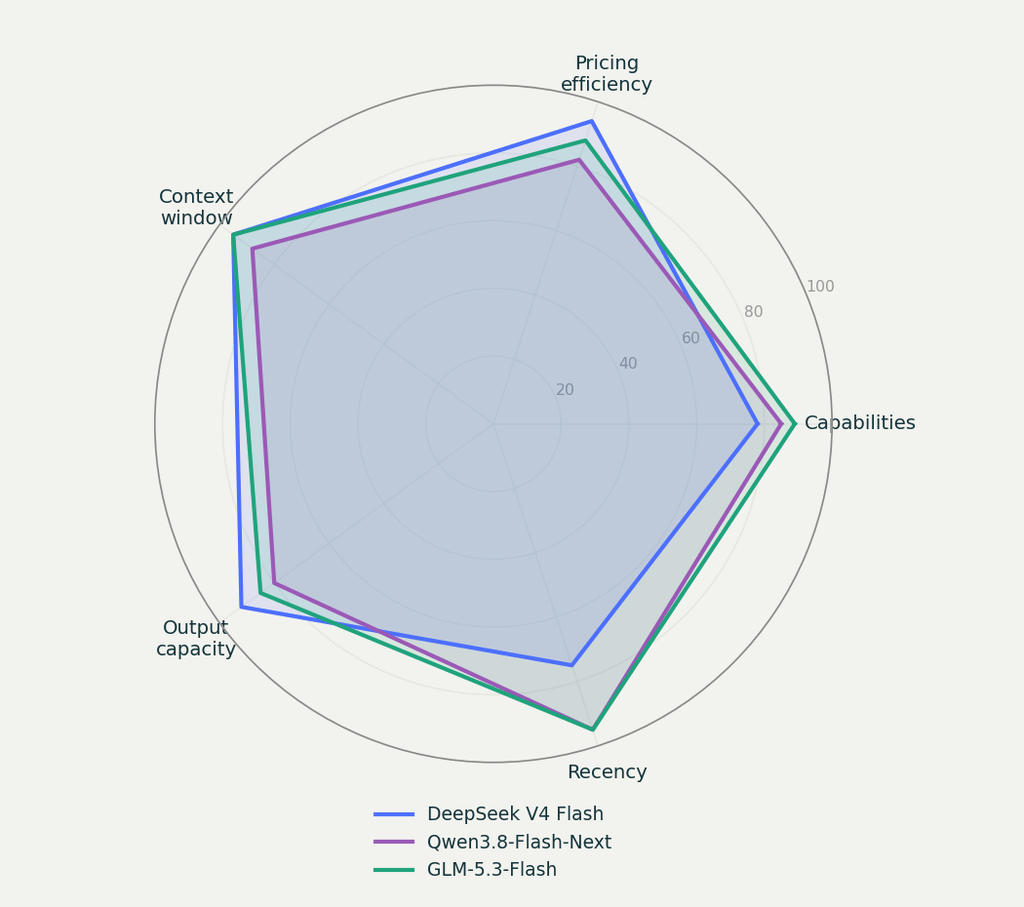
Normalized 0–100, combining the benchmark table above, AA independent data, pricing, context, output capacity, recency, and versatility:
| Metric | DeepSeek V4 Flash | Qwen3.8-Flash-Next | GLM-5.3-Flash |
|---|---|---|---|
| Capabilities | 78 | 85 | 89 |
| Pricing efficiency | 94 | 82 | 88 |
| Context window | 95 | 88 | 95 |
| Output capacity | 92 | 80 | 85 |
| Recency | 75 | 95 | 95 |
| Composite | 84 | 86 | 90 |
- GLM-5.3-Flash (90) — strongest composite claim
- Qwen3.8-Flash-Next (86) — best efficiency story, most complete language/agentic table
- DeepSeek V4 Flash (84) — volume and speed king
A Necessary Caveat on Vendor Numbers
Every non-AA figure above is self-reported, and reproducibility gaps are already documented: AA’s independent Terminal-Bench 2.1 run scored DeepSeek 79% versus the vendor’s 82.7, and an independent DeepSWE re-test of DeepSeek’s V4 Pro measured pass@1 far below the official table. Qwen reports the highest score across two harnesses (Claude Code and mini-SWE-agent) for DeepSWE. GLM’s HLE 55.3 uses a tool-augmented setup. None of this means the numbers are fake — it means you should replicate the two or three benchmarks that map to your workload before committing.
Run DeepSeek, Qwen, and GLM in Europe with Zero Data Retention
Get 600 Million tokens on the Regolo Core plan (€39/mo flat, ~€0.065/1M). Switch endpoints in 1 line of code with full OpenAI SDK compatibility on 100% green datacenters.
Practical recommendation
- Best overall quality-to-price, especially async/agentic → GLM-5.3-Flash. Top independent intelligence (57), top agentic coding (DeepSWE 63.4), MIT weights, and promo pricing until Sep 9. Accept the 49 tok/s.
- Best speed + cost at volume → DeepSeek V4 Flash. 108+ tok/s, $0.14/$0.28 with near-free cache hits, 2,500 concurrency. The high-throughput default.
- Best balance and best architecture bet → Qwen3.8-Flash-Next. 6B active parameters delivering 56 on the AA Index, the strongest language/office-agent table, native multimodal, 88 tok/s.
The right engineering answer is routing, not loyalty: send simple high-volume traffic to the cheapest capable endpoint (usually DeepSeek), escalate agentic and multimodal work to GLM or Qwen, and re-run your own eval set every few weeks — this tier now moves on a monthly cadence.
FAQ
Which Flash model has the best quality-to-price in September 2026?
GLM-5.3-Flash for async and agentic workloads (AA Index 57 at ~$0.09/task list, ~$0.045 on promo). DeepSeek V4 Flash for sustained high-volume text. Qwen3.8-Flash-Next for the best all-round balance.
Is GLM-5.3-Flash actually fast?
No. Despite the name it generates ~49 output tokens/s — below the 67 tok/s class median and about half the flagship GLM-5.3’s speed — though its 1.52s time-to-first-token is competitive. Use it for batch, not interactive loops.
How long does the GLM-5.3-Flash promo last?
The 50% launch discount ($0.075 input / $0.25 output per 1M tokens) runs until September 9, 2026 on Z.ai’s API; some third-party gateways run parallel promos.
Can I self-host these models?
All three ship open weights. GLM-5.3-Flash needs ~306 GiB (FP8) and Hopper-or-newer GPUs for the current vLLM path. DeepSeek’s official recipe targets a 4× GB300 node. Qwen3.8-Flash-Next has an official FP8 variant, and community quantizations run on a single desktop (≈11 tok/s at 2-bit CPU, up to ~52 tok/s with GPU offload) — usable for evals, not production.
Which model is best for agentic coding?
On published numbers: GLM-5.3-Flash (DeepSWE 63.4, Terminal-Bench 84.3) for long agentic sessions; Qwen3.8-Flash-Next (SWE-bench Pro 62.5) for repository-level fixes; DeepSeek V4 Flash for cost-effective volume (SWE-bench Verified 79).
Should I trust vendor benchmark tables?
Directionally, yes; literally, no. Independent re-runs show gaps of ~4 points (Terminal-Bench) and occasionally more. Reproduce the benchmarks that match your workload on your own harness before locking a routing decision.
Ship Private AI. Not Infrastructure.
You have the private AI App architecture, bow give it an inference layer built for production.
Regolo gives European teams fast, OpenAI-compatible access to Mistral, Llama, Qwen, DeepSeek, GLM, and more — with zero data retention, EU data residency, and no new SDK to learn.
Change your base_url. Keep your LangChain code. Start shipping.
🚀 Start your 30-day free trial →
Build, test, and deploy with no infrastructure to maintain.
No credit card. No migration project. No compromise on data control.
💬 Join the Regolo Discord →
Meet builders working on private RAG, local LLMs, LangChain, Ollama, and production AI systems. Share your setup, get feedback from the community, and speak directly with the Regolo team.
🤝 Talk to an AI Infrastructure Engineer →
Running a sensitive workload, scaling beyond a proof of concept, or assessing a managed EU inference provider? Get a tailored architecture and commercial proposal for your team.
📂 Clone the GitHub repository →
Get the full implementation from this guide: ingestion scripts, ChromaDB setup, hybrid retrieval, the 30-Question RAG Floor, evaluation examples, and deployment configuration.
Private AI should not require a private data center.
Regolo gives your team an EU-native path from local experimentation to production-grade inference.
Build with Regolo
- Discord: Join the community →
- GitHub: Explore open-source workflows →
- X / Twitter: Follow @regolo_ai →
- Reddit: Join the community →
- Documentation: Read the API docs →
- Contact: Talk to the team →
Built with ❤️ by the Regolo team. Questions? regolo.ai/contact or chat with us on Discord