

As of 2 August 2026, the EU AI Act is no longer a future planning exercise. The European Commission’s AI Office and national market surveillance authorities across all 27 member states now hold active enforcement powers — they can request technical documentation, evaluate models, order corrective measures, and issue fines.
For CTOs, this changes the conversation: AI Act compliance is not only a legal question. It is an architecture, vendor, and governance question — and much of it is decided at the infrastructure layer.
This guide explains what “EU AI Act compliance” actually means when your organization builds, operates, or buys AI infrastructure.
The regulation in brief
The AI Act (Regulation (EU) 2024/1689) is the world’s first comprehensive legal framework for artificial intelligence.
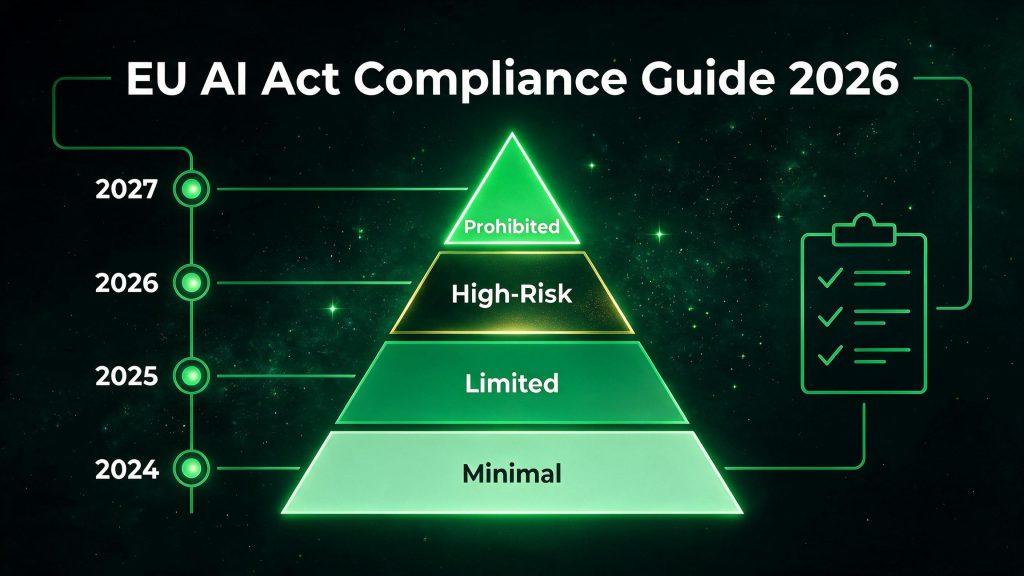
It entered into force on 1 August 2024 and follows a risk-based approach with four tiers:
- Unacceptable risk — nine prohibited practices (social scoring, emotion recognition in workplaces and education, untargeted facial-recognition scraping, and, from December 2026, AI “nudification” apps). Banned outright since 2 February 2025.
- High risk — systems in areas like employment, credit scoring, education, biometrics, critical infrastructure, law enforcement, and migration. Subject to strict obligations before market placement.
- Transparency risk — chatbots, generative AI, deepfakes: disclosure and labeling duties under Article 50, enforceable since 2 August 2026.
- Minimal risk — the vast majority of AI systems; no new rules.
Critically, the Act does not regulate “infrastructure” as an abstract category. It regulates roles in a value chain: providers of AI systems, providers of general-purpose AI (GPAI) models, and deployers. Your compliance posture depends on which role you occupy — and infrastructure decisions often determine that role.
The 2026 timeline: what actually applies now
The Digital Omnibus (Regulation (EU) 2026/1744, in force 27 July 2026) reshuffled the calendar days before the main application date; the most common misreading in the market right now is “the AI Act was delayed.” It was not — only the high-risk tier moved.
| Obligation | Status |
|---|---|
| Prohibited practices (Art. 5) + AI literacy (Art. 4) | In force since 2 Feb 2025 |
| GPAI model obligations (Art. 51–56) | In force since 2 Aug 2025 |
| Enforcement powers (AI Office + national authorities), penalty framework | Active since 2 Aug 2026 |
| Article 50 transparency (chatbot disclosure, AI-content marking, deepfake labels) | Enforceable since 2 Aug 2026 |
| Machine-readable watermarking for pre-existing systems | Grace period to 2 Dec 2026 |
| Legacy GPAI models (on market before Aug 2025) | Full compliance by 2 Aug 2027 |
| High-risk systems, Annex III (employment, credit, education, critical infrastructure…) | From 2 Dec 2027 |
| High-risk systems embedded in regulated products, Annex I | From 2 Aug 2028 |
Two things stand out for technology leaders: first, GPAI obligations have been law for a year — what arrived in August 2026 is the enforcement toolkit: information requests, model access, and recall powers. Second, the high-risk delay to December 2027 is an extension of time, not a relaxation — the underlying requirements (conformity assessments, risk management, data governance, human oversight) are materially unchanged.
Who you are: provider, deployer, or accidental provider
The single most important classification exercise for a CTO is mapping your systems to AI Act roles — because the role can shift without anyone noticing.
A company that integrates a third-party model via API is typically a deployer, with comparatively light duties: use systems per instructions, ensure human oversight, monitor operation, retain logs under your control. But a deployer is requalified as a provider — inheriting the full regime of documentation, conformity, and enforcement exposure — when it:
- Fine-tunes or substantially modifies a model on its own data
- White-labels or rebrands an AI system under its own name or trademark
- Changes the system’s intended purpose
This happens constantly and quietly: a bank fine-tunes a commercial model on customer interactions; a software company embeds a third-party model and sells it under its own brand. Each is a candidate for requalification, and in most organizations nobody has asked the question.
If your infrastructure roadmap includes fine-tuning pipelines or white-labeled AI features, this is an hour with counsel before a letter arrives — not after.
What compliance means at the infrastructure layer
For companies that operate AI infrastructure — model hosting, inference platforms, GPU cloud, MLOps tooling — the Act’s obligations translate into concrete engineering and operational capabilities.
GPAI model obligations
Providers of general-purpose models must maintain technical documentation for the AI Office, provide information to downstream providers, comply with EU copyright law, and publish a public summary of training data. If you host or serve open-weight models, understanding where you sit relative to these duties is essential — the Commission’s July 2025 guidelines clarify scope along the value chain.digital-strategy.
Systemic risk and physical infrastructure
Models trained above 10²⁵ FLOPs are presumed to pose systemic risk, triggering additional duties: notification to the AI Office, model evaluations including documented adversarial testing, systemic risk assessment and mitigation, serious incident reporting, and — notably — “an adequate level of cybersecurity protection for the model and its physical infrastructure“. This is the one place the Act explicitly names infrastructure: datacenter security, model-weight protection, and theft/misuse prevention are statutory obligations for systemic-risk providers, not best practices.
Logging and traceability
High-risk systems require automatic event logging and record retention so results can be traced — a requirement that lands directly on your observability stack. Deployers must retain logs under their control; providers must enable post-market monitoring and serious-incident reporting.
Vendor selection as a compliance surface
From August 2026, the Commission can demand information and, in extreme cases, pull non-compliant models from the EU market. If a vendor’s model leaves the market, every product built on it inherits the disruption. Procurement contracts should now allocate provider/deployer roles explicitly, warrant that outputs are marked per Article 50(2), commit suppliers to documentation access and inspection cooperation, and flow obligations down the supply chain.
Transparency plumbing
Article 50 duties — perceivable chatbot disclosure, machine-readable marking of generated content, deepfake labeling — are enforceable now, and enforcement sits with national market surveillance authorities.
For infrastructure teams, the operational question is pipeline integrity: machine-readable marking must survive export, editing, and publishing workflows, and any system placed on the market after 2 August 2026 needs it from day one.
High-risk systems: start the 2027 work now
The December 2027 deadline for Annex III high-risk systems feels distant. It is not. Providers of high-risk systems must establish risk and quality management systems, prepare technical documentation demonstrating conformity, retain automatically generated logs, register in the EU database, ensure human oversight, and guarantee accuracy, robustness, and cybersecurity; deployers in finance, insurance, and public services must additionally run fundamental rights impact assessments.digital-strategy.
These workstreams carry lead times of six to twelve months — and the AI system inventory required for December 2027 is precisely the inventory a supervisory authority can ask to see today, since a regulator’s first move is typically a documentation request, not a dawn raid. The harmonized technical standards that high-risk compliance depends on are expected in late 2026, which makes the coming quarters the right window to build against them.
Penalties and enforcement
The Article 99 penalty framework is now fully operative:
- Up to €35M or 7% of global annual turnover for prohibited practices
- Up to €15M or 3% for GPAI, transparency, and most other violations
- A lower tier for inaccurate or misleading information supplied to authorities
For SMEs and startups, the lower of the two caps applies — a proportionality mechanism, not an exemption. Enforcement is deliberately decentralized: the AI Office polices GPAI models centrally, while national authorities handle Article 50 and systems already in force, meaning enforcement intensity will vary by country.
In Italy, operational supervision sits with ACN (the National Cybersecurity Agency) and AgID as notifying authority, under Law No. 132/2025.
The bottom line
EU AI Act compliance for AI infrastructure is not a certification you buy — it’s an operating posture: the Act asks whether your organization knows what AI it runs, what role it plays for each system, whether its models and pipelines can produce documentation, logs, and disclosures on demand, and whether someone is accountable for all of it. The infrastructure choices you make this year — which models you host, how you log and secure them, which vendors you bet on — are compliance decisions, whether or not legal is in the room.
Ship Private AI. Not Infrastructure.
You have the private AI App architecture, bow give it an inference layer built for production.
Regolo gives European teams fast, OpenAI-compatible access to Mistral, Llama, Qwen, DeepSeek, GLM, and more — with zero data retention, EU data residency, and no new SDK to learn.
Change your base_url. Keep your LangChain code. Start shipping.
🚀 Start your 30-day free trial →
Build, test, and deploy with no infrastructure to maintain.
No credit card. No migration project. No compromise on data control.
💬 Join the Regolo Discord →
Meet builders working on private RAG, local LLMs, LangChain, Ollama, and production AI systems. Share your setup, get feedback from the community, and speak directly with the Regolo team.
🤝 Talk to an AI Infrastructure Engineer →
Running a sensitive workload, scaling beyond a proof of concept, or assessing a managed EU inference provider? Get a tailored architecture and commercial proposal for your team.
📂 Clone the GitHub repository →
Get the full implementation from this guide: ingestion scripts, ChromaDB setup, hybrid retrieval, the 30-Question RAG Floor, evaluation examples, and deployment configuration.
Private AI should not require a private data center.
Regolo gives your team an EU-native path from local experimentation to production-grade inference.
Build with Regolo
- Discord: Join the community →
- GitHub: Explore open-source workflows →
- X / Twitter: Follow @regolo_ai →
- Reddit: Join the community →
- Documentation: Read the API docs →
- Contact: Talk to the team →
Built with ❤️ by the Regolo team. Questions? regolo.ai/contact or chat with us on Discord