

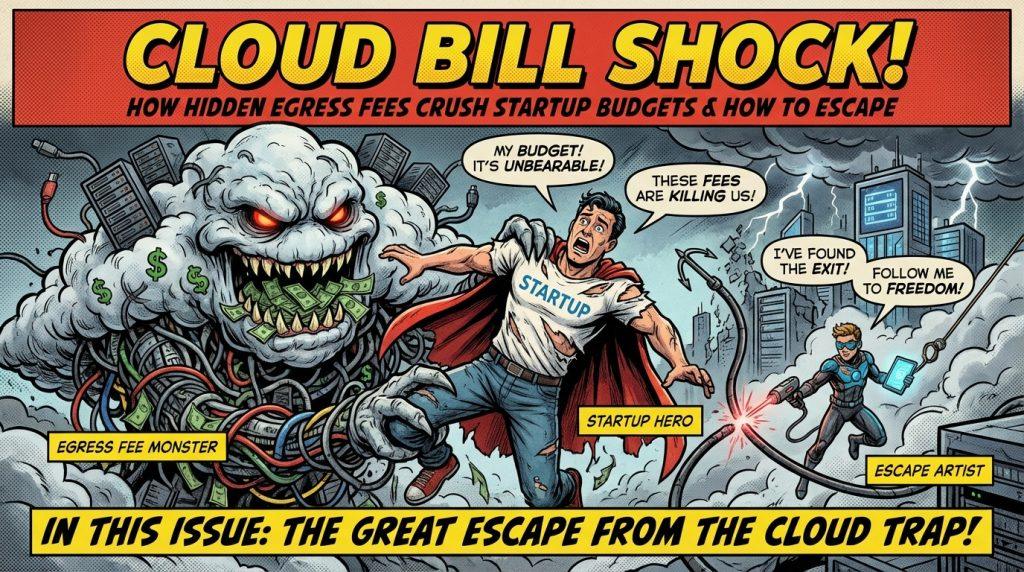
Your AI feature goes viral. Traffic spikes. Users love it. Then your AWS invoice arrives — $47,000 for one month, with $18,000 labeled simply as “data transfer.”
Welcome to Cloud Bill Shock: the silent margin killer that 42% of businesses using hyperscalers cannot predict, and that 28% have already experienced as an unexpectedly large charge with no warning.
This guide walks you through exactly why it happens, what it costs you, and how token-based transparent billing — the model Regolo is built on — is the structural antidote to hyperscaler opacity.
Part 1: Understanding the Anatomy of Cloud Bill Shock
Why “Pay for What You Use” Is Misleading
Hyperscalers — AWS, Azure, Google Cloud — market themselves with a deceptively simple promise: consumption-based pricing. The reality is a labyrinth of 100+ services, each with:
- Tiered rate structures that change at usage thresholds
- Regional pricing variations that few teams track
- Dependency costs — networking, egress, cross-AZ traffic — that only surface on the invoice, never in the estimator
The result? When 42% of businesses cannot predict their monthly cloud bill, the problem isn’t user error. It’s a systemic failure of pricing transparency.
Consider what happened to one startup: their Google Cloud translation API usage spiked unexpectedly, resulting in a $450,000 invoice. The dispute process yielded just $50,000 in credits. The damage — to cash flow, team morale, and investor confidence — was largely irreversible.
Part 2: The Three Hidden Cost Layers
Layer 1 — The Egress Trap
Data egress means moving data out of the cloud. It’s where hyperscalers extract maximum margin, because ingress (data going in) is nearly free — by design. Getting your data back out is where the tax hits.
2025 Egress Pricing Reality:
| Provider | Internet Egress Rate | Free Tier | Cross-AZ/Region Gotchas |
|---|---|---|---|
| AWS | $0.09/GB | 100 GB/month | $0.01–$0.02/GB cross-AZ |
| Azure | $0.087/GB (first 5 TB) | 100 GB/month | Zone-to-zone traffic billed |
| GCP | $0.12/GB (first 1 TB) | 5 GB/month | Variable inter-region |
Run the numbers for a typical AI workload:
- 50 TB transferred monthly to end users → ~$4,300/month in egress fees alone on AWS
- 10 TB replicated daily across regions → ~$150,000 annually in inter-region transfer costs
These aren’t theoretical projections. They’re real invoices hitting startup finance teams every month.
The structural trap is intentional: hyperscalers incentivize data ingress while making egress punishingly expensive. This discourages multi-cloud strategies and workload migration — locking you into an ecosystem that gets more expensive the more you grow.
Layer 2 — Premium Networking as a Hidden Tax on Reliability
Want a high-availability architecture? You’ll pay a networking tax to build it.
AWS charges $0.01–$0.02 per GB for cross-availability-zone traffic within the same region. Build a standard HA setup with 1 TB of monthly internal traffic, and you’re paying an invisible $10–$20/month surcharge just for the privilege of redundancy — a fee Azure and GCP generally waive.
For AI startups serving inference from multiple regions, these fees compound exponentially with scale. Cloud spending now consumes 6–11% of revenue for most SaaS companies — directly compressing the margins that determine your valuation multiple.
Layer 3 — The Idle Compute Tax
Perhaps the most frustrating layer: you pay for silence.
Reserved instances, warm GPU pools, and always-on inference nodes rack up charges even when your models process zero requests. In the AI era — where workloads require up to 100× more compute than previous-generation applications — idle time isn’t an edge case. It’s a budget leak running 24/7.
When your inference traffic spikes from 10K to 1M requests overnight, your egress fees scale proportionally. And if you’ve provisioned infrastructure for peak load, you’re also paying full-rate for idle capacity during every quiet hour in between.
Part 3: The Shift Toward Token-Based, Transparent Billing
What “Pay for What You Actually Use” Really Looks Like
Startups are demanding a new model: inference-optimized providers with transparent, token-based billing. This trend has seen 112% growth in search interest over the last 30 days — reflecting a fundamental rejection of the egress-fee paradigm.
Token-based pricing eliminates idle compute costs entirely by charging only for actual inference activity — input tokens in, output tokens out. No warm GPU nodes billing by the hour. No egress calculations. No cross-AZ surprises. Your cost is a direct, predictable function of your actual AI workload.
Traditional Hyperscalers vs. Token-Based Inference:
| Feature | Traditional Hyperscalers | Token-Based Inference (Regolo) |
|---|---|---|
| Billing Model | Per-hour + egress + networking | Per input/output token |
| GPU Idle Costs | Full hourly rate regardless | €0 when idle |
| Data Egress | $0.08–$0.12/GB | Included — no line item |
| Predictability | 42% cannot predict bills | Usage directly correlates to cost |
| Plan Flexibility | Reserved instance lock-in | Pay-as-you-go or flat plans |
Part 4: Regolo’s Pricing — Concrete Numbers, Zero Surprises
Regolo operates on a simple principle: you only pay for what you really use, billed in tokens, with no hidden infrastructure taxes underneath.
Two Plans, One Question: How Predictable Do You Need to Be?
For Companies That Need Stable, Budgetable Pricing
Regolo’s flat plans are built for consistent, high-volume workloads where finance teams need a fixed monthly number:
| Plan | Tokens per Day | Monthly Price |
|---|---|---|
| Core Plan | 20 million tokens | €39/month |
| Boost Plan | 50 million tokens | €89/month |
Both plans give you access to any model in the catalog. If you exceed your daily quota, overage is automatically billed at pay-as-you-go rates — so you’re never blocked, and you’re never surprised by a hard cutoff mid-deployment.
Consider: At €39/month for 20 million tokens daily, a startup running 10 million inference requests monthly at 100 tokens per request is looking at less than €40/month for the compute layer — before even applying the 70% introductory discount (more on that below).
For Developer Teams Who Value Flexibility
If your usage is uneven, experimental, or scaling rapidly, Regolo’s pay-as-you-go model gives you granular control through a real-time dashboard. You pay per million tokens, with rates varying by model:
LLM Models:
| Model | Input (per 1M tokens) | Output (per 1M tokens) |
|---|---|---|
| deepseek-r1-70b | €0.60 | €2.70 |
| Llama-3.3-70B-Instruct | €0.60 | €2.70 |
| mistral-small3.2 | €0.50 | €2.20 |
| qwen3-30b | €0.50 | €1.80 |
| qwen3-coder-30b | €0.50 | €2.00 |
| qwen3-vl-32b | €0.50 | €2.50 |
| gpt-oss-120b | €1.00 | €4.20 |
| gemma-3-27b-it | €0.95 | €5.50 |
| Llama-3.1-8B-Instruct | €0.05 | €0.25 |
| Qwen3-8B | €0.07 | €0.35 |
| maestrale-chat-v0.4-beta | €0.05 | €0.25 |
Embeddings, Audio, Vision & Reranking:
| Model | Pricing |
|---|---|
| gte-Qwen2 / Qwen3-Embedding-8B | €0.05 input / €0.25 output per 1M tokens |
| faster-whisper-large-v3 | €0.00015 per second |
| Qwen-Image (generation) | €0.0005 per million pixels (~€0.0005 per 1024×1024 image) |
| Qwen3-Reranker-4B | €0.01 per query |
The 70% Introductory Discount: Start at a Fraction of the Cost
New accounts receive a 70% discount across all models for the first three months. For teams evaluating Regolo against their current hyperscaler bill, this effectively means:
- Llama-3.3-70B inference: €0.18 input / €0.81 output per million tokens for 90 days
- Qwen3-30B: €0.15 input / €0.54 output per million tokens for 90 days
Proceed with confidence: this is the right moment to run a parallel benchmark between your current infrastructure cost and Regolo’s token-based pricing — with almost no financial risk during the evaluation period.
Part 5: A Real-World Cost Comparison
The Scenario
Consider an AI startup processing 10 million inference requests monthly, averaging 100 tokens per request (1 billion tokens total), running on Llama-3.3-70B-Instruct. Compare what this looks like on AWS versus Regolo:
| Cost Component | AWS (Traditional) | Regolo (Pay-as-You-Go) |
|---|---|---|
| GPU Compute (Inference) | ~$3,200/month | ~€600/month (600M input + 400M output tokens) |
| Data Egress | ~$180/month | €0 — included |
| Cross-AZ Networking | ~$80/month | €0 |
| Idle GPU Time | ~$1,500/month | €0 — token-based billing |
| TOTAL | ~$4,960/month | ~€600/month |
Savings: ~88% — and that’s before applying the introductory 70% discount, which would bring the Regolo cost to approximately €180/month for the first three months.
Take note: the gap isn’t primarily from cheaper GPU hours. It comes from eliminating three entire cost categories — egress, networking, and idle time — that simply don’t exist in a token-based model.
Part 6: How to Escape the Egress Trap
Proceed with this four-step plan to audit your current exposure and begin transitioning to predictable infrastructure.
Step 1 — Audit Your Current Egress Costs
Before you can fix the problem, you need to see it clearly.
Dirigiti verso cloud cost management tools such as nOps or CloudOptimo to:
- Tag all resources by workload type
- Separate egress costs from compute costs on your current invoices
- Identify the top three data transfer line items by volume
Take note: most teams discover that egress and networking costs represent 20–40% of their total bill — buried in line items that never surfaced in their initial pricing estimates.
Step 2 — Benchmark Against Token-Based Pricing
With your current token volumes in hand, run a direct comparison:
- Calculate your average monthly input and output token count
- Match against the Regolo model tier that fits your use case
- Factor in the 70% introductory discount for a realistic 90-day projection
This exercise typically takes under an hour and produces a number your finance team can act on immediately.
Step 3 — Migrate AI Workloads to Token-Based Inference
Direct your highest-egress workloads — model inference, output delivery, embedding generation — away from provisioned GPU instances and onto token-based platforms.
What to verify in a provider before migrating:
- Per-token billing with no hourly baseline charges
- Explicit egress policy (included vs. billed separately)
- Real-time usage dashboard for monitoring consumption
- GDPR compliance and data residency guarantees for European workloads
Step 4 — Set Hard Budget Limits Now
Until you complete your migration, protect yourself with strict controls:
- Set billing alerts at 50%, 75%, and 90% of your monthly budget cap
- Apply hard resource quotas per workload
- Enable cost anomaly detection in your current cloud provider’s settings — it exists but is often disabled by default
The $450K GCP bill scenario described earlier could have been limited to a few thousand dollars with proper quotas in place. No retroactive discount negotiation required.
Frequently Asked Questions
How does Regolo billing work?
Regolo offers two options: flat-rate plans (Core at €39/month for 20M daily tokens; Boost at €89/month for 50M daily tokens) and a pay-as-you-go model billed per million input and output tokens. Overage on flat plans is automatically billed at pay-as-you-go rates.
Are there minimum payments or contract commitments?
No minimum payment amount and no commitment required. You use it as needed. The pay-as-you-go model is specifically designed for teams that need flexibility without lock-in.
Is there a discount for new accounts?
Yes — Regolo offers a 70% discount on all models for the first three months. For extensive or enterprise-scale use, the sales team can tailor a custom solution.
Is multi-cloud cheaper for reducing egress?
It can reduce exposure, but hyperscalers discourage migration through high egress costs — the “Cloud Hotel California” effect: cheap to enter, expensive to leave. Token-based providers with transparent pricing offer a cleaner structural exit.
🚀 Start your free 30-day trial at regolo.ai and deploy LLMs with complete privacy by design.
👉 Talk with our Engineers or Start your 30 days free →
- Regolo Discord – Share your thoughts
- GitHub Repo – Code of blog articles ready to start
- Follow Us on X @regolo_ai
- Open discussion on our Subreddit Community
🚀 Ready to scale?
Built with ❤️ by the Regolo team. Questions? support@regolo.ai or chat with us on Discord