
Thinking Machines Lab has released Inkling, its first foundation model trained from scratch and designed for developers who need more control than a closed API can offer. The model combines open weights, multimodal inputs, long-context processing, and configurable reasoning effort in a package aimed at specialized AI applications.
Inkling is not positioned as a universal replacement for every frontier model – instead, it is built for teams that want to fine-tune behavior, manage inference costs, and build agentic systems around a model they can inspect and adapt.
Table of Contents
- What Inkling Is
- Model Architecture
- Multimodal Capabilities
- Controllable Thinking Effort
- Performance and Benchmarks
- Practical Use Cases
- Safety and Limitations
- FAQ
What Inkling Is
Inkling is a general-purpose multimodal artificial intelligence model developed by Thinking Machines Lab, the company founded by former OpenAI chief technology officer Mira Murati.
It can process text, images, and audio, while producing text as its primary output format. The model contains 975 billion total parameters, although only 41 billion parameters are activated for each inference step. This design allows Inkling to retain the knowledge capacity of a very large model without requiring every component to run for every token.
Inkling is intended to become a customizable foundation for AI agents, coding tools, enterprise assistants, retrieval-augmented generation systems, and multimodal workflows.
Model Architecture
Inkling uses a Mixture-of-Experts architecture, commonly referred to as MoE. Instead of routing every token through the same dense neural network, the model sends each token to a smaller group of specialized experts.
The architecture contains 256 routed experts and two shared experts within each MoE feed-forward layer. For every token, Inkling activates six routed experts alongside the two shared experts, which explains why its active parameter count is far lower than its total parameter count.
This approach improves computational efficiency while preserving broad model capacity. In plain terms, Inkling does not need to wake up all 975 billion parameters whenever it answers a question.
The model has 66 decoder-only transformer layers and combines local sliding-window attention with global attention layers. That mixture is designed to reduce the cost of processing long contexts while retaining the ability to reason across distant parts of an input.
Inkling also supports a context window of up to one million tokens. This is large enough to analyze long technical documents, software repositories, legal archives, large codebases, research collections, or extensive conversation histories.
Multimodal Capabilities
Inkling accepts text, image, and audio inputs in the same model pipeline. This makes it suitable for workflows where information is spread across written material, screenshots, charts, photographs, voice recordings, and structured tool outputs.
Images are processed through a hierarchical patch encoder before entering the shared token representation used by the language model. Audio is converted into discrete representations that can be analyzed alongside text and visual information.
The model can transcribe speech, follow spoken instructions, answer questions about recordings, and reason over longer audio files. It can also inspect visual material, including diagrams, documents, charts, and interface screenshots.
For image processing, supported inputs generally range from 40 to 4,096 pixels in size. Audio files are expected to use 16 kHz WAV formatting and are generally limited to roughly 20 minutes.
Video appeared in Inkling’s pretraining material, but direct production support is focused on text, images, and audio. That distinction matters because many multimodal model announcements blur the line between training data and actual user-facing input support.
Controllable Thinking Effort
Inkling’s most distinctive feature is controllable thinking effort. Developers can adjust how much reasoning budget the model should use for a particular task, allowing them to trade off speed, cost, and answer quality.
A lower setting can be useful for simple tasks such as classification, routing, extraction, or short customer-support replies. Higher settings are better suited to complicated coding tasks, multi-step reasoning, tool use, and difficult planning problems.
The adjustable effort range runs from 0.2 to 0.99, with user-facing options that can be expressed through labels such as minimal, low, medium, high, and maximum. The feature is designed to give application builders a practical control over token use rather than treating model behavior as fixed.
This matters in production. A company does not need the same amount of reasoning for every request, and using maximum compute for trivial tasks is an expensive mistake.
A support system, for example, could use low effort to classify incoming requests and retrieve relevant documentation. It could then escalate only difficult cases involving code, policy interpretation, or complex troubleshooting to a higher reasoning setting.
I would still test this carefully before relying on it in an autonomous workflow. Lower reasoning settings can save money, but they may also introduce failures that become expensive when the task involves financial decisions, code changes, or customer-facing actions.
Performance and Benchmarks
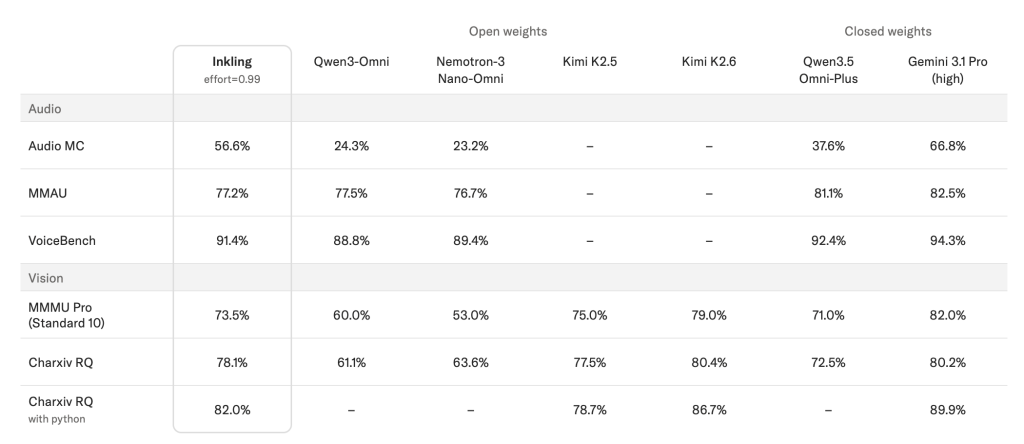
Thinkingmachines: Audio and vision benchmarks against specialist omni models (open- and closed-weight), reported at effort=0.99.
At its highest reported reasoning setting, Inkling achieved strong results across mathematics, science, coding, multimodal understanding, and audio benchmarks. Its reported score on AIME 2026 was 97.1%, while it achieved 87.2% on GPQA Diamond.
On software-engineering evaluations, Inkling reached 77.6% on SWE-bench Verified and 63.8% on Terminal Bench 2.1. Those scores suggest that the model is designed not only for static question answering but also for agentic workflows involving tools, terminals, and code repositories.
| Benchmark | Reported Score | Primary Focus |
|---|---|---|
| AIME 2026 | 97.1% | Mathematical reasoning |
| GPQA Diamond | 87.2% | Graduate-level science |
| SWE-bench Verified | 77.6% | Software engineering |
| Terminal Bench 2.1 | 63.8% | Terminal-based agents |
| MMMU Pro | 73.5% | Multimodal reasoning |
| VoiceBench | 91.4% | Spoken-language understanding |
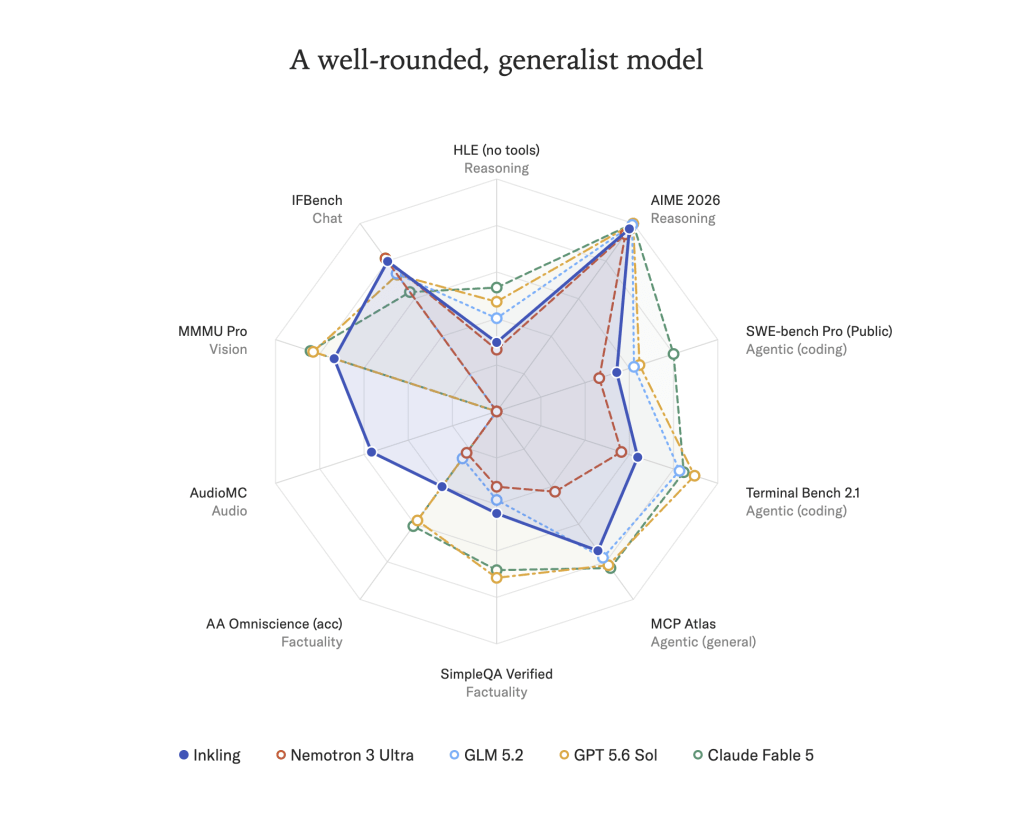
Inkling performs competitively against other open-weight systems, especially across multimodal tasks and configurable reasoning workloads. Yet it does not dominate every benchmark, and competitors outperform it in some coding, factuality, and general reasoning evaluations.
Well, not exactly—benchmark tables are useful, but they are not final judgments. Agentic scores can vary significantly depending on tools, prompts, sampling settings, time limits, and the evaluation harness used by researchers.
Practical Use Cases
Inkling is well suited to organizations building specialized AI systems rather than generic chatbots. Its strongest potential lies in multimodal workflows where text alone is not enough.
A software company could use Inkling to analyze bug reports, source code, terminal logs, screenshots, product documentation, and customer recordings inside a single agentic workflow. A financial-services organization could combine policy documents, scanned forms, call transcripts, and internal tools to support human reviewers.
The model may also be useful for research assistants that need to process long documents, coding agents that interact with development environments, customer-support systems that understand voice interactions, and retrieval-augmented applications that need to reason across several information formats.
The one-million-token context window could be particularly valuable for large enterprise archives. But context size alone does not guarantee reliable recall, reasoning, or factual accuracy across an enormous prompt. I would treat long-context capability as a tool to evaluate, not a promise to accept without testing.
Inkling was evaluated on Design Arena’s Agentic Web Dev leaderboard, where blinded human evaluators compare generated web apps head to head. It ranks among the strongest open-weights models.
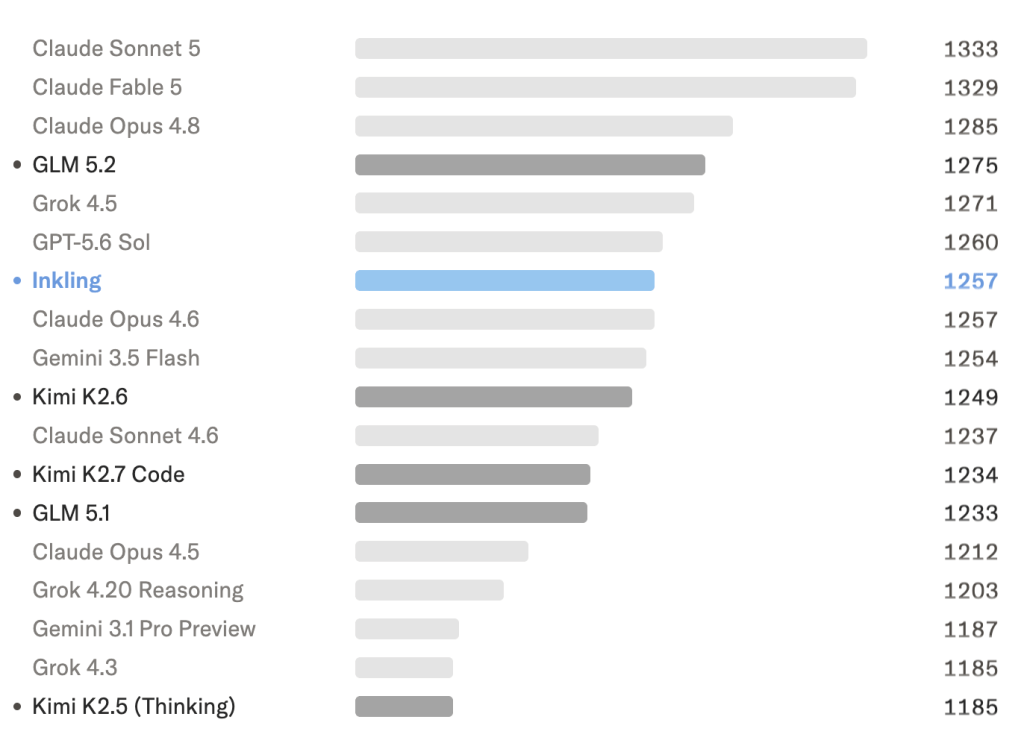
ThinkingMachine: Inkling’s position on Design Arena’s Agentic Web Dev leaderboard, a blinded human evaluation of generated apps. Dots refer to open-weights models.
Safety and Limitations
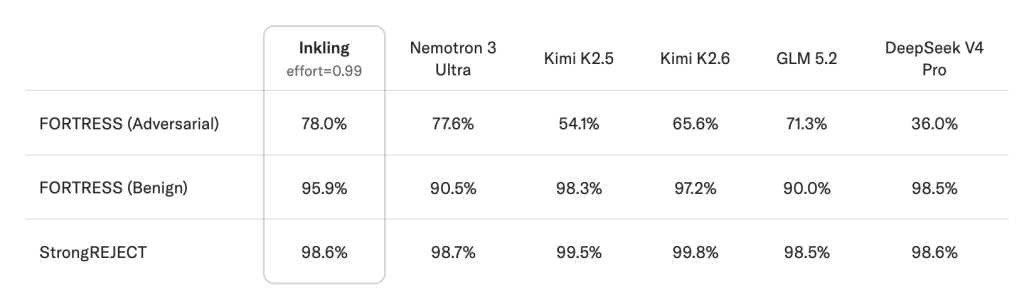
Thinking Machines Lab identifies several limitations that developers should address before deploying Inkling in sensitive environments. Like other large language models, it can hallucinate, misunderstand instructions, reflect biases present in training data, and produce inconsistent results during extended multi-turn interactions.
The model may also struggle with uncommon languages, narrow professional domains, ambiguous instructions, and adversarial prompting. These risks are especially relevant when Inkling is connected to tools, databases, external systems, or autonomous decision-making processes.
High-stakes applications should include human review, access controls, audit trails, output filtering, monitoring, and task-specific validation. This is especially important in healthcare, legal services, finance, cybersecurity, and safety-critical operations.
Resources
- Inkling Website: https://huggingface.co/thinkingmachines/Inkling
- Hugging Face: https://huggingface.co/thinkingmachines/Inkling
FAQ
Is Inkling fully open source?
Inkling is released with open weights under the Apache 2.0 license, allowing developers to download, fine-tune, modify, and integrate the model into their own products.
Can Inkling generate images or audio?
Inkling can process text, images, and audio as inputs, but it generates text rather than images, speech, or video as outputs.
What does 41B active parameters mean?
Inkling contains 975 billion parameters in total, but its Mixture-of-Experts router activates only about 41 billion parameters during each inference step.
Does Inkling support long documents?
Yes. Inkling supports a context window of up to one million tokens, making it suitable for large document collections, codebases, transcripts, and long-running AI workflows.
Is Inkling easy to run locally?
No. Its full checkpoint requires approximately 2 TB of GPU memory, while a quantized version still requires around 600 GB of aggregate GPU memory.
Who should use Inkling?
Inkling is most relevant for developers, researchers, and enterprises that need a customizable multimodal model for agents, coding tools, long-context analysis, support automation, and retrieval-augmented generation systems.
Start your free 30-day trial at regolo.ai and deploy LLMs with complete privacy by design. If need help you can always reach out our team on Discord 🤙
👉 Talk with our Engineers or Start your 30 days free →
- Discord – Share your thoughts
- GitHub Repo – Code of blog articles ready to start
- Follow Us on X @regolo_ai
- Open discussion on our Subreddit Community
Built with ❤️ by the Regolo team. Questions? regolo.ai/contact or chat with us on Discord