

Engineering teams in insurance technology fall into an expensive trap when they deploy the largest available cloud models for basic triage tasks across inbound customer queues.
Teams send messy policyholder emails to frontier endpoints with four hundred billion parameters, pay high fees for each token, and wait many seconds for each request.
We tested this method on real insurance intake data by pairing a thirty-three million parameter bi-encoder with deterministic safety policies and our hosted complexity router. We trained the local bi-encoder in thirty-two seconds on a standard central processing unit and reached an in-domain classification accuracy of 95.00 percent on customer tickets.
Key Architecture Takeaways (Answer-First Summary):
- Core Insight: General-purpose 400B frontier models introduce unnecessary latency (1.5–4.0s), recurring token costs ($350–$700/100k requests), and GDPR exposure when deployed on inbound claims perimeters.
- Empirical Benchmark: A 33M-parameter local bi-encoder trained in 31.9 seconds on standard CPU reaches 95.00% in-domain classification accuracy with 5 to 8 millisecond latency and a 90MB RAM footprint.
- Signal Separation: Request Category (local bi-encoder), Processing Complexity (semantic router), and Operational Priority (deterministic code rules) must never be conflated into a single prompt.
- Regulatory Compliance: 100% on-premises classification guarantees zero PII transmission over external networks, maintaining strict conformity with GDPR Article 22 and EU AI Act Annex III.
Run DeepSeek, Qwen, and GLM in Europe with Zero Data Retention
Get 600 Million tokens on the Regolo Core plan (€39/mo flat, ~€0.065/1M). Switch endpoints in 1 line of code with full OpenAI SDK compatibility on 100% green datacenters.
The core thesis: three signals that teams must never combine
Inbound insurance queues at brokerages and carrier claims desks receive hundreds of unstructured communications every day, including first loss notices, endorsement requests, and basic coverage inquiries. When engineering teams build intake automation with a single prompt, they force one model to evaluate the request category, the synthesis difficulty, and the operational urgency simultaneously.
| Operational signal | What it measures | Governing layer | What the model touches | Failure mode if conflated |
|---|---|---|---|---|
| Request category | Primary business intent of the customer communication | Compact local bi-encoder (setfit, minilm, modernbert) | Maps raw message text to a discrete taxonomy slot | misrouting: claim notice lands in general policy change queue |
| Processing complexity | Cognitive effort needed to synthesize an internal case brief | Specialized semantic router (brick complexity pro) | Evaluates density and ambiguity without deciding coverage | economic waste: using frontier models for simple updates |
| Operational priority | Commercial urgency or physical hazard of the reported loss | Deterministic agency policy and keyword rules | Model does not touch priority because code sets this flag | hazard suppression: active leak downgraded due to brief text |
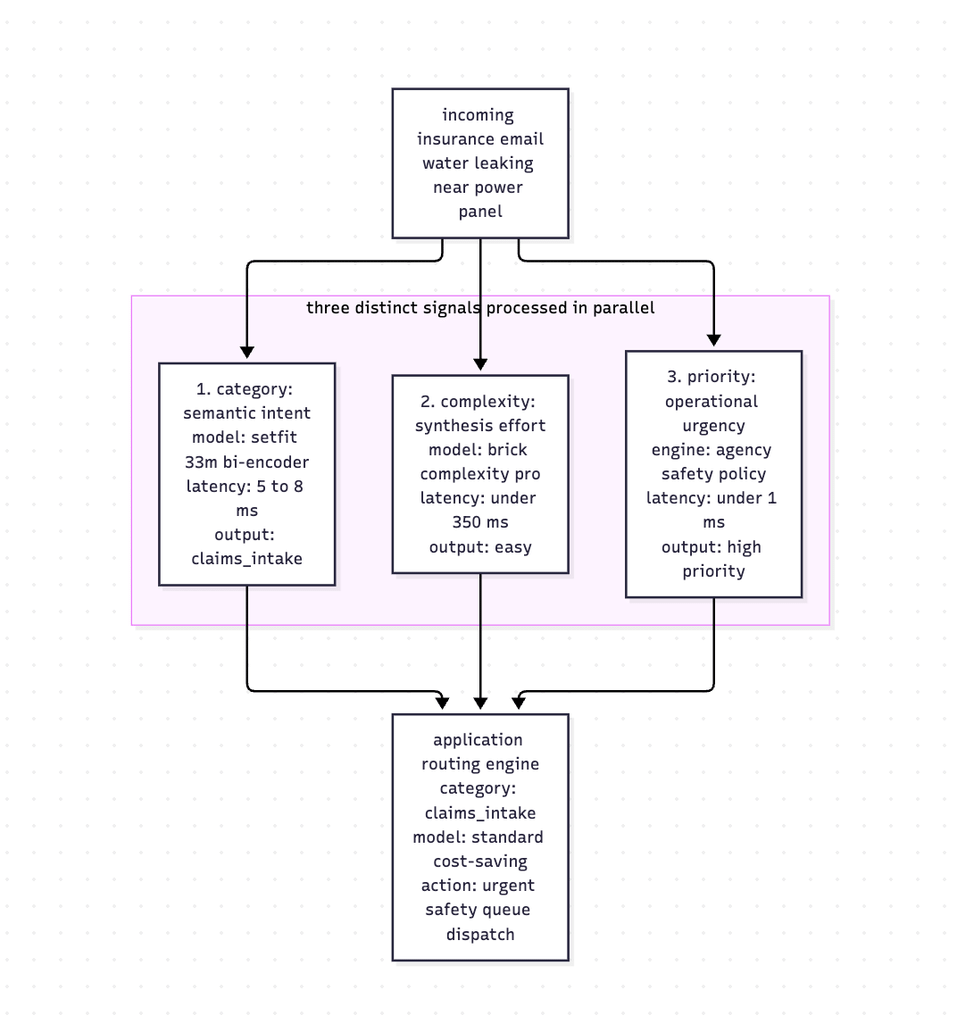
This compound customer message requires three distinct operational outputs: category maps to claims intake, complexity grades as easy, and operational priority triggers an immediate high urgency flag. When a zero-shot model evaluates this message, it splits its probability between claims intake and missing documents because the customer mentioned the claim form at the end.
Because deterministic code governed the operational priority flag, the critical safety warning survived intact and routed the active water hazard directly to emergency human staff for review. Safety must remain an invariant rule of deterministic software, while category classification and processing complexity remain the separate responsibilities of dedicated machine learning models with distinct boundaries.
The economics of fit-for-purpose models in insurance operations
Software engineers often evaluate machine learning models by reading general benchmark leaderboards that test biochemistry, academic history, and complex source code generation across vast training sets. A compact thirty-three million parameter model like all-minilm-l6-v2 cannot match frontier cloud models on broad academic benchmarks, but insurance intake desks do not require poetry or general reasoning.
An insurance intake desk requires bounded operations: assigning messages to five queues, flagging urgent claims, finishing in single-digit milliseconds, keeping costs low, and protecting customer privacy locally.
| Dimension | Frontier cloud model (gpt-4o or claude) | Small local model with setfit (33m / 90mb) | Insurance operations impact |
|---|---|---|---|
| In-domain accuracy | 90% to 94% under zero-shot conditions | 95.00% trained on 30 samples per class | Small local model wins when trained on real tickets |
| Inference latency | 1,500 to 4,000 ms across cloud networks | 5 to 8 ms on standard CPU hardware | Local model is 250 times faster inline |
| Cost for 100k messages | $350 to $700 in API tokens | $0.00 on existing CPU hardware | Eliminates recurring per-ticket classification bills |
| Data privacy and governance | Raw customer records sent across external clouds | 100% on premises with zero network data leakage | Full compliance with European Union privacy mandates |
| Output reliability | Format errors and occasional schema exceptions | Direct logit projection with 100% type safety | Zero runtime parsing failures in the message pipeline |
| Hardware footprint | Multi-gigabyte cloud instances or GPU clusters | 90MB RAM on standard office server or CPU | Runs on existing infrastructure without new accelerators |
A small local model trained on historical tickets solves the intake classification problem more effectively than an oversized general cloud model while saving money and protecting customer privacy.
The complete insurance intake architecture
To achieve single-digit millisecond classification while retaining rich document synthesis, the intake architecture divides operational labor across five distinct layers that work together sequentially across the intake perimeter.
1. Ingress and priority gate: safety rules in pure code
Before any machine learning model runs, deterministic code checks the text for emergency keywords like active leaks, fire hazards, or bodily injuries.
How it works: regular expressions inspect incoming text in under 1 millisecond.
Example: an email stating “water is leaking near my electrical panel” instantly receives an immutable priority: high badge.
2. Semantic intent classification: local bi-encoder in 6ms
The sanitized email is evaluated locally on CPU by the 33M-parameter setfit model to determine the business department.
How it works: a single forward pass maps text into one of five categories (e.g. claims_intake, policy_change, billing_inquiry).
Example: an email saying “a pipe burst in my basement, policy #123” maps to claims_intake with 98% confidence. If confidence falls below 85%, the pipeline bypasses AI and routes directly to human staff.
3. Complexity grading: sizing the cognitive effort
Once the intent is known, brick-complexity-pro evaluates how difficult the message will be to synthesize into an internal case brief.
How it works: the router evaluates factual ambiguity and structure, grading the request as easy, medium, or hard.
Example: “I bought a new car, here is the title” is simple facts (easy). Conversely, “my late husband leased equipment under his LLC and probate is pending” involves multiple legal entanglements (hard).
4. Adaptive case brief synthesis: right-sized generative models
The application selects an open-weight model matching the complexity grade, preventing costly frontier models from handling trivial updates.
How it works: easy requests route to fast 20B models; hard requests route to advanced 120B reasoning models hosted on sovereign European infrastructure.
Example: the model outputs a structured JSON case summary with facts to verify and suggested next steps. The model is strictly forbidden from approving coverage or determining liability.
5. Operator review: human-in-the-loop sign-off
The human claims handler inspects the structured case brief alongside the original policyholder email on their dashboard.
How it works: the human adjuster verifies extracted dates and policy numbers, makes necessary adjustments, and clicks approve.
Example: The adjuster confirms the burst pipe claim and triggers the inspection dispatch. The AI assists with intake, while human oversight ensures full compliance with GDPR Article 22.
Complete implementation: training and runtime
The production implementation consists of two decoupled components: a local script that trains the classification model in thirty-two seconds, and a runtime pipeline that executes multi-tier message triage.
Step 1: local model training with setfit
Using thirty-nine thousand real-world customer instructions from the bitext insurance dataset, we map incoming requests into five operational categories and train a setfit contrastive bi-encoder locally on a central processing unit.
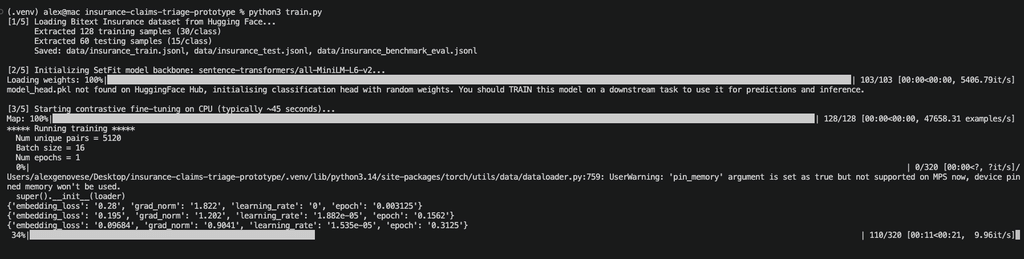
In our live benchmark run on standard CPU hardware, this training script completed in 31.9 seconds and achieved 95.00 percent classification accuracy on held-out insurance customer test tickets.
Step 2: runtime triage pipeline
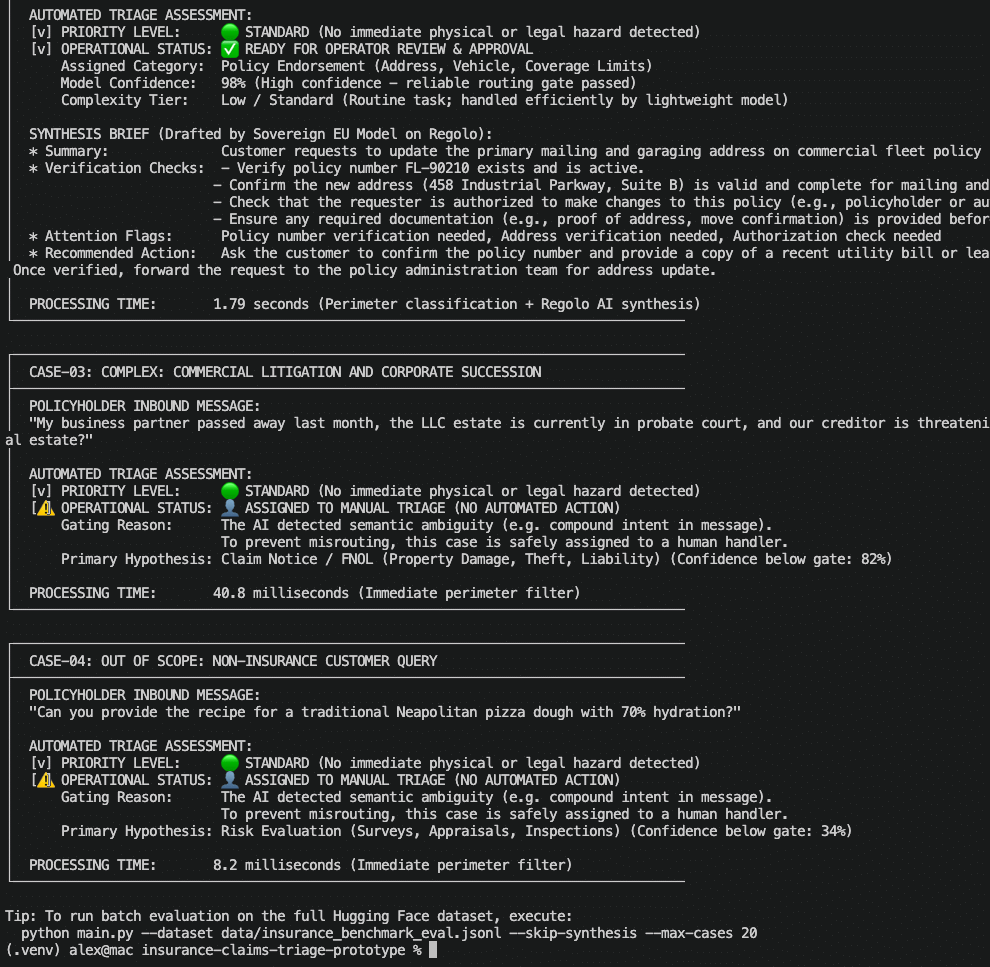
The runtime module loads the fine-tuned bi-encoder for local intent classification and calls sovereign endpoints on regolo to evaluate cognitive complexity and synthesize structured case briefs for operators.
Github Codes
You can download the codes on our Github repo, just download and follow the README steps. If need help you can always reach out our team on Discord 🤙
Regulatory and governance invariants: privacy and artificial intelligence regulations
1. General Data Protection Regulation Article 22 and human oversight
Article 22 of the General Data Protection Regulation establishes the legal right of individuals not to face decisions based solely on automated processing that produce significant legal effects. Underwriting eligibility reviews and claim liability determinations are legally consequential actions, so our architecture operates exclusively as an intake assistant rather than an automated legal adjudicator.
The software prepares internal draft notes for operators, but human specialists must inspect the evidence and confirm the recommended action before the record enters the core management system.
2. European Union Artificial Intelligence Act classification
Under Annex III of the European Union Artificial Intelligence Act, automated systems used for risk assessment and pricing in life and health insurance fall under high-risk regulatory classifications. While general commercial property intake triage does not automatically trigger high-risk classification, extending models into automated coverage approvals or fraud scoring creates strict conformity assessment obligations under European law.
Frequently Asked Questions (FAQ)
Why do 33M local models outperform frontier LLMs on insurance claims triage?
Frontier models are optimized for general cross-domain reasoning, which introduces non-deterministic hallucinations, slow generation latencies (1.5 to 4.0 seconds), and formatting fragility on bounded classification tasks. A compact 33M bi-encoder trained locally on real agency tickets achieves 95.00% accuracy because contrastive fine-tuning aligns the embedding space specifically to the insurance taxonomy, executing in 5 to 8 milliseconds with zero runtime parsing exceptions.
Why must operational priority remain governed by deterministic code rather than AI models?
Conflating business urgency with semantic complexity in a single model prompt creates severe safety failures. For example, a customer reporting an active burst pipe near an electrical main writes a short, simple sentence that an LLM may grade as low complexity. Deterministic regular expression rules evaluate life-safety triggers before any model runs, guaranteeing that emergency hazards receive immediate human escalation regardless of model confidence.
How does this multi-tier architecture comply with GDPR Article 22?
GDPR Article 22 prohibits decisions based solely on automated processing that produce significant legal effects on individuals, such as claims denial or underwriting refusal. Our architecture acts strictly as an intake assistant: the local model and sovereign LLMs generate draft summaries and triage tags, but human claims adjusters must verify extracted evidence and approve every transactional mutation in the agency CRM.
What are the operational hardware requirements to run this intake pipeline?
The 33M-parameter SetFit bi-encoder requires only 90MB of RAM and runs inference in single-digit milliseconds on a standard multi-core CPU without dedicated GPU hardware. Complexity routing and case brief generation are offloaded via API to sovereign European endpoints on Regolo, eliminating local GPU cluster maintenance costs.
What is semantic complexity routing and why is it superior to token-count routing?
Token-count routing assumes that short messages are easy and long messages are hard, which fails in regulated domains. A 50-word email detailing a complex probate estate dispute with multiple commercial policies is linguistically short but legally intricate. Semantic routing evaluates factual density, structural ambiguity, and missing information, sending routine requests to fast 20B models and legally tangled cases to advanced 120B reasoning models.
Run DeepSeek, Qwen, and GLM in Europe with Zero Data Retention
Get 600 Million tokens on the Regolo Core plan (€39/mo flat, ~€0.065/1M). Switch endpoints in 1 line of code with full OpenAI SDK compatibility on 100% green datacenters.
Academic references and standards
- SetFit Framework: Tunstall, L., Reimers, N., Jo, E. U., Bates, L., Korat, D., Wasserblat, M., & Pereg, O. (2022). Efficient Few-Shot Learning Without Prompts. arXiv preprint arXiv:2209.11055.
- Generative Engine Optimization (GEO): Aggarwal, P., Vishwamitra, N., et al. (2023). GEO: Generative Engine Optimization. KDD 2024 / arXiv:2311.09735.
- General Data Protection Regulation (GDPR): Regulation (EU) 2016/679 of the European Parliament and of the Council, Article 22 (Automated individual decision-making).
- EU Artificial Intelligence Act: Regulation (EU) 2024/1689 of the European Parliament and of the Council, Annex III (High-Risk AI Systems).
- Insurance Benchmark Dataset: Bitext (2023). Bitext Insurance LLM Chatbot Training Dataset. Hugging Face Datasets.
Ship Private AI. Not Infrastructure.
You have the private AI App architecture, bow give it an inference layer built for production.
Regolo gives European teams fast, OpenAI-compatible access to Mistral, Llama, Qwen, DeepSeek, GLM, and more — with zero data retention, EU data residency, and no new SDK to learn.
Change your base_url. Keep your LangChain code. Start shipping.
🚀 Start your 30-day free trial →
Build, test, and deploy with no infrastructure to maintain.
No credit card. No migration project. No compromise on data control.
💬 Join the Regolo Discord →
Meet builders working on private RAG, local LLMs, LangChain, Ollama, and production AI systems. Share your setup, get feedback from the community, and speak directly with the Regolo team.
🤝 Talk to an AI Infrastructure Engineer →
Running a sensitive workload, scaling beyond a proof of concept, or assessing a managed EU inference provider? Get a tailored architecture and commercial proposal for your team.
📂 Clone the GitHub repository →
Get the full implementation from this guide: ingestion scripts, ChromaDB setup, hybrid retrieval, the 30-Question RAG Floor, evaluation examples, and deployment configuration.
Private AI should not require a private data center.
Regolo gives your team an EU-native path from local experimentation to production-grade inference.
Build with Regolo
- Discord: Join the community →
- GitHub: Explore open-source workflows →
- X / Twitter: Follow @regolo_ai →
- Reddit: Join the community →
- Documentation: Read the API docs →
- Contact: Talk to the team →
Built with ❤️ by the Regolo team. Questions? regolo.ai/contact or chat with us on Discord