

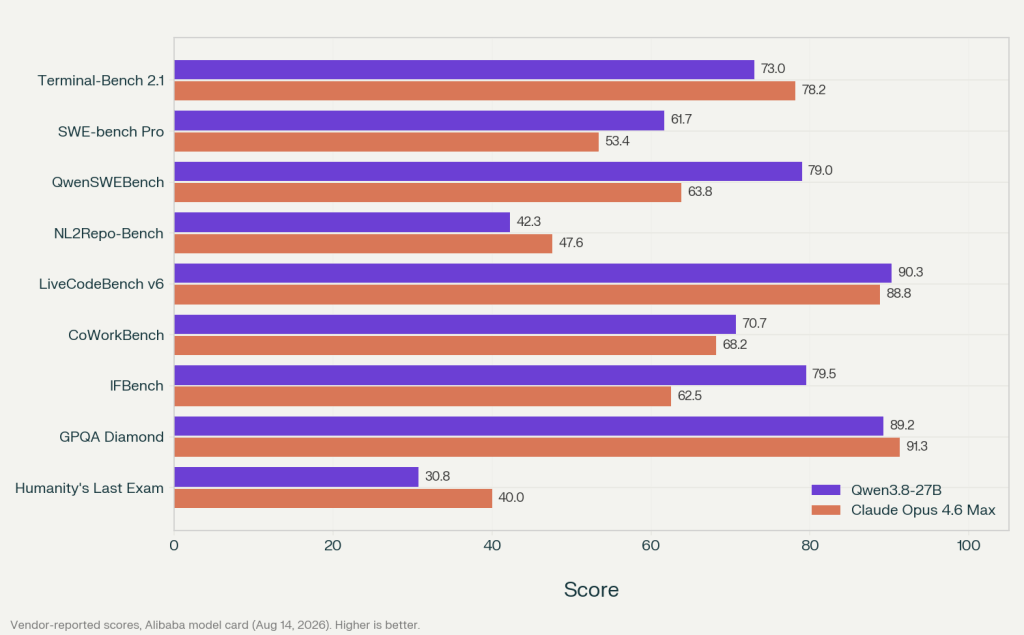
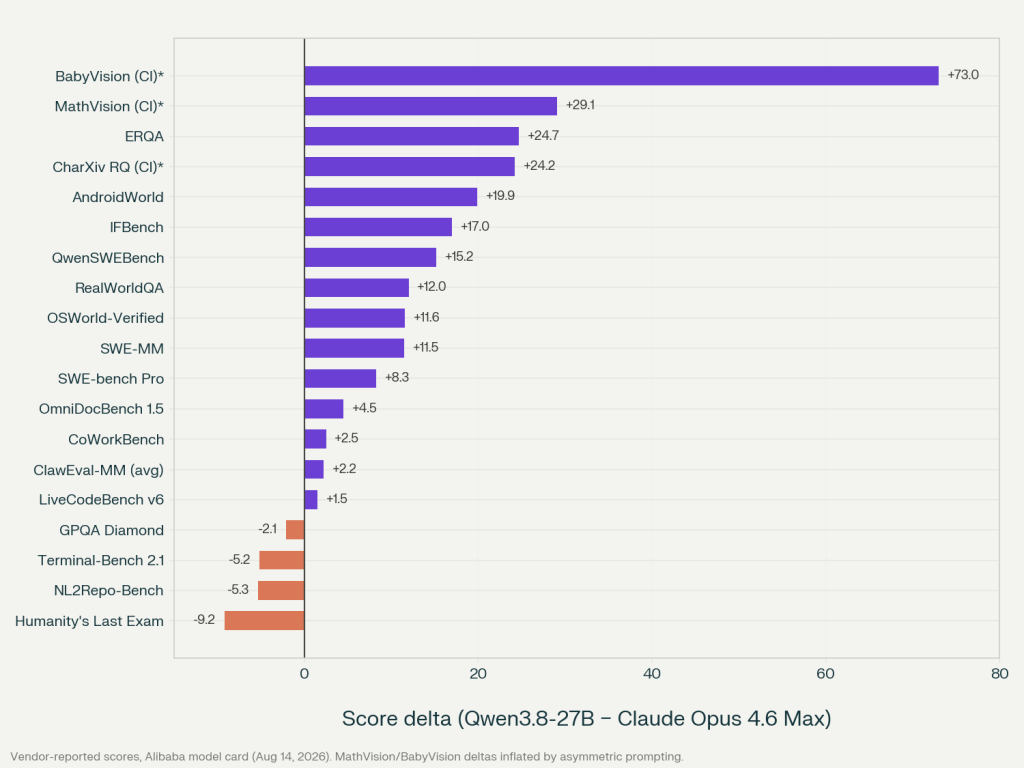
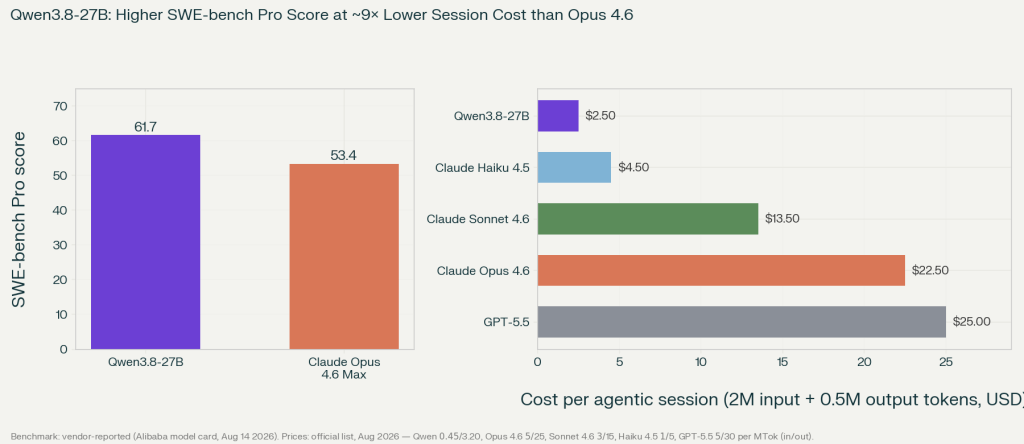
Qwen3.8-27B outperforms Claude Opus 4.6 Max on 16 of the 24 benchmarks in its official model card, with its largest wins in agentic coding (SWE-bench Pro: 61.7 vs 53.4), instruction following (IFBench: 79.5 vs 62.5), and computer use (OSWorld-Verified: 84.3 vs 72.7). It still loses on pure knowledge reasoning, including Humanity’s Last Exam (30.8 vs 40.0). All figures are vendor-reported by Alibaba as of the August 14, 2026 release.
TL;DR — Key Takeaways
- Qwen3.8-27B is a dense 27-billion-parameter open-weight model (Apache 2.0) released by Alibaba on August 14, 2026, with a native 262,144-token context window and image/video input.
- It beats Claude Opus 4.6 Max on agentic work: software engineering, office tasks, instruction following, desktop and mobile control.
- It loses to Opus 4.6 Max on knowledge-heavy reasoning: GPQA Diamond, Humanity’s Last Exam, and Terminal-Bench 2.1.
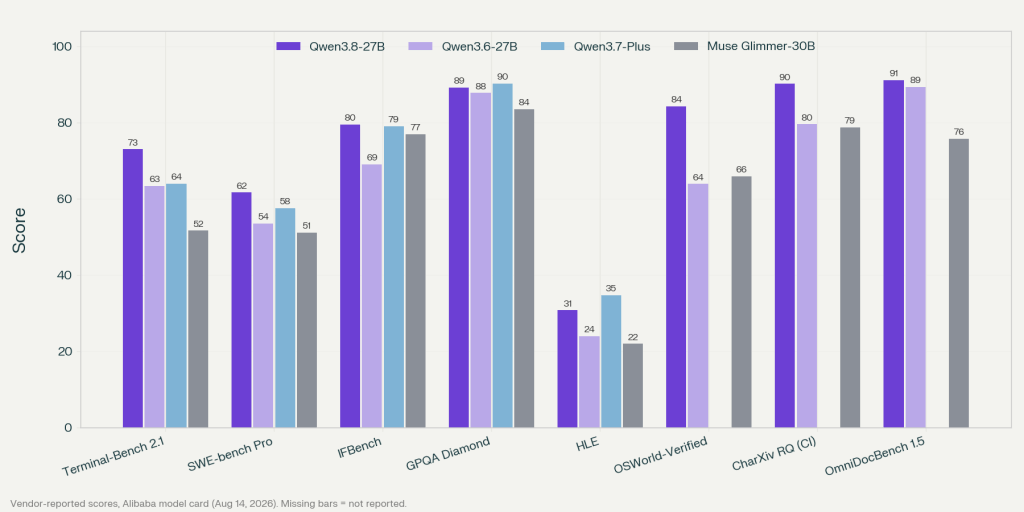
- Against Muse Glimmer-30B, the other open-weight comparator, Qwen3.8-27B wins every overlapping benchmark row.
- Every number is self-reported by Alibaba; no independent reproduction existed at launch. Treat the table as a ceiling, not a floor.
Run Qwen3.8-27B via sovereign API with 262K native context
Save 93.2% vs Alibaba Cloud Model Studio rates with the Regolo Core plan (€39/month for 600M tokens). Guaranteed Zero Data Retention in RAM and GDPR compliance on European green datacenters.
What Is Qwen3.8-27B?
Qwen3.8-27B is a dense, open-weight vision-language model released by Alibaba’s Qwen team on August 14, 2026, under the Apache 2.0 license. It has 27 billion parameters (28 billion including the vision encoder), a hybrid architecture of 48 Gated DeltaNet linear-attention layers and 16 full-attention layers, and a native context window of 262,144 tokens, extensible to 1 million with YaRN. It accepts text, images, and video as input and runs on a single 24 GB GPU at 4-bit quantization.
For direct head-to-head metrics against other frontier open weights, see our GLM-5.2 vs Qwen3.8-27B official comparison and examine how both models pair on European infrastructure.
Which Benchmarks Does Qwen3.8-27B Win Against Claude Opus 4.6 Max?
Agentic coding and knowledge work
| Benchmark | Qwen3.8-27B | Opus 4.6 Max | What it measures in practice | Why it matters |
|---|---|---|---|---|
| SWE-bench Pro | 61.7 | 53.4 | Resolving real GitHub issues end-to-end (harder “Pro” split) | Strongest single signal for autonomous coding agents on real codebases |
| QwenSWEBench | 79.0 | 63.8 | Qwen’s in-house agentic software engineering suite (3-run mean, 8-hour timeout) | Directional only — vendor-designed test |
| CoWorkBench | 70.7 | 68.2 | Long-horizon, multi-domain office tasks (in-house) | Proxy for multi-step office automation |
| IFBench | 79.5 | 62.5 | Instruction following: obeying precise constraints and formats | Widest text-side gap; critical for reliable structured output in production |
| LiveCodeBench v6 | 90.3 | 88.8 | Fresh competitive-programming problems, contamination-resistant | Measures reasoning on unseen code, not memorization |
| DeepSWE 1.1 | 42.2 | not reported | Agentic coding in long sessions (Claude Code harness, 256K context) | A win by absence — weight it lightly |
Computer use and vision
| Benchmark | Qwen3.8-27B | Opus 4.6 Max | What it measures in practice | Why it matters |
|---|---|---|---|---|
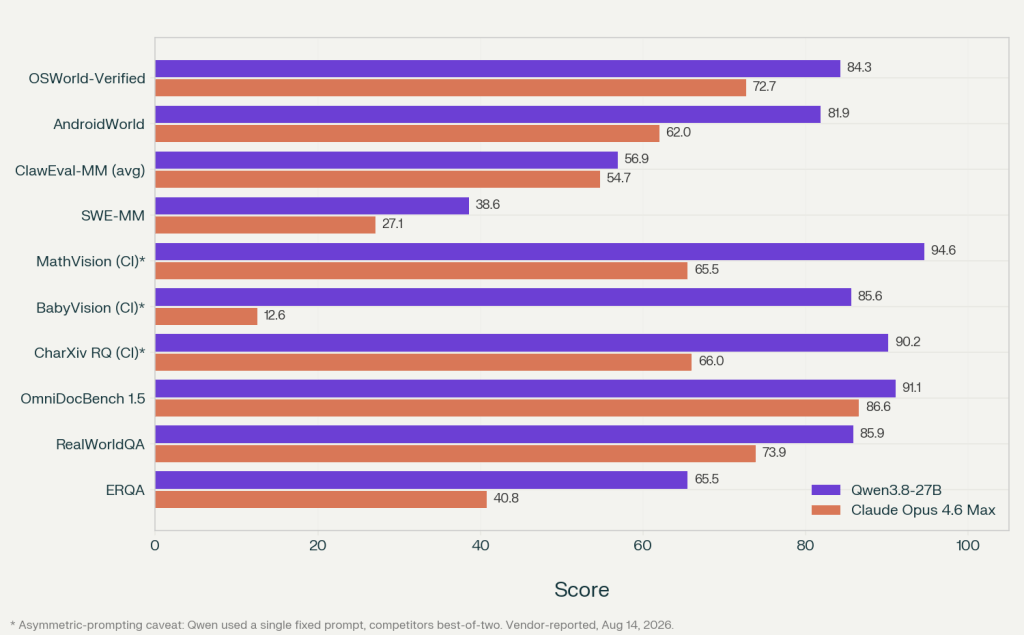
| OSWorld-Verified | 84.3 | 72.7 | Operating a real desktop: clicks, apps, files, browser | The strongest result on the card (+11.6); key for RPA and desktop agents |
| AndroidWorld | 81.9 | 62.0 | The same, on Android devices | Core metric for mobile automation |
| SWE-MM | 38.6 | 27.1 | Multimodal software engineering: screenshots/designs to code | Relevant for front-end generation from mockups |
| ClawEval-MM (Pass@3 / Avg) | 57.4 / 56.9 | 52.5 / 54.7 | Multimodal agentic tasks; Pass@3 = success in at least 1 of 3 tries | Measures agentic robustness, not just perception |
| MathVision (with code interpreter) | 94.6 | 65.5 | Math from diagrams, with tool use | Caveat: asymmetric prompting inflated the gap |
| BabyVision (with code interpreter) | 85.6 | 12.6 | Fine-grained visual reasoning | Same fixed-prompt caveat |
| CharXiv RQ (with CI) | 90.2 | 66.0 | Reading scientific charts from papers | Useful for technical document analysis tools |
| OmniDocBench 1.5 | 91.1 | 86.6 | Document parsing: OCR, tables, layout | Document intelligence and data extraction |
| RealWorldQA | 85.9 | 73.9 | Understanding real-world photos | Everyday spatial perception |
| ERQA | 65.5 | 40.8 | Embodied reasoning (physical space, robotics) | Only relevant for physical/robotic agents |
How Does Qwen3.8-27B Compare to Muse Glimmer-30B?
Qwen3.8-27B beats Muse Glimmer-30B on every benchmark row where both models have a reported score. Among dense open-weight models around 30 billion parameters, there is currently no contest on official numbers.
| Benchmark | Qwen3.8-27B | Muse Glimmer-30B |
|---|---|---|
| Terminal-Bench 2.1 | 73.0 | 51.7 |
| SWE-bench Pro | 61.7 | 51.2 |
| IFBench | 79.5 | 77.0 |
| GPQA Diamond | 89.2 | 83.5 |
| Humanity’s Last Exam | 30.8 | 22.0 |
| OSWorld-Verified | 84.3 | 65.9 |
| CharXiv RQ (no CI / with CI) | 83.7 / 90.2 | 78.8 |
| OmniDocBench 1.5 | 91.1 | 75.8 |
Where Does Qwen3.8-27B Lose to Claude Opus 4.6 Max?
Qwen3.8-27B trails Opus 4.6 Max on pure knowledge reasoning and raw terminal coding. The pattern is consistent: it wins on agentic execution and computer use, and loses on encyclopedic, ambiguous reasoning.
| Benchmark | Qwen3.8-27B | Opus 4.6 Max | Gap |
|---|---|---|---|
| Terminal-Bench 2.1 | 73.0 | 78.2 | -5.2 |
| NL2Repo-Bench | 42.3 | 47.6 | -5.3 |
| GPQA Diamond | 89.2 | 91.3 | -2.1 |
| Humanity’s Last Exam | 30.8 | 40.0 | -9.2 |
Are the Qwen3.8-27B Benchmark Numbers Trustworthy?
All Qwen3.8-27B benchmark scores are vendor-reported by Alibaba and had not been independently reproduced at launch. Three specific caveats apply:
- Imported competitor scores. The SWE-bench Pro comparison uses Opus 4.6 Max’s official published score rather than re-running it in the same harness, so the two numbers are not perfectly comparable.
- Asymmetric prompting. On MathVision and BabyVision, Qwen used a single fixed prompt while competitors received the better of two prompt variants.
- In-house benchmarks. QwenSWEBench and CoWorkBench are designed by Qwen itself; treat them as directional signals, not proof.
Independent evaluations from third-party labs were still pending as of August 19, 2026. Until they land, read the official table as a ceiling on performance, not a floor.
Run Qwen3.8-27B via sovereign API with 262K native context
Save 93.2% vs Alibaba Cloud Model Studio rates with the Regolo Core plan (€39/month for 600M tokens). Guaranteed Zero Data Retention in RAM and GDPR compliance on European green datacenters.
What Should Builders Do With These Benchmarks?
The practical reading depends on workload type. For agentic execution — coding agents, desktop and mobile automation, document parsing — Qwen3.8-27B’s numbers, Apache 2.0 license, and 24 GB GPU footprint make it the strongest self-hostable candidate in its class as of August 2026. For knowledge-heavy, ambiguous reasoning, closed frontier models still lead. A routing architecture that sends agentic work to a self-hosted Qwen3.8-27B and escalates ambiguous knowledge tasks to a frontier API captures most of the quality at a fraction of the cost.
To evaluate hosting economics and migration from Anthropic or Alibaba, check our Qwen3.8-27B on Regolo vs Alibaba Model Studio pricing comparison, review the Qwen3.8-27B pricing breakdown, or switch directly to a compliant European Claude alternative.
Frequently Asked Questions
Is Qwen3.8-27B better than Claude Opus 4.6 Max?
On Alibaba’s official model card, Qwen3.8-27B beats Claude Opus 4.6 Max on 16 of 24 benchmarks, mainly in agentic coding, instruction following, and computer use. Opus 4.6 Max still leads on knowledge reasoning benchmarks such as GPQA Diamond and Humanity’s Last Exam. All figures are vendor-reported.
What is Qwen3.8-27B’s SWE-bench Pro score?
Qwen3.8-27B scores 61.7 on SWE-bench Pro, compared to 53.4 for Claude Opus 4.6 Max’s official score. The comparison uses different harnesses, so treat the 8.3-point gap as approximate.
Can Qwen3.8-27B run locally?
Yes. Qwen3.8-27B is released under Apache 2.0 and runs on a single 24 GB GPU at 4-bit quantization. Full BF16 weights require roughly 55.6 GB of memory.
What is the context window of Qwen3.8-27B?
Qwen3.8-27B has a native context window of 262,144 tokens, extensible to 1 million tokens using YaRN.
Does Qwen3.8-27B support images and video?
Yes. Qwen3.8-27B is a natively multimodal vision-language model that accepts text, image, and video input.
Ship Private AI. Not Infrastructure.
You have the private AI App architecture, bow give it an inference layer built for production.
Regolo gives European teams fast, OpenAI-compatible access to Mistral, Llama, Qwen, DeepSeek, GLM, and more — with zero data retention, EU data residency, and no new SDK to learn.
Change your base_url. Keep your LangChain code. Start shipping.
🚀 Start your 30-day free trial →
Build, test, and deploy with no infrastructure to maintain.
No credit card. No migration project. No compromise on data control.
💬 Join the Regolo Discord →
Meet builders working on private RAG, local LLMs, LangChain, Ollama, and production AI systems. Share your setup, get feedback from the community, and speak directly with the Regolo team.
🤝 Talk to an AI Infrastructure Engineer →
Running a sensitive workload, scaling beyond a proof of concept, or assessing a managed EU inference provider? Get a tailored architecture and commercial proposal for your team.
📂 Clone the GitHub repository →
Get the full implementation from this guide: ingestion scripts, ChromaDB setup, hybrid retrieval, the 30-Question RAG Floor, evaluation examples, and deployment configuration.
Private AI should not require a private data center.
Regolo gives your team an EU-native path from local experimentation to production-grade inference.
Build with Regolo
- Discord: Join the community →
- GitHub: Explore open-source workflows →
- X / Twitter: Follow @regolo_ai →
- Reddit: Join the community →
- Documentation: Read the API docs →
- Contact: Talk to the team →
Built with ❤️ by the Regolo team. Questions? regolo.ai/contact or chat with us on Discord