

We’re excited to announce now Regolo is available on Opper AI.
Opper is the leading European AI gateway, with more 700+ models and today giving direct access to Regolo hosted open-weight models through a single, unified, EU-hosted API with Zero Data Retention.
Regolo’s contribution is privacy-first, sustainable inference on a curated library of production-ready open-weight models: Mistral Small 4, GPT-OSS-120B, Qwen3.5-122B, Gemma 4, Llama 3.3 70B, and Apertus — plus embeddings, reranking, and speech-to-text (Whisper large-v3) for complete RAG and document pipelines.

A fully European stack, end to end
When Opper routes a call to Regolo, the request never leaves the EU — gateway and inference under the same jurisdiction, with no transatlantic hops.

Zero data retention by default
Regolo never stores or reuses your data: no prompt logs, no completion logs, no training on customer data – combined with Opper’s single DPA covering every model in the catalog, European teams get the cleanest compliance posture available on a gateway: one subprocessor, configurable EU residency at the route level, and ZDR at the inference layer.

100% renewable energy
Every Regolo route runs in data centers powered by 100% renewable, carbon-free energy: for teams tracking the environmental footprint of their AI workloads, you can now pin routes to 100% green energy power inference without changing a line of code.
Use Brick + Opper: cut inference costs by up to 80%
Earlier this year we open-sourced Brick, our Mixture-of-Models router: it embeds every prompt into a six-dimensional capability space — dispatches your prompt to the cheapest model in the pool.
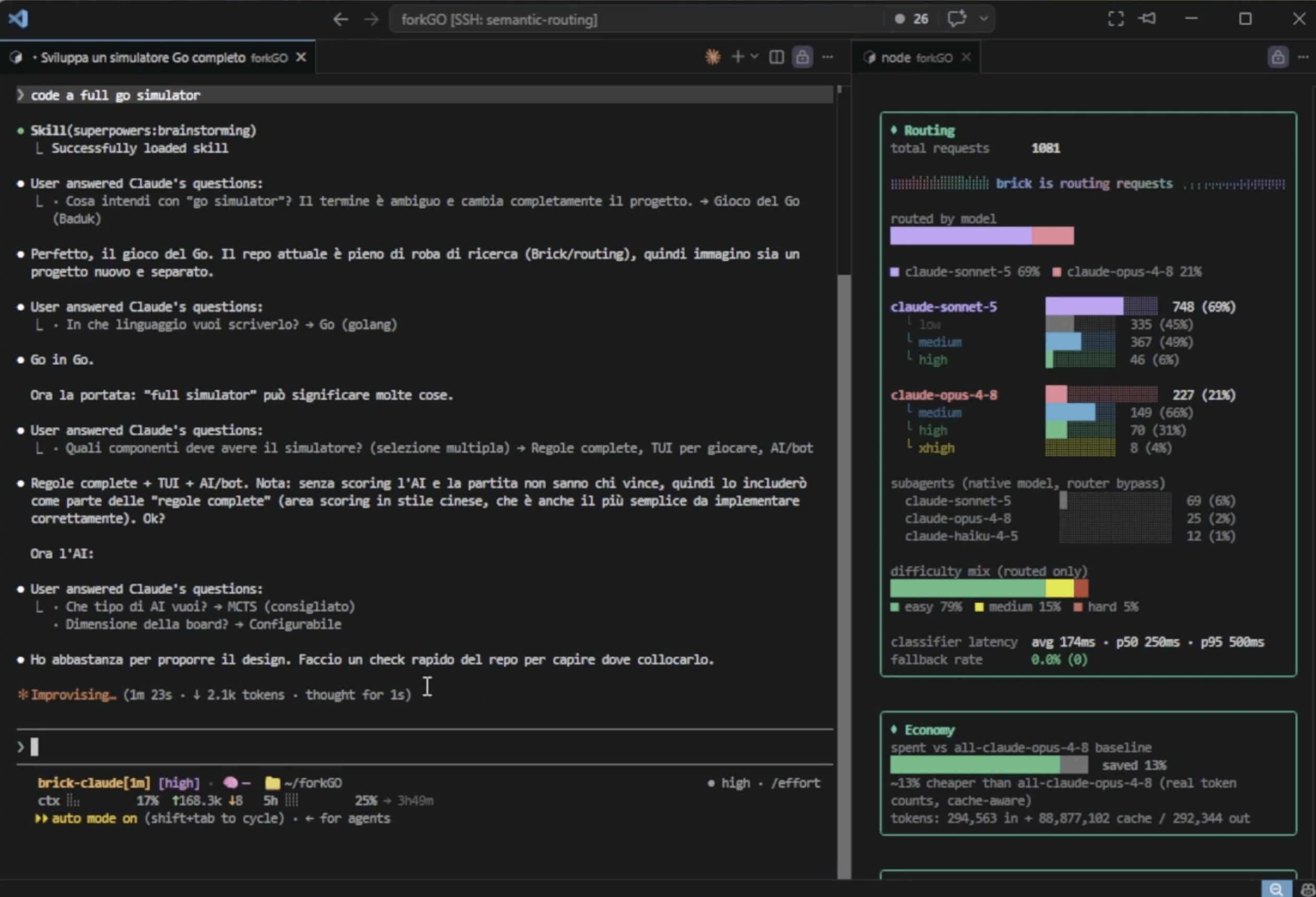
One decision, no cascading calls, no escalation ladder
It’s Regolo’s open-source semantic router (Apache 2.0, world-record routing performance on Hugging Face): it reads each request, understands how complex it is, then forwards it to the cheapest model in the pool that can handle it well.
Simple questions go to small, fast models. Hard reasoning goes to the big ones. No manual rules, no cascades.
The benchmark results:
- Up to 80% lower inference costs in balanced mode — with accuracy within ~2% of a frontier-only setup
- Up to 22x cost reduction in min-cost mode for high-volume workloads
- Max-quality mode actually beats single-model accuracy (76.98% vs 75.02% baseline) — the most expensive model isn’t always the best answer
Get Started
Paste this into your coding agent (Claude Code, Cursor, Codex, and more) and it will set up Opper and route to Regolo for you:
Use curl to download, read and follow: https://skills.opper.ai
Then set up Opper to use Regolo as the provider, e.g. regolo/glm5.2Code language: JavaScript (javascript)
If you’re already on Opper, Regolo models are available today — just use a regolo/ model string and Opper is drop-in compatible with the OpenAI SDK:
import OpenAI from "openai";

const client = new OpenAI({
  apiKey: process.env.OPPER_API_KEY,
  baseURL: "https://api.opper.ai/v3/compat",
});

const completion = await client.chat.completions.create({
  model: "regolo/glm5.2-beta",
  messages: [{ role: "user", content: "Hello" }],
});

console.log(completion.choices[0].message.content);Code language: JavaScript (javascript)
Follow the quick start in Opper docs for evaluations, fallbacks, and structured output.