

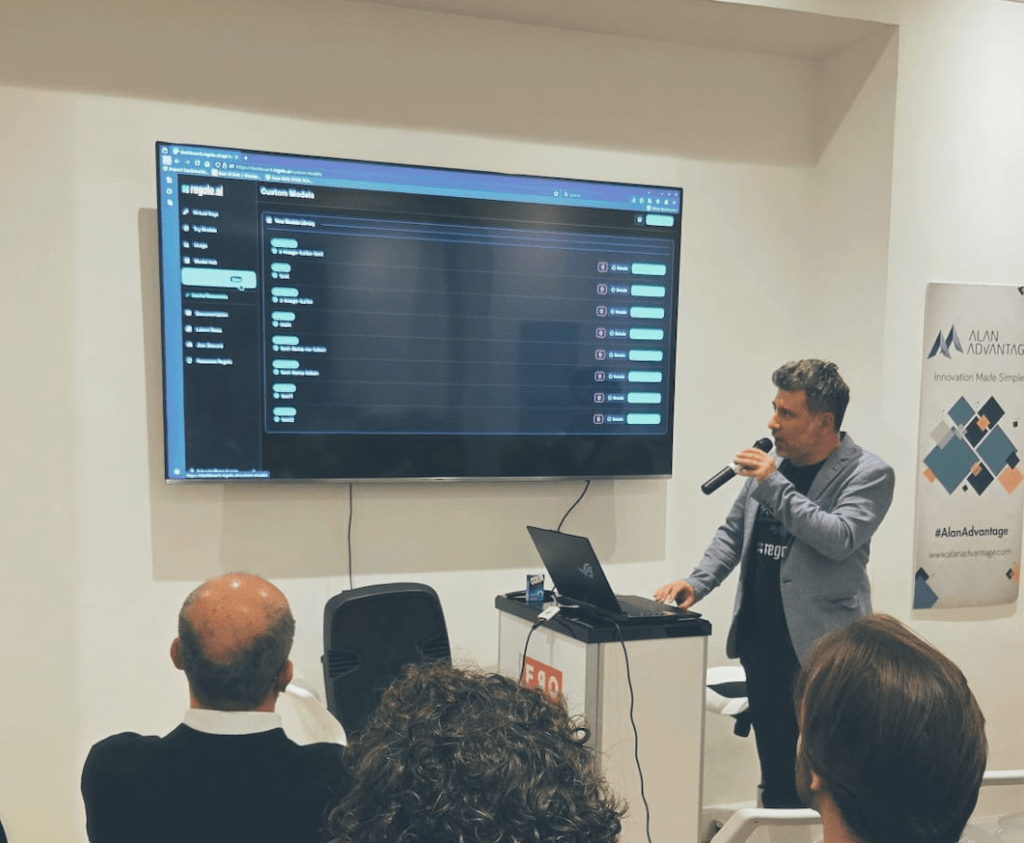
Regolo.ai is a European, 100% green LLM inference platform built on open source, EU datacenters, and zero data retention to simplify AI in production.
Artificial intelligence in production should not force enterprises to choose between speed, compliance, and sovereignty. Regolo.ai was created exactly to solve this tension: a European inference provider that hides infrastructure complexity, embraces open source, and runs on 100% green data centers with a strict zero data retention policy.
Why Regolo.ai
For most European SaaS and ecommerce companies, putting LLMs into production still feels harder than it should. You either spin up and manage your own GPU clusters, or you depend entirely on hyperscalers with opaque pricing, extra-EU data flows, and limited control.
Regolo.ai was born as an European inference provider to offer a third path:
- You keep full control of your data and architecture.
- Regolo handles GPU orchestration, autoscaling, observability, and failover.
- You consume models via simple, OpenAI-compatible APIs.
- European Data Residency
- 100% Green Energy 🍀
Instead of asking teams to become accidental experts in Kubernetes, GPU drivers, networking, and quota management, Regolo.ai abstracts all that away. You point your LLM client to a different base_url, change the model name, and your application runs on European, green infrastructure.
At the same time, Regolo’s pricing is designed to stay cost-effective, both for early-stage projects and high-volume production workloads. There is no requirement to overprovision hardware or commit to long-term GPU leases just to keep latency under control; Regolo scales elastically under the hood, so you only pay for what you actually infer.
Open Source as a Strategic Choice
Regolo.ai is not just “compatible” with open-source tooling; open source is a core part of how the platform is built and how it evolves. Marco Cristofanilli, one of the core team members, is also maintainer of projects like kube-ai, which focuses on making AI workloads first-class citizens in Kubernetes environments.
This mindset translates into several concrete advantages for customers:
- Open interfaces: the platform exposes OpenAI-compatible endpoints, so you can use standard SDKs (Python, TypeScript, curl) and popular frameworks without lock-in.
- Reproducible architectures: guides and example code are shared openly, so your team can understand and reproduce how inference, routing, and RAG pipelines are assembled.
- Easier migrations: if you ever need to move parts of your stack on-premises or to another region, you are not tied to proprietary protocols or closed runtimes.
A minimal Python example looks like this:
from openai import OpenAI

client = OpenAI(
    api_key="REGOLO_API_KEY",
    base_url="https://api.regolo.ai/v1"
)

response = client.chat.completions.create(
    model="qwen-3-32b-it",
    messages=[
        {"role": "user", "content": "Explain our refund policy in Italian."}
    ]
)

print(response.choices[0].message.content)
The same principle applies to embeddings, rerankers, and vision models; by following the OpenAI-like interface, Regolo lets you plug and play with open-source orchestration tools such as:
- LangChain and LlamaIndex for RAG.
- Flowise, Langflow, and similar low-code builders.
- n8n and other workflow engines.
Regolo.ai also contributes back with guides and code, from end-to-end RAG examples on open models to integrations with community projects. This closes the loop: the company benefits from the open-source ecosystem, and at the same time helps it grow with high-quality, production-focused examples.
European Infrastructure, Zero Data Retention, Full Compliance
For European enterprises, model quality is only one part of the evaluation; the other part is where the data flows and how it is handled. Regolo.ai is designed so that infrastructure and legal constraints become an enabler rather than a blocker.
Three design choices are central here:
- EU Datacenters: inference runs in European facilities, with data residency aligned to EU expectations and easier mapping to local regulations and internal policies.
- Zero Data Retention: inference requests and responses are not stored or reused for training; once the response is returned, the data is discarded.
- Compliance by design: the platform architecture is built with GDPR, AI Act readiness, and common security frameworks in mind, making it much easier for your legal and infosec teams to sign off.
Practically, this means you can design flows such as:
- A customer-support copilot that reads from your EU-hosted knowledge base and answers via an LLM, without logs of conversations being stored on an external US server.
- An internal assistant that helps employees navigate contracts, HR policies, and SOPs, where every inference stays inside the European perimeter.
Because the APIs are compatible with common SDKs, teams can implement strict policies around network egress (VPC peering, IP allowlists, private links) without changing application code. This is particularly important when working with regulated industries such as finance, healthcare, and public sector.
100% Green Inference as a Product Requirement
In many infrastructure providers, “green” is a marketing slide; for Regolo.ai it is a product constraint. The platform is built to run on 100% green-powered datacenters, and the engineering decisions follow from that constraint.
This has several engineering implications:
- High GPU utilization: by managing inference for multiple customers on shared clusters, Regolo can keep utilization high, reducing waste and lowering per-request energy cost.
- Model selection and optimization: the team prioritizes models that deliver a strong quality–latency–cost balance, avoiding overkill configurations that burn energy for marginal gains.
- Right-sizing workloads: instead of defaulting to the largest model, you are encouraged (and given tools) to route traffic to smaller, task-specific models where appropriate.
For enterprises, sustainability is no longer a secondary KPI; it enters board-level discussions, ESG reporting, and even procurement requirements. Being able to tell stakeholders that your LLM workloads run on green infrastructure, with measured energy usage and no overprovisioned clusters idling, is a concrete advantage.
A simple mental model:
- On-prem GPU racks that are underutilized are “always on”, regardless of traffic.
- A shared, green, European inference layer can match capacity to real usage, making every forward pass more efficient.
How Regolo.ai Fits into Your Open-Source AI Strategy
Putting these threads together, Regolo.ai gives technical teams a way to align AI strategy with three non-negotiable principles: open source, sovereignty, and sustainability.
A typical adoption path might look like this:
- Phase 1: Prototype with open-source frameworks (LangChain, LlamaIndex) against public models.
- Phase 2: Swap the inference endpoint to Regolo.ai to benefit from EU infra, zero retention, and managed scaling, without changing orchestration code.
- Phase 3: Optimize costs and latency by combining multiple models (general LLM + reranker + vision) behind a single API strategy.
This approach lets you:
- Keep your architecture open and auditable, with community tooling and standards.
- Run on an European, 100% green backbone, compatible with your compliance posture.
- Avoid the complexity of running and maintaining GPU infrastructure while still owning your data flows.
- Regolo Discord – Share your thoughts
- GitHub Repo – Code of blog articles ready to start
- Follow Us on X @regolo_ai
- Open discussion on our Subreddit Community
🚀 Ready to scale?
Built with ❤️ by the Regolo team. Questions? support@regolo.ai or chat with us on Discord